
It is the summer of 1979. I am standing – tired and sweaty, surrounded by a sea of cardboard boxes – in a brand-new kitchen in Glencoe Illinois where we have relocated after spending three years living outside London. We’ve been back for months now, but our kitchen renovation took longer than promised (of course) and our family dinners have alternated between take-out or one of a handful of local restaurants we rotate through each week. And the boxes…well, they are always there…taking up space and reminding me that we are still unsettled.
So, despite what feels like the herculean task ahead of me – to unpack and sort all this…stuff – I’m ecstatic. Finally, the mission of finding the perfect place for each pot, wooden spoon, polenta maker and wine glass will be satisfied, and I can begin to shape this new space into my own. I designed this room not only to be the place where I would launch the creative side of my business through food experimentation and refinement, but also to be the focal point of my new home. It was where I planned to do a lot a lot of cooking, a lot of thinking, and – hopefully – a lot of hanging out with the people that I loved and admired. I have always believed that there is no better environment than the kitchen in which to bring people together. Cooking and comradery are natural companions and if everything went according to plan, this new kitchen would become the quintessence of everything I wanted my business and personal life to become.
Memories of our life in England flooded back as I unwrapped the copious layers of bubble wrap and brown paper from the kitchen equipment shipped back from England. It was complemented by a tower of beautiful newly purchased glassware, china and kitchenware that I hoped would bring some fresh sparkle to our new life back in the United States. It had only been a few months since we left behind our adopted home in the English countryside, but it already felt like a lifetime away.

Sheila after a day at Harrods
Different recollections emerged from each box I unpacked. My dear friend Sheila Bradley’s presence materialized from the many boxes of Waterford crystal reminding me of our intense shopping day at Harrods Department store in Knightsbridge, London. Delicate, finely etched glassware evoked recollections of the wild shopping day I had at the famous glassmaker Salviati in Venice with good friend Mary Nahser. And it felt like almost every box I unpacked contained something from one of my many shopping escapades with fellow ex-pat Jean Barringer. It took me days and memory after pleasant memory to get my new kitchen in order.
The final unpacking revealed what I consider to be the nuts and bolts of a kitchen: dutch ovens, bakeware, pots, pans, skillets, sauce pans, mixing bowls, knives and utensils – all the essentials needed to slice and dice and mix ingredients to their maximum potential. These tools would allow me to actually create the items that would eventually be placed on or in all of that lovely china and glassware.

The first challenge for my new headquarters was to test recipes for the new Italian venture that my partner, Paolo Volpara and I had decided to launch. We were not sure what form that business would take but we knew it would involve Italian food and wine, so my study of Italian cuisine needed to begin immediately.

the first of nine “capitolos”
Our initial idea was to publish a newsletter each month that would feature recipes and wine from the region – a wine and food club of sorts. We called them Capiolos which translates to Chapters in English. Each Capitolo would include articles on regional history and culture, but the main focus was food. We ended up publishing nine of these Capitolos and since each one contained a minimum of six recipes – and sometimes as many as twelve – I was pretty much tied to my stove, cranking out Italian dish after Italian dish, learning about the great diversity of Italian cuisine along the way.
Something was always simmering on my stove, roasting in my oven or being mixed or mashed or tossed in one of my many newly purchased vessels. For that first year after my return, my friends and family pretty much always knew where to find me – in my kitchen surrounded by pots, pans and a plethora of produce, pastas, meats and numerous other ingredients – some familiar, some not – but all eventually to find their way into some new dish I was about to prepare.

Nancy at stove Convito’s first location
In the end, Paolo and I decided not to limit ourselves to this idea of cultural education and instead decided to open a brick-and-mortar Italian wine and food market, where we offered not just the newsletter, but also the ingredients and prepared dishes that the Capitolos detailed. But even after we opened this first version of Convito, I still tested most of the recipes in my home kitchen since the tiny little four-burner electric stove in back of our deli was hardly conducive to testing. As it was, I barely had enough space to slice prosciutto or to wrap fresh pasta, let alone run a test kitchen! So, my personal headquarters was the better option.
Working with ingredients and methods that were sometimes entirely new to me was exciting and challenging, but I occasionally ended up with concoctions of a dubious nature. Though rarely did I throw anything out before someone else had tried it, sometimes even my best efforts at salvaging a wayward dish were unsuccessful. My built-in tasters (Bob, Rob and Candace) would always arrive hungry and game to sample something new, but even my home team would have to give me an occasionally “thumbs down” when I couldn’t quite salvage a wayward dish. But I came to understand that these failures were part of the process and I eventually learned to focus on the triumphs instead!
Mostly I worked alone but occasionally my good friend Janet Alms came over to help. I loved the company and the extra set of hands. We also shared many a good belly-laugh as we cooked and giggled our way through the list of recipes I put on the agenda for that day. Often times the laughter came about from just trying to unscramble Paolo’s mother Wanda’s translated recipes.
But more often than not our laughter came from nervously working with exotic and unfamiliar ingredients like bottarga (pressed then dried fish roe, a specialty of southern Italy). “What the hell is this?” Janet asked – holding up what looked like a golden-brown, adobe-like brick. “Is this even edible?” After a good laugh, we tackled Wanda’s recipe for spaghetti tossed with a little olive oil, parsley, chili peppers, and the “brick” (bottarga) grated over the top. Bottarga has a very distinctive, salty, briny somewhat bitter flavor. I couldn’t imagine I would like it with anything but definitely changed my mind after the recipe was completed. It was surprisingly delicious!
We were also dubious about Nduja, a Calabrian spicy, spreadable pork sausage mixed with a blend of chili peppers. Janet and I poked and sniffed it for a while and before shrugging our shoulders and trusting that Wanda’s combination of nduja with tomatoes, onions, garlic and herbs would become something special. Once again we discovered it was also surprisingly tasty – savory, spicy and especially great as a sauce for chicken. Years later I served in in my café naming it Pollo alla Calabrese (blog post Basilicata and Calabria “Behind Closed Doors”). I was beginning to look forward to new flavors and textures realizing that most often they took me on a new taste adventure and expanded my culinary knowledge. Janet, an adventurous soul, was excited to be a part of the discovery. (Today both of these ingredients are readily available in most specialty markets.)
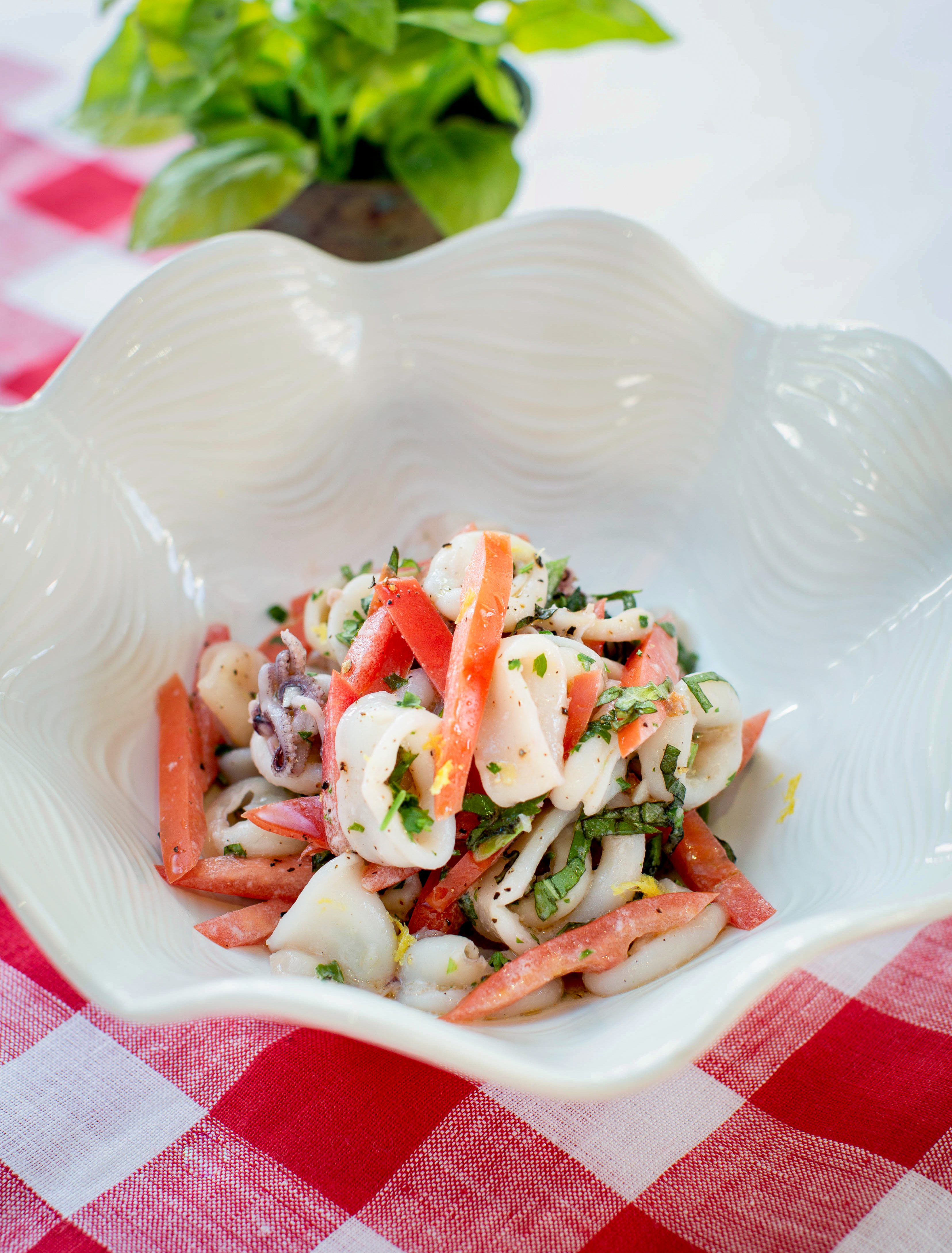
The cooking session with Janet that I remember most was the day we were to make a very simple calamari salad from the Veneto region. Though I was familiar with calamari (I had often ordered fried calamari in restaurants), I had never cooked it. Unfortunately, I didn’t realize that you could buy pre-cleaned calamari so instead I came home with a big bag that was frozen, un-cleaned and surprisingly squid-like! Before we even got to the “simple” salad recipe, we had to first defrost the calamari then laboriously struggle with the cleaning of this alien-looking creature. Beginning by removing the finned, tube-looking portion from the tentacles (which was weird enough), we bravely continued on to remove the beak and discard the cuttlebone. Luckily I found cleaning instructions in a Good Housekeeping cookbook (there was no internet back then) to help us through the whole process which probably took way longer than it should have – mainly because we didn’t have a clue as to what we were doing.
By the end of this process our fingers were raw and slimy and we were ready to move on to actually making the salad. As we were cleaning up, Janet picked up a thin silvery sac that we had put off to one side (it seemed to be particularly gross) and it suddenly split open. Whoosh! Black squid ink spilled out in all directions, dripping over the countertop onto the tiled kitchen floor below. We began frantically mopping up the ink – our hands becoming stained black in the process – hysterically laughing the whole time, tears streaming down both of our faces. The grout between some of the tiles turned black and remained that way for years to come as a reminder of that day with the squid!
Once we finally got to the salad preparation, it took almost no time at all. It was very simple and very delicious! However, that afternoon session marked the end of my calamari cooking days. Let the competent calamari-familiar chefs in the restaurant kitchens do all the work I thought – and I will simply enjoy the results!
© rob warner photography 2020
Insalata di Calamari
Squid, Tomato & Basil Salad
Serves 6 – 8 as an antipasti
2 lbs squid (purchase cleaned and cut into tentacles and body parts)
Zest and juice of 1 lemon
½ cup olive oil
1 teaspoon minced garlic2 cups sliced tomatoes (seeded)
½ cup fresh basil, julienned
2 tablespoons extra virgin olive oil
4 tablespoons white wine vinegar
Salt & freshly ground pepper to taste
Rinse the squid in water. Pat dry on paper towels. Slice the body parts into rings about ¾ – 1 inch slices.
In a large sauté pan over high heat, add the olive oil. When hot add the squid and sauté quickly (approximately 1 ½ minutes). Add the garlic. Then add the lemon zest and lemon juice and cook another minute, stirring constantly. Remove from the heat.
When cool, add the tomatoes, basil, additional olive oil and vinegar. Toss well.
Taste for salt and pepper. Serve at room temperature.
***************************************************************
Another avenue for testing my new Italian dishes was to try them out for my friends and family at a dinner party. This way I could retest each dish and ask my dinner guests for their input. I had many dinner parties during the first five years after my return from England. Besides being a “testing outlet”, entertaining was something I truly enjoyed. By this time, I had formulated my “dinner party style,” points I followed for each and every dinner party I hosted – small, large, casual, formal, indoors or out.
The FOOD naturally comes first in my planning. The menu is what stimulates me to have a dinner party in the first place. What type of cuisine? New dishes or old favorites? How many courses? Formal or casual fare? It is a pleasure for me to think about types of food, dishes that go well with one another and just the overall food focus of the event.
Next I think about the GUEST LIST. Choosing people that compliment each other – whether by common interests or personality – dramatically increases the odds of the success of any gathering. When it’s a large gathering that is a less important element because there is much mingling of different groups and “matching” becomes more up to the guests than the hostess. But when the intimacy of a meal for 6 – 10 people where sitting at the table and conversing during and in between courses is a big part of the evening, the guest list is much more important.
Then comes the WINE and how it pairs with the food – important to me especially after I opened my market and café where wine is a big part of my business. For a large gathering one simply has to pick a good white and a good red but in a small gathering when the dinner is comprised of multi-courses, matching wine and food is an essential and complex task, but one that was always rewarding to undertake.
The last criteria I consider is the LOOK of my table. Though not necessarily crucial to the success of a dinner party it is for me maybe the most fun part of the planning. I love working on the centerpiece and pulling together elements from the china and pottery, glassware and other artifacts I have collected over the years to make a table setting match the theme or mood I have decided upon for my “event” – whether a lunch, a dinner, a buffet or a large cocktail party.

Paolo and I in the Kitchen
Since most of my testing for the Capitolos was focused on the regions of Italy, the dinner parties I hosted early on had a regional theme. The very first one was to celebrate Piemonte, the northeast region where my mentor and partner had grown up. Not only was it one of the first regions that Wanda and I tested (some dishes in her small Milanese kitchen and some in my new kitchen) but also because I had visited it frequently with Paolo. It was close to our Milanese headquarters so weekend sojourns were easy. I knew it well.
The dinner party took place on a cold, snowy evening in February – the weather perfectly in tune with the hearty, robust cuisine and big full-flavored wines of the region. Once I decided on the menu I turned to the guest list, deciding on a group of “arty” people who I knew had a great appreciation for both food and wine – rather essential I thought for this heavily focused food and wine dinner. My list began with my artist sister, Karen and her-very-art-knowledgeable husband Jeff. I expanded the list to include a Chicago art gallery owner and her husband, an architect and an interior designer.

Piemonte table
Because Piemonte is one of the great wine regions of Italy (and perhaps the world) pairing the food with the wine took on even more importance than usual. Its most important grape variety, Nebbiolo, produces powerful, full-bodied red wines like Barolo, Barbaresco and Gattinara. But there are other great wines that come from this region as well. Barbera, Dolcetto, the famous sparkling Asti Spumante and two of my favorite whites Gavi and Arneis are among them. My goal was to find a way to incorporate as many of these wines as possible into my menu either by matching them with one of the courses or by actually using them as an ingredient in the cooking of one of the dishes.
The evening began with my guests gathered in the living room with a glass of Gavi, a delicate floral white wine, accompanied by breadsticks. Since breadsticks are said to have originated in Torino, the capital of Piemonte, they fit well with the theme for the evening. Plus they are easy to easy to eat while standing up and socializing. I like to begin my dinner parties with light fare so as not to fill guests up before the main event. And the main event this night would be a multi-coursed dinner.

Piemonte dinner
It was here during this hour that I gave guests an overview of what to expect on their culinary journey – – and it was the last time for the next hour or two where I wasn’t shuffling between the kitchen and the dining room cooking and plating the dinner I had prepared. Bob escorted our guests into the dining room. The “look” of my table that evening was to somehow convey a wine theme. The centerpiece contained not just flowers but also grapes and was surrounded by six antique twisted wooden candlesticks intended to give the illusion of grape vines. The lace tablecloth and the simple grape embossed wine glasses gave the table a homey, rustic feeling – the very feeling I had experienced in many of the small, intimate out-of-the-way, restaurants of the region – some of my favorite in all of Italy.
I served the more complex, rich white wine Arneis with the first course – a gratin of roasted red and yellow peppers with anchovies. It held up to the complexity of the dish. It also went well with the next course of savory spinach and cheese sausages. As I scurried back and forth from the kitchen to my seat at the table, I counted on my husband to take care of the wine. Since I opened Convito Italiano, he had become very knowledgeable about Italian wine, so his commentary on each wine allowed my absence to go largely unnoticed.
I managed to incorporate three wines that night during the main course. I used a Barbera as a braising ingredient for the roasted leg of veal and served a wonderful big Barbaresco as the accompanying wine. And the potatoes served with the veal were cooked in Asti Spumante. Bingo – three wines in one course! We finished with the coup de gras – pears poached in the most famous wine of the region Barolo. (All recipes can be found in My Italian Journeys – Piemonte I, II and III).
We finished our wine, relaxed for a while then completed our culinary journey with espresso and a famous chocolate of the region – gianduia – a chocolate pudding with hazelnut flavoring. As it turned out, the “Piemonte group” had great chemistry. They matched each other as well as the wines matched the food. Conversation flowed. One of the best things about a “themed” dinner party is that it provides built-in conversation and also ties the evening together. That is, as long as my commentary about the food, wine and culture doesn’t dominate. The purpose is to take guests on an adventure while still allowing them to socialize.
***************************************************************
The success of my Piemontese dinner gave me the confidence to try something different for my next regional dinner party – an outside affair. The region I chose was Tuscany and featured Bistecca alla Fiorentina – a steak marinated in extra virgin olive oil and rosemary, seasoned with salt and pepper then lightly seared on a very hot grill leaving the center bright pink. Since the steak was to be cooked on our patio grill, an outside gathering seemed the obvious choice.

The “look” of the table for the night was less important since it was the height of the summer season. Flowering bushes and flowering plants surrounded us and the need for candlelight was eliminated since the clear, cloudless blue sky remained light until 9:30. I did, however, make a centerpiece with flowers from my garden and used my Tuscan pottery for the salad course and my Villeroy & Boch “Medici” patterned charger plates for the main course
Tuscany is another of Italy’s famous wine regions, so like my Piemonte dinner, wine was an important component of the evening. So was the guest list. I wanted to make certain that they were wine enthusiasts, so my friend (and famous food writer and journalist) Bill Rice who had visited and written about Tuscany frequently anchored the guest list. Bill’s credentials for comprehensive knowledge of wine and food were quite impressive. He was executive food editor for the Washington Post for eight years, wrote for Food & Wine Magazine, the Chicago Tribune and was author of several award-winning cookbooks.
We began our evening gathered around the grill with a lovely crisp white Vernaccia di San Gimignano while munching on a Tuscan favorite of mine – crostini topped with a chicken liver spread. (blog – Tuscany II). Once we were seated, I served a glass of Vermentino – a more fruity and citrusy white wine with the first course – and a Panzanella salad; a mixture of summer tomatoes, cucumbers, thinly sliced red onion, basil and toasted croutons tossed lightly with a red wine vinaigrette (recipe also in blog Tuscany II).
Chianti – the most famous wine of the region, accompanied the main course – the grilled steak – which I served with a dish of Tuscan beans and potatoes. White beans – cannellini in particular – are a ubiquitous ingredient in Tuscan dishes. In fact, they are so common, Tuscans are often referred to as “mangiafagioli” – translated it means “bean eaters”. I loved the combination of white beans and potatoes with sauteed pancetta and onions elevating the savory component of the dish. (blog Tuscany III “ A Region for all Seasons”).
I was not the only one discussing the regional food and wine that evening. Bill Rice related his many visits to various Tuscan wine estates – where no doubt he was treated like a king – and he also brought along two bottles of incredible Tuscan wine a Brunello di Montalchino from the famous producer Altesino, as well as another Chianti. I had served Monsanto Chianti with our meal and his was from the equally famous wine producer Antinori. Both were rich, robust examples of Chianti at its very best. Given our bounty of fine wine, we embarked on our own mini-wine-tasting headed by the master himself, Bill Rice. My guests were enthralled by the wine and especially by Bill’s commentary, delivered in his own dry, witty style with sidebar stories by Bill’s wife, Jill Van Cleave, also a cookbook author and friend of mine from the professional culinary women’s organization Les Dames d’Escoffier. After a refreshing dish of lemon sorbetto we ended our Tuscan evening with a glass of the famous Tuscan dessert wine Vin Santo and a few almond twice-baked cantucci (said to have originated in the Tuscan city of Prato).
 As guests began leaving, Bill asked me if I would share my white bean and potato recipe with him. I was thrilled and of course, agreed to send it the next day. It later appeared in his Chicago Tribune column and eventually in his cookbook Steak Lover’s Cookbook – of course giving me credit for the recipe. In his cookbook he described it as “a vegetable side dish that refused to play a supporting role”.
The recipe as translated by Bill, was much clearer and more organized than the one I had originally given him. I was beginning to learn from all of my cookbook-author friends the lessons of good recipe writing as well as the importance of testing and
retesting every recipe. I was, however, surprised that Bill pretty much followed the exact ingredients and measurements I had given him, though his instructions were much clearer than mine. I took note! My recipe writing in the future improved.
***************************************************************
I continued my regional dinner parties with a particularly formal affair featuring the exotic and complicated cuisine of Veneto. This dinner party was held on New Year’s Eve for our “New Year’s Eve Group” – friends that had celebrated that holiday together since 1969. The original group (Janet & Paul Alms, Sheila & Ed Bradley, Colleen & Tom Thompson and me and my then husband Bob) had all decided that having a small intimate dinner was infinitely preferable to the noisy, horn-blowing, confetti-throwing events that we had all experienced in the past. We started what eventually became a tradition at Janet and Paul Alms’ home with a delicious Coq au Vin dinner that set a high bar. Every year we rotated houses with the host/hostess deciding on the menu. When my then-husband and I returned from England, the original group was still intact (though Colleen Thompson had become Colleen Remsberg and introduced her wonderful new husband Chuck to the mix) and we also added good friends Mary & Ron Nahser and Colleen & Mike Houlahan.

When it was my turn to hostess, I chose Carnevale as my theme for the evening. Carnevale, the pre-lent festival was not until February but its celebratory focus seemed to fit the mood of New Year’s Eve and it was a great chance for me to use all the Carnevale masks I had acquired over the years for the “look” of my table.
The artistic masks would of course, star in my centerpiece of pink and rose-colored flowers. They sat between beautiful clear and pink etched glass candelabras also purchased during a trip to Venice. Small etched wine goblets, water goblets and larger red wine glasses were placed just in the top-right corner of pink charger plates completing what I considered to be a very festive table.

The guest list was easy – our New Year’s Eve group, of course – old friends who never seemed to run out of topics to discuss. What better way to welcome the New Year than with friends that know your history and share your sense of humor. And because they are all very curious people, they seemed to welcome the regional discussions of the wine, culture and food of Veneto.

The New Year’s Eve Group
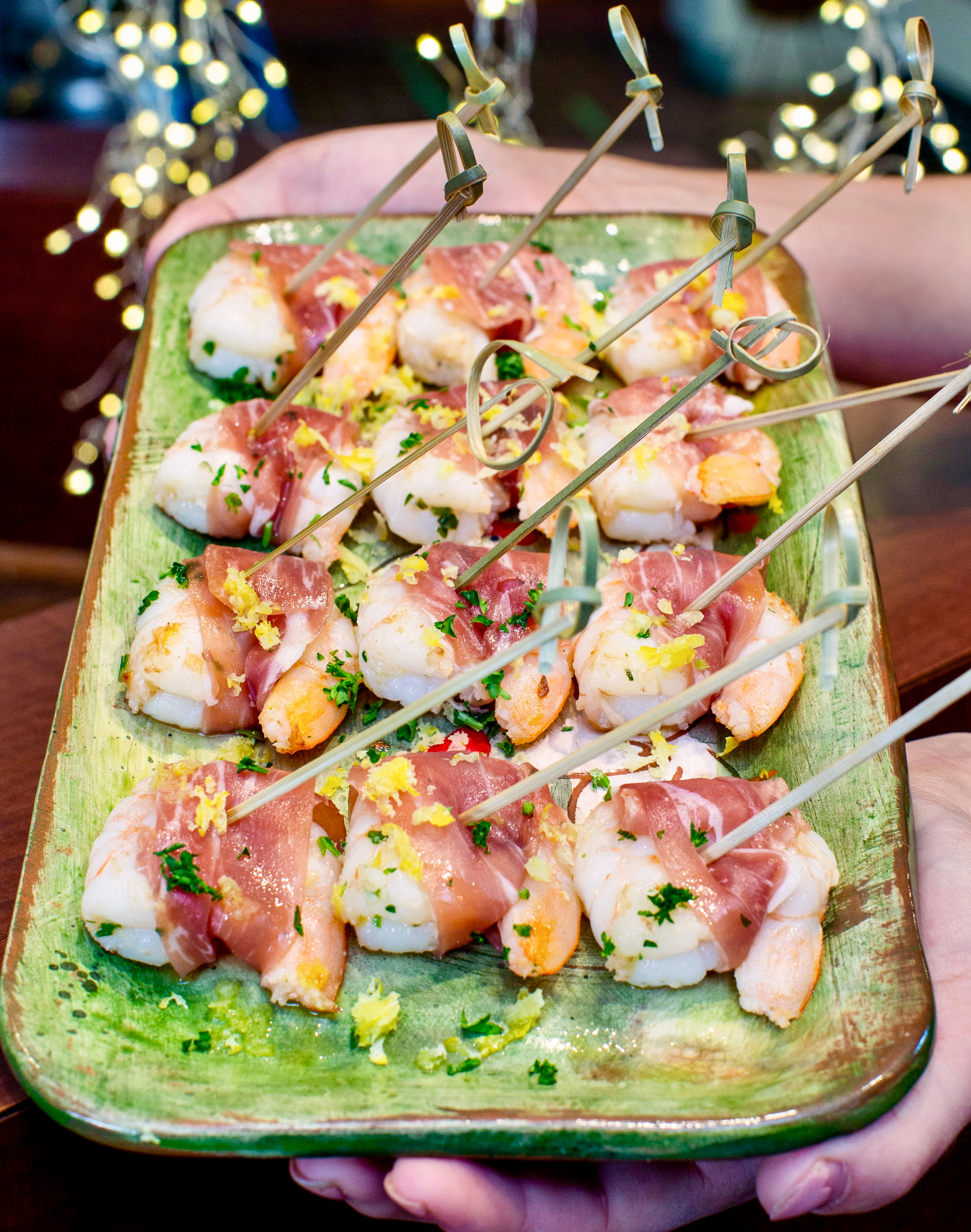
I wanted the meal to emphasize both sides of the Veneto I had come to know; the sophistication of the more famous dishes of Venice, as well as he lesser-known fare of the countryside. I began the meal with a dish that paid tribute to both parts of the region, Prosciutto Wrapped Lemon Shrimp that I passed in the living room along with a glass of sparkling wine. Who would have thought that prosciutto and shrimp would go together so well? The saltiness of the prosciutto truly complimented the meatiness of the shrimp and matched well with Italy’s most famous sparkling wine, Prosecco.
All my guests knew about Harry’s Bar in Venice, opened in 1931 by bartender Giuseppe Cipriani and some had actually been there, so I decided to serve their signature carpaccio for our first course. Harry’s Bar was famous for three things: Bellini cocktails, celebrity clientele and their carpaccio. Their signature dish was named after Vittore Carpaccio, the Venetian Renaissance painter known for his use of brilliant reds and whites in the minute detail of his landscape painting and the actual color palate of this dish. I served it with another famous name from the region, a glass of Soave, Veneto’s most famous white wine – its oily-like richness able to stand up to raw beef.
Then came a classic rice and pea dish called Rise e Bisi, representing the homey side of the Veneto, served with one of the most well known wines of the region – Pinot Grigio. I love the simplicity of risi e bisi. It is similar to risotto but a bit on the soupy side (intentionally) so I served it in soup dishes. Finally I served a duck breast with a side dish of baked red onions stuffed with a squash puree. Not only did I use Amarone (the region’s most famous red wine) to make a sauce for the duck, but also served the very same wine to accompany that dish. The red fruit intensity of Amarone pairs perfectly with duck.
We concluded with Tiramisu, the iconic dessert invented in the Veneto region in the 1960s with, of course, yet another glass of Prosecco. Lots of food. Lots of wine. And lots of good cheer! Felice Anno Nuovo!
© rob warner photography 2020
Prosciutto Wrapped Lemon Shrimp
Serves 6 (2 shrimp per person)12 medium shrimp, cleaned and cooked
3 tablespoons extra virgin olive oil
3 tablespoons lemon juice
zest of 1 lemon
freshly ground pepper
salt to taste
3 slices of prosciutto, sliced thin
Marinate the shrimp in the olive oil and the lemon juice, lemon zest, lots of freshly grated pepper and salt to taste. Marinate for at least two hours.
Cut each slice of prosciutto in half lengthwise, then in half horizontally producing 12 slices of prosciutto. Each prosciutto slice should be about 6 inches long and 1½ inches wide. Place each shrimp at the end of the prosciutto slice and roll the shrimp in the slice wrapping it around the shrimp, leaving the ends of the shrimp exposed. Serve at room temperature as a passed appetizer or as a delicious first course serving 2 or 3 prosciutto wrapped shrimp on a bed of arugula tossed with olive oil and lemon.
***************************************************************
My series of regional dinners was not only a great outlet for retesting the dishes I had been cooking in my kitchen, but also were enormously gratifying – an avenue for me to celebrate the many great aspects of the latest region I had been studying and testing recipes for. But not every dinner party had a single region as its theme. Some menus were comprised of dishes from all over Italy. The most memorable of these “all Italian” dinners was the one I cooked for the Great Cooks section of Bon Appetit magazine. As thrilled as I was to be selected for this honor, I was also filled with nervous anticipation. Up until this time, press coverage of Convito had mostly centered on my market and café. This article would be much more personal – an actual photo shoot to take place in my home with me as the main attraction. Yikes!
The theme the magazine had selected was a formal one. “Elegant Do-Ahead Dinner” would be the headline with the sub-title “An Illinois Hostess Creates a Superb Italian Menu for 12”. The pressure was on. I immediately began combing through my recipes. I wanted my menu to represent the diversity of Italian cuisine as well as the strengths of my quickly developing culinary skills.
Test, test, test were the words I awakened to every morning. I had to get this right. After all it was a national exposure for my business. The dishes I selected included Napolitano Marinated Mussels, Venetian Shrimp in Tomatoes, Tuscan Croutons with Broccoli Puree and several dishes from the Piemonte region – Spinach and Cheese Sausage, Spumonte Potatoes and a chocolate hazelnut pudding called Gianduia. The main course was from Umbria – Chicken in Piquant Liver Sauce preceded by a salad from Lombardia, Artichokes with Mushrooms. Before the actual event occurred I must have tested each of these dishes three of four times. My kitchen became my home during the entire month prior to the shoot.

Finally, the day arrived. I was ready – or so I thought. Arriving first was the journalist who was writing the article. Following her was a food stylist and her assistant, then a woman who was clearly in charge of the whole production – introducing me to everyone and explaining how the day would proceed. During her very lengthy explanation the camera crew arrived, several men entering the kitchen with what seemed like a whole truckload of equipment, lights, cameras and lots of things I couldn’t identify. Needless to say I was completely overwhelmed.
The magazine not only wanted to photograph me cooking all the dishes to be included in the article but they also wanted shots of my table, my husband pouring wine and even my kids helping me prepare one of the dishes. The idyllic family all happily cooking together! The final photograph would be of the twelve guests.

When I finished cooking each dish, the food stylist plated the item then whisked it away to the area where it was to be photographed. To me this was the most interesting part of the day. I learned so many tricks about food photography just by watching the stylist tweak each dish – a little olive oil applied carefully with a brush or a spritz of water to make a dish look fresh and appetizing. It was amazing to watch. I would use all those tricks in the years ahead for various Convito food photography sessions and for this blog. The goal, I learned was to make the dish look mouth-watering not to necessarily taste mouth-watering. It was beginning to dawn on me that all of the food I was preparing for my “elegant dinner party” would not be edible by the time they all arrived.
It was a thoroughly exhausting, but incredibly fun day. As the hour approached for my guests to arrive, I left my horribly messy kitchen and went to change into my party dress (I would worry about cleaning up later). I greeted them all with a glass of wine escorting them into our living where they would be “positioned” by the photographer around my cocktail table, which was covered with bowls and platters of appetizers all of which had been “tweaked” and handled by the food stylist for hours. We all proceeded to “stage” our cocktail hour pretending to enjoy the food while we sipped our wine and engaged in what I’m sure was rather vacuous conversation. It was hard to concentrate since the camera was clicking and we were constantly being repositioned for what the photographer felt would be the best shot.
All of my guests were good friends who were working at or with Convito in some capacity and had been forewarned that this “dinner party” was really for a photo shoot so nothing seemed to surprise them. They were all just incredibly good sports.

As the Bon Appetit crew packed up and left, everyone breathed a sigh of relief. Except for me…I still had to serve dinner for twelve! It had been clear early on that most of the food I had cooked would be inedible. As it turned out, it was ALL-inedible. Once this became an established fact, my husband, Bob thankfully placed an order for pizza.
 When we finally all adjourned to my dining room table – which was formally decked out in a lace tablecloth topped with crystal goblets, bone china and candlesticks – no one cared that our meal was not made up of the elegant dishes that had been photographed (and ruined) hours earlier. The pepperoni pizzas and a plethora of fine Italian wines was the perfect accompaniment to the comprehensive “review” of our elegant “pretend dinner”. We would all look at articles like this in magazines and newspapers quite differently in the future. It was all mirrors and magic!
 It’s amazing how magic works. Just recently I ran into one of the 12 guests who attended this dinner. I told him that I was writing about our Bon Appetit dinner party in my next blog. “Oh I remember that so well! Each course was fantastic,” he responded. “Ron”, I said, “we didn’t eat any of the dinner I had prepared. You didn’t have a multi-coursed Italian dinner at all. You just had pepperoni pizza.” We both had a good laugh!

© rob warner photography 2020
Fresh Mushrooms and Artichoke Salad
Serves 12
4 large artichokes
½ lemon
¾ # mushrooms, thinly sliced
5 ounces Parmesan cheeses, shaved with potato peeler (about 2 cups)
1 cup extra virgin olive oil
1/3 cup lemon juice
salt & freshly ground pepper
Snap off upper ¾ of each artichoke leaf. (leaving just inner cone of leaves), rubbing exposed parts with lemon as you work, to prevent discoloration. Cut off cone of leaves to just above artichoke bottom. Trim and discard darker green parts using paring knife. (leave heart and choke in tact) Bring large amount of salted water to a boil in large pot (or prepare steamer). Squeeze juice of cut lemon into water then add lemon shell. Add artichokes, cover pot with paper towel and boil or steam until just crisp tender – about 3 minutes. Drain well. Pat dry. Cool.
To serve, remove chokes with spoon or knife tip, then slice artichoke bottoms thinly. Transfer to a large bowl. Add mushrooms and cheese. Whisk olive oil with lemon juice one drop at a time. Pour dressing over mushroom mixture and toss gently. Season with salt and pepper to taste. Line individual plates with lettuce leaf. Top with salad.
***************************************************************
I had my amazing kitchen for almost twelve years. It is by far the best one I ever had – the most functional, the most beautiful and the very best “hanging around” space I could ask for. And it was mine during the time that I was at my most creative – testing recipes for my new food venture and entertaining like I had never done before or since. It is crazy when I look back to all the parties I had during these twelve years – parties for friends, for staff, for family. I don’t know where I found the time to also manage the details of my new business. Oh, the energy of youth!
Cooking with friends like Janet Alms, with family-members like my mother-in-law Mary Barocci, with my sister Karen and with my two children Rob and Candace is a gift I will never forget. I cannot imagine a warmer, more collaborative environment in which to make great food and even better memories. Those sessions, those dishes, those people, and that kitchen are indelibly etched into my memory bank and remain some of the sweetest and the most delicious times of my life.


