The greatest cities of Europe – Paris, Rome, Berlin – were just a short distance away from where we lived outside of London during the three years I lived in England. Because I could fly to France or Italy or Germany for just a long weekend, travel became much easier – much more accessible and more frequent. I learned quickly that I could experience all the glories of Paris not just in April but also in summer, in autumn and even in winter. To see the avenues lined with stunning fall foliage or alternately, with the happy blossoms of spring or even in the rainy months of winter, the avenues with a kind of soft light glowing from its handsome lamp posts giving them an impressionistic moody radiance – each season painting a very different picture of this beautiful city. I didn’t have a favorite. I loved them all – all the seasons – in all of the many countries I had the good fortune to visit during my years abroad.
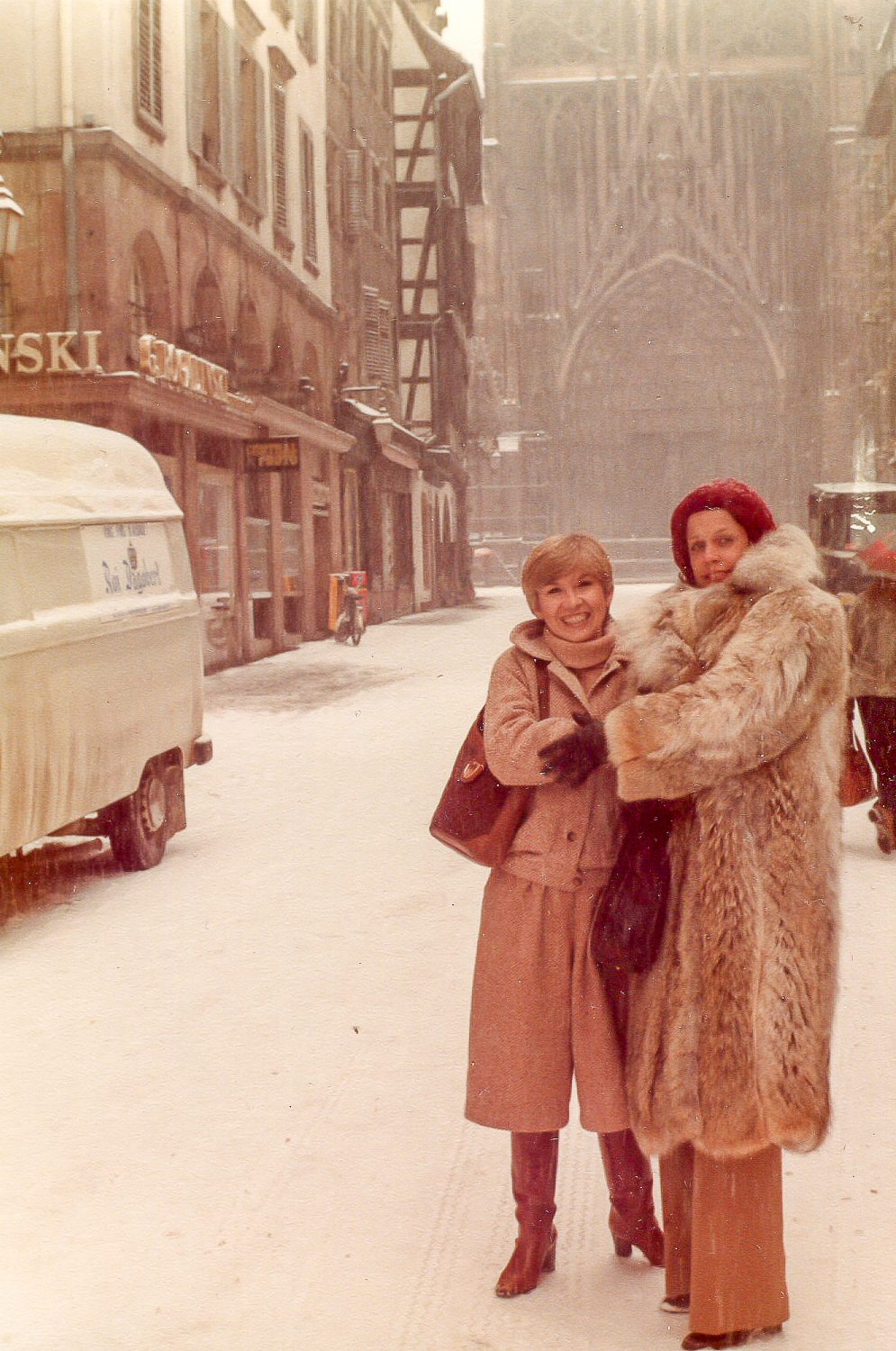
I also learned the fine art of traveling – how to make the total experience of visiting a brand-new country – whether one of its small villages, its peaceful countryside or its bustling cities – deeper and more meaningful. That skill of finding the right balance of education and fun was one I picked up from Nancy Youngclaus (now Nancy Tooman), a master at injecting intense touring activities with leisurely lunches and delightful dinners that brought personality and a true sense of place to the town or country being visited. Our stroll down the historic Champs-Elysees was elevated with a glass of Champagne at Fouquet’s outdoor café; an already magical walking tour of Strasbourg was made unforgettable when we sought refuge from an unexpected snowstorm by ducking into the much celebrated Au Crocodile for a lunch of inspired Alsatian food; and our exploration of Rome’s most colorful produce market – Campo de Fiori – was transformed when we escaped the crowds and sated our hungry bellies with a slice of pizza from the piazza’s corner bakery Forno Campo de Fiori.
Bill Youngcaus, Nancy’s husband at the time, was employed by the same advertising agency as my then-husband Bob. Nancy and Bill were experienced ex-pats, living in Caracas, Venezuela and then Surrey, England for over three years. They knew the plusses and minuses of living abroad. One of those plusses – a big one – was travel. Travel, they believed, expanded the mind by introducing you to new cultures, new ways of thinking and of course, new foods. We would eventually travel all over Europe with them and I was the lucky recipient of all their expertise.
Bob and Bill met in Chicago as young account-executives at Leo Burnett before any of us lived abroad. That business connection grew into a friendship, which eventually included Nancy and I, so when they were assigned to the Caracas office in the early ‘70s our budding relationship took a pause. A few years later it was our turn when Bob was assigned to manage the London office. Nancy and Bill had already been transferred there too so we were all thrilled at the prospect of reconnecting with them in England. However, that excitement didn’t last long. Months after we arrived, the Youngclaus family packed up again and relocated to Frankfurt where Bill had been reassigned – once again – to run Burnett’s Germany office. As disappointed as we were, that certainly did not prevent us from making frequent plans to travel together, sometimes with our kids in tow and sometimes just the four adults. Either way, it was always a delight to be with them and always a learning experience. Nancy, an art history major, was the perfect museum guide. She was a brilliant lecturer and instinctively knew just how much history and explanation would take us right up to (but not past) the moment when our children’s eyes would glaze over – actually sometimes even the adults – and she would lose us. Incredibly, she rarely did, and I think my kids absorbed more cultural history from Nancy than they did in all their studies until they got to college.
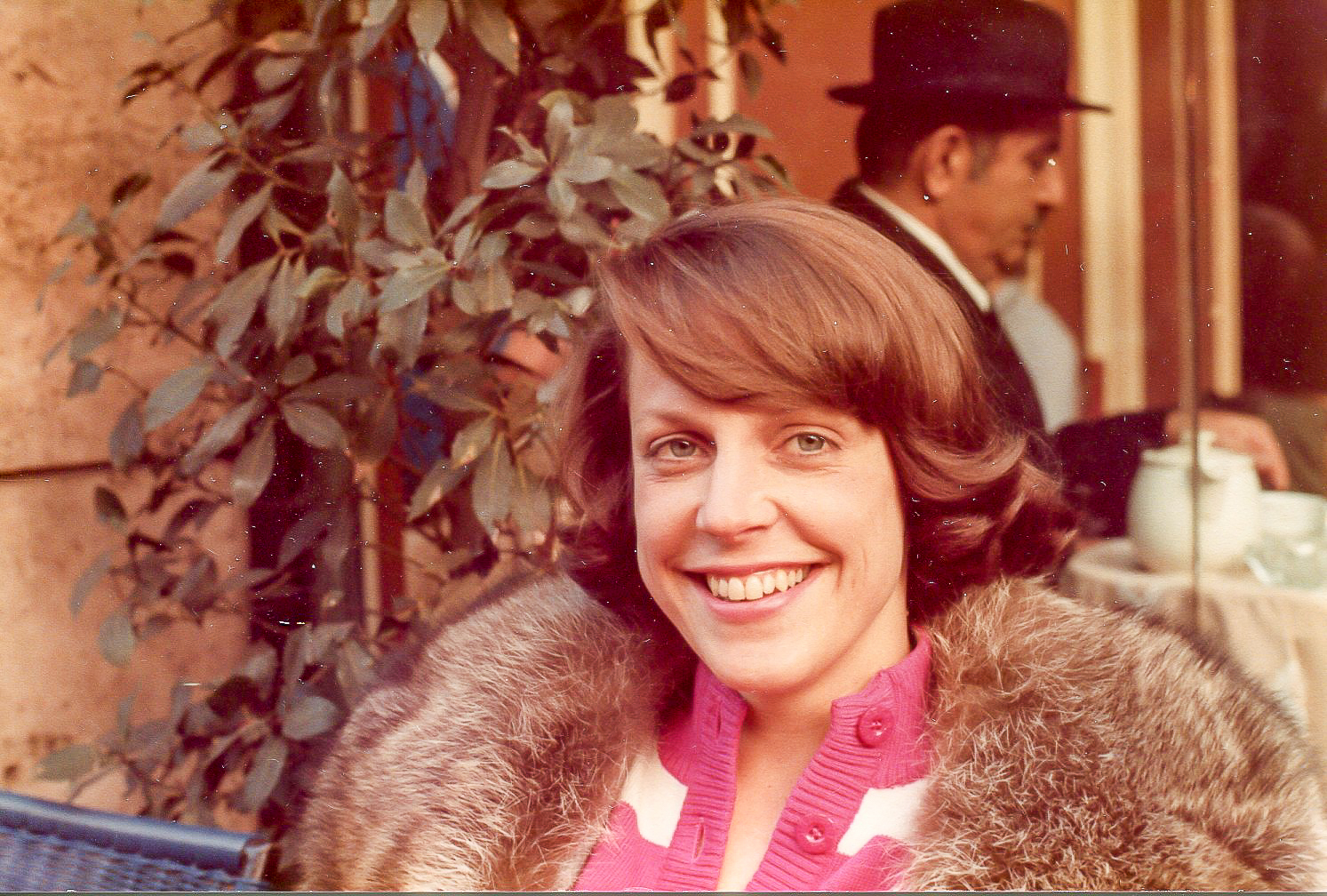
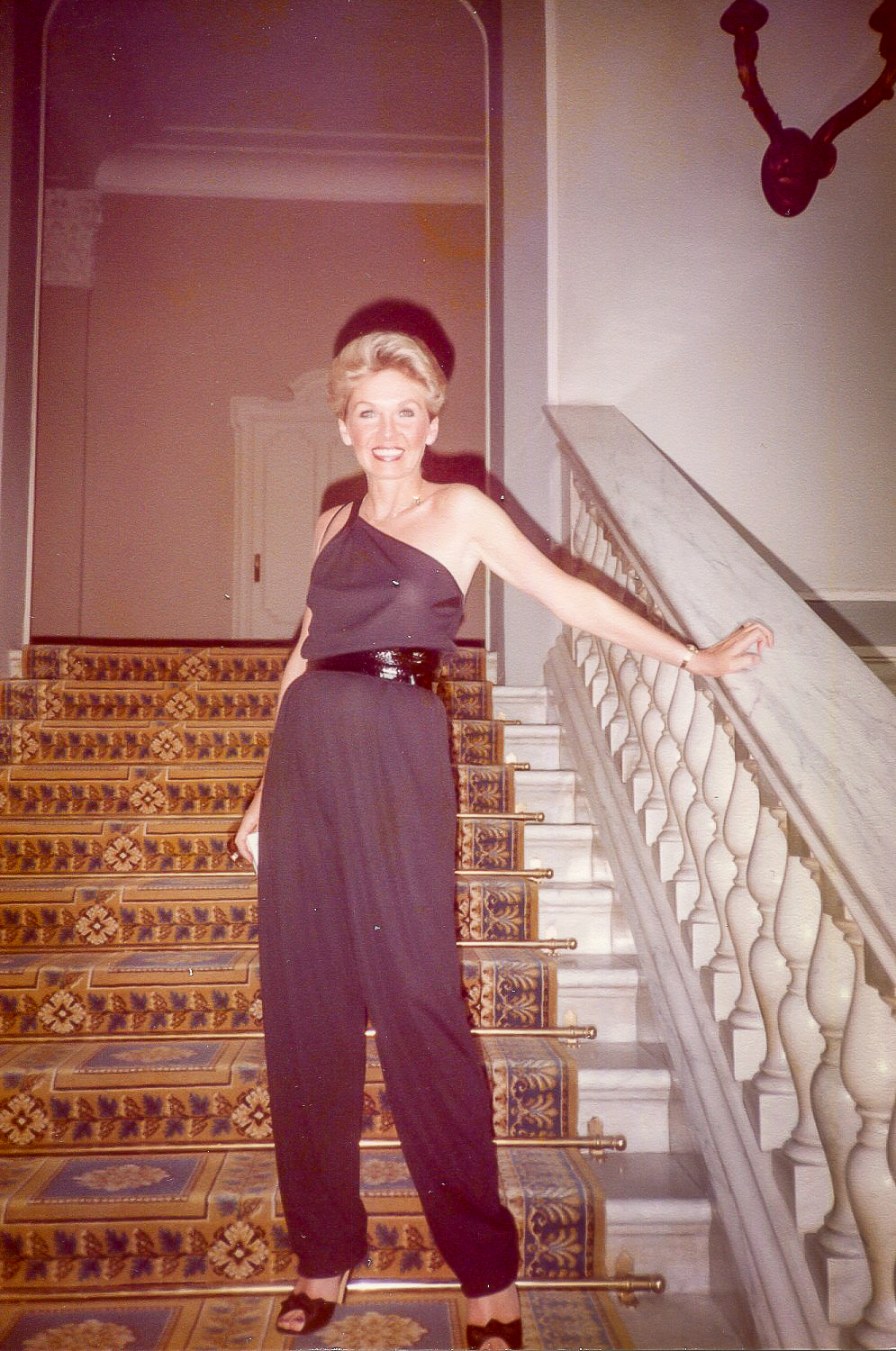
Nancy Tooman (then Youngclaus) in Paris
Our first ever trip to Paris was a family affair with Robby (11), Candace (6) and the two Youngclaus girls – Lisa (12) and Ann (11) joining the four adults. While the Dads were in meetings, Nancy treated me and the kids to her Ville Lumiere (City of Light) tour, an age-neutral introduction to Paris delivered as we visited a few of the city’s most magical sites. Number one on our tour was the Eiffel Tower, the centerpiece of Paris. Our collective amazement of ascending the iron structure via a combination of elevators and (countless) stairs to the top was rewarded with a magnificent view of the city.
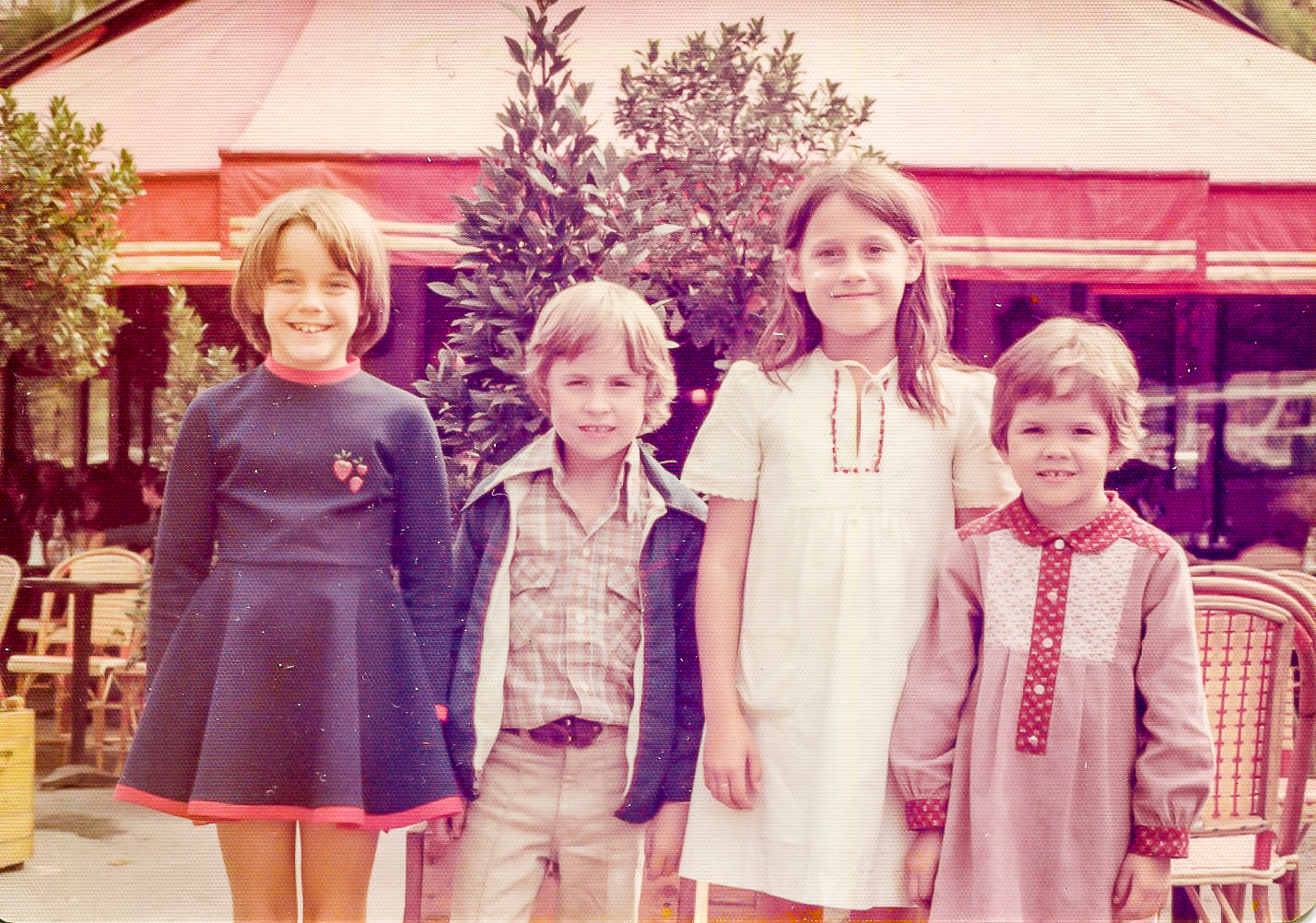
Ann, Robby, Lisa and Candace in front of Fouquets on Champs-Elysees
Also included in Nancy’s City of Lights tour was the Champs-Elysees with the Arc de Triomphe positioned at its western terminus where twelve radiating avenues all converge. Its imposing majesty made it a logical second destination for anyone who wants to feel the power and energy of this city. Sitting in the chic outside café of my go-to spot Fouquets, we enjoyed a feast of ice cream and delicate French pastries and all found ourselves caught up in the excitement of watching an incredible parade of people from all over the world do their “hustle and bustle” on one of the world’s grandest avenues. It felt like we had arrived at the center of the universe.
Nancy’s goal in this Ville Lumiere tour was to give us a grand overall feeling of the city and its atmosphere. Much of our tour was spent outside – strolls on the quieter, cobblestone streets of the Left Bank, walks up and down the glamorous and more open avenues of the Right Bank and a most memorable boat trip on the Seine, the river that flows through the heart of Paris giving us all a breathtaking perspective of one of the most beautiful cities in the world.
Nancy did, however, indulge us with just one museum tour – her “Kid Tour” of the Louvre, the largest museum in the world containing one of the world’s most impressive collections of art. Considering that this museum is known to be overwhelming even for adults, Nancy decided to substantially shorten our tour by making a beeline to Leonardo De Vinci’s Mona Lisa. Hand in hand, weaving in and out of the crowds, we followed her – at last coming to a halt in front of this famous lady. Nancy’s lecture on the artist, the mystique of the painting and the lore of its ownership over the centuries, concluded with a hushed description about how the Mona Lisa’s eyes seem to follow the viewer as one moves around the room. Something scientific about optical illusions was the explanation which I didn’t quite understand at the time (or if I’m honest, to this day), but regardless, I found the idea that Mona Lisa is always looking at you downright eerie. The kids were mesmerized by this yarn Nancy spun combining art, legend, history and science. I’m not sure how well they remember it, but for me the painting and Nancy’s stories are forever intertwined.
After an appropriate length of time admiring the Mona Lisa’s mysterious smile, Nancy turned us all around and again quickly led us through the crowd to the museum’s exit in search of the nearest cafe for lunch. We were starving! Paris has lots of cafes, bistros and brasseries with kid friendly food and we found a charming one facing the Louvre situated in the arcades of the Rue de Rivoli. My kid’s favorite lunch in Paris (actually in many of the cities they visited) was a grilled cheese sandwich with pommes frites. It simply felt like home. Another dish they frequently ordered during this Paris trip was a crepe stuffed with ham and cheese topped with a creamy cheese sauce.
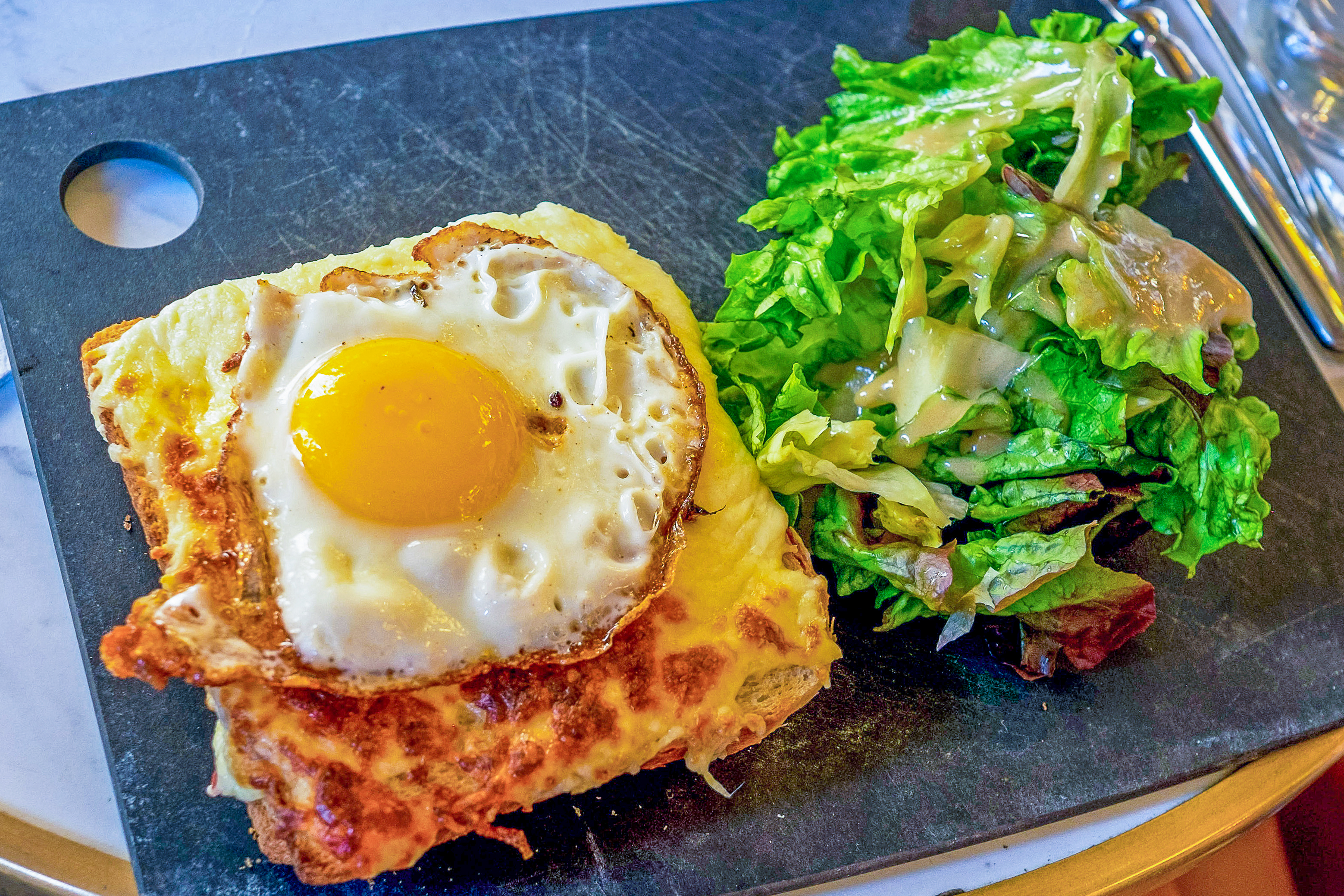 I also had my own Parisian ham and cheese favorite – the Croque-Monsier – basically a ham and cheese sandwich but oh-so much more delicious. The Croque Monsieur is traditionally made with ham and either Emmental or Gruyere cheese between slices of brioche-like bread, then topped with grated cheese and either baked in an oven or fried in a frying pan. Some brasseries also add Béchamel sauce, making it even richer and more delicious. Another version is the Croque Madame, which is the same sandwich only topped with a fried egg. I love both. The Croque Monsieur is currently on the Convito menu and has become a customer favorite.
We avoided fancier French restaurants with precious (and extremely expensive) food when we dined with the kids. Instead we chose more casual bistros and brasseries where the atmosphere was bustling and noisy and the food simpler and more familiar. The eight of us added to the noise level of any brasserie or bistro we chose by loudly assaulting Bill (the only fluent French speaker in the group) with a ton of questions about the menu, about pronunciation, about everything! We also bombarded him (usually at the same time and at the same volume) with demands of what to tell or ask the waiter. You could see beads of perspiration breaking out on his brow during each dinner. And it wasn’t just the children who were demanding his attention – it was also the other three adults. I never fully learned how fluent he was in French, but it was clear that he was way better than the rest of us, so he became our de-facto translator. Once the ordering was complete you could see him relax and enjoy himself – that is, until the next meal. Poor guy!
Onion soup was frequently my choice of a first course. Since it is so rich and filling, I always tried to follow it with something light. But the call of steak-frites or roast chicken with mashed potatoes was often too strong to resist. Today when I prepare onion soup at home, I usually serve it as the main course accompanied by a green salad. The recipe I still use is from the French cooking classes I took from Leslee Reis before I moved to England. I’m certain Leslee based her recipe on all the many onion soups she consumed while traveling and studying in Paris. I love its somewhat sweet, deep flavor with its savory, cheesy gratinee and crunchy crouton. It is the recipe I use in my restaurant today.
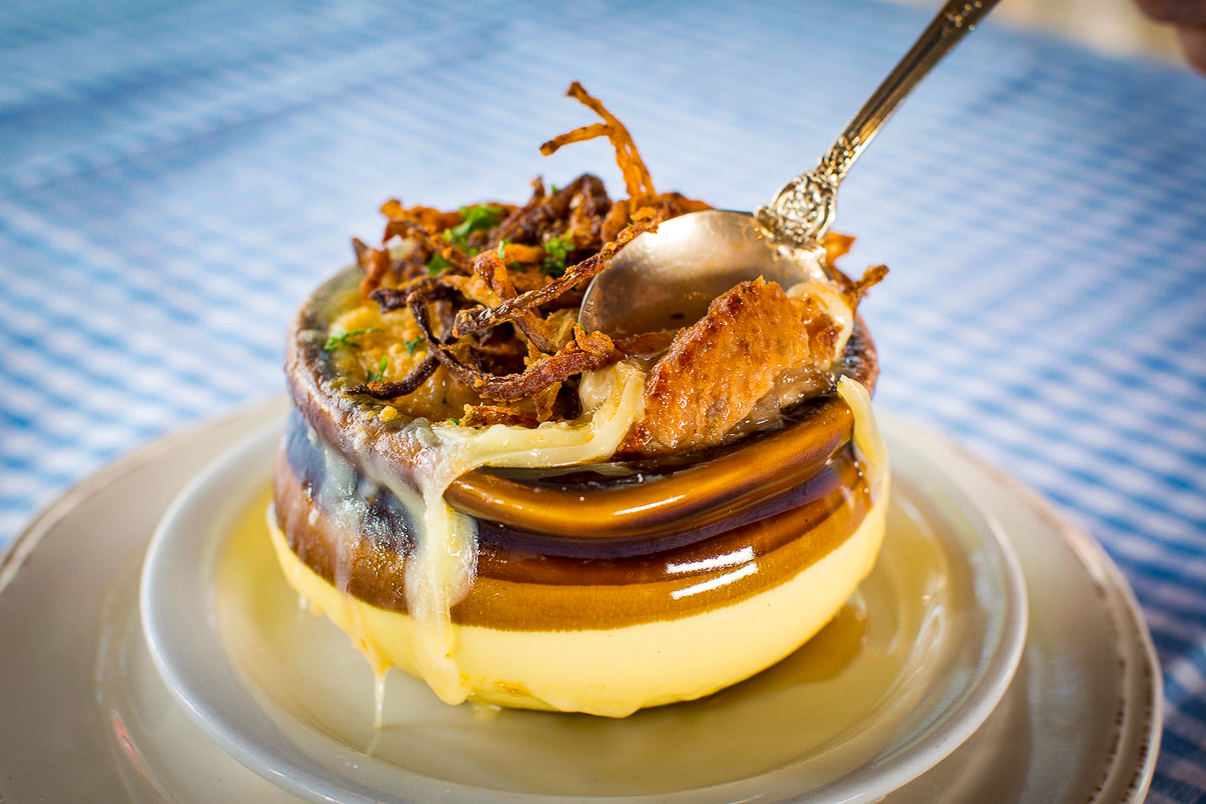
© rob warner photography 2020
Soupe A L’Oignon Gratinee
Soup
3 Tablespoons butter
1 ½ tablespoons vegetable oil
6 cups thinly sliced yellow onions (about 2 ½ pounds)
1-teaspoon salt
½ teaspoon sugar*
3 Tablespoons flour
8 cups beef stock
1 cup white or red wine or dry vermouth
1 bay leaf
½ teaspoon sage
¼ cup cognacHeat butter and oil until bubbling. Add sliced onions and stir. Cover and cook over moderate – low heat for 20 minutes, stirring occasionally. Uncover pan, raise heat to moderate-high and stir in salt and sugar*. Cook 30 minutes, stirring frequently; onions should be a deep golden brown.
Lower heat, stir in flour, and cook slowly, stirring for 2 minutes.
Remove from heat. Stir in 1 cup of the stock and whisk to blend flour = then add remaining stock and wine, seasonings and bring to a simmer. Simmer slowly for 30 – 40 minutes. Remove bay leaf. Add the cognac and stir well. Taste for seasoning.
*Sugar helps to brown onions
Gratinee
8 – 10 French bread slices about 1 inch thick*
1 ½ cups grated imported Swiss or Gruyere cheesePre-heat the oven broiler.
Ladle the hot soup into 6 individual soup crocks or heatproof bowls. Top each with a browned bread slice. Sprinkle each with ¼ cup of grated cheese. Place the bowls on a cookie sheet for ease in handling.
Set in middle of a pre-heated 350-degree oven for 30 minutes. Can run under broiler to glaze cheese.
*French bread slices – better if French baguette is somewhat stale. 6 tablespoons butter melted mixed with 3 tablespoons oil. Brush on bread slices and brown in skillet turning to brown both sides.
***************************************************************
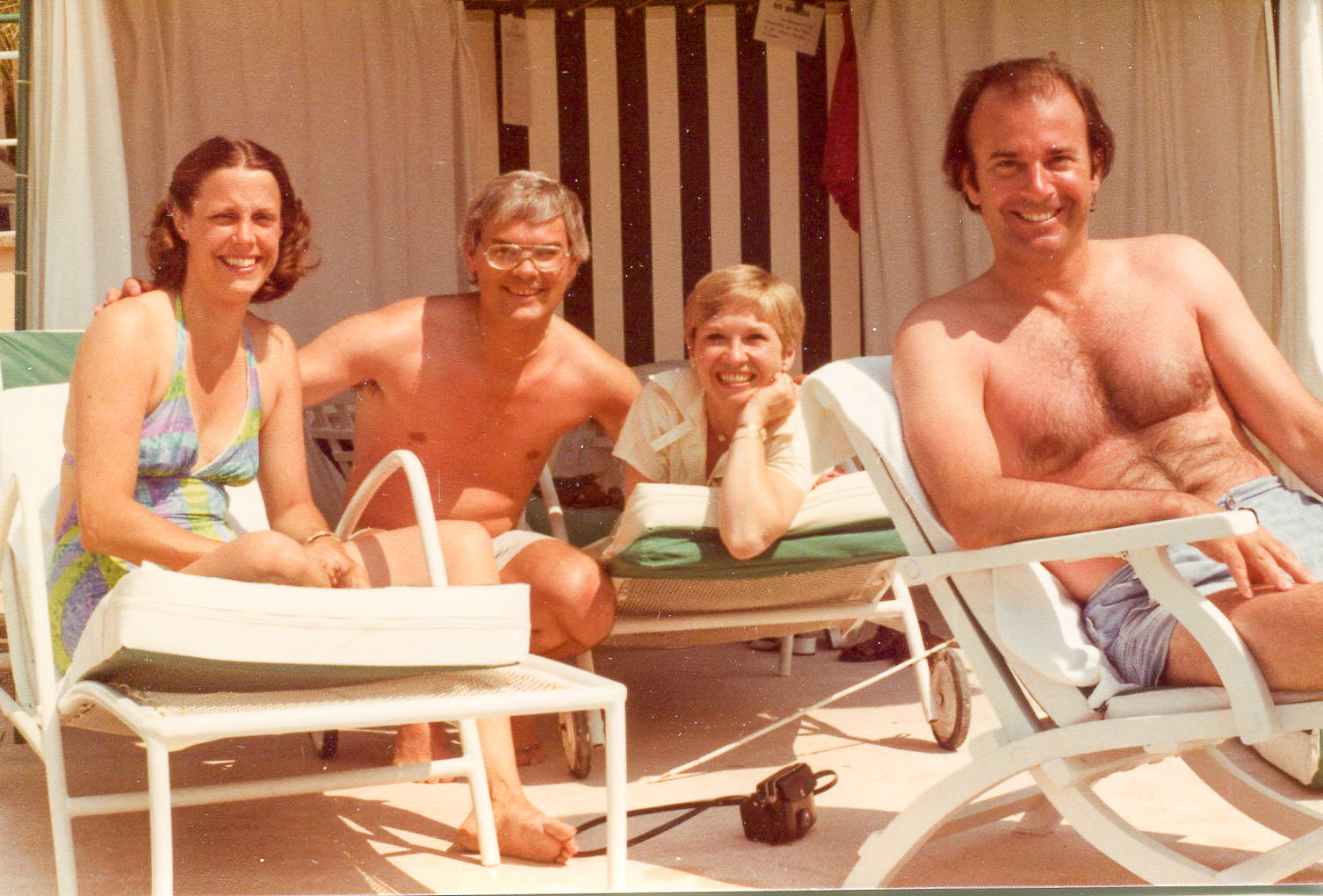
We continued traveling with Nancy and Bill Youngclaus throughout our time in England. Traveling as a foursome with two Nancys could be confusing with both of us constantly responding to the name “Nancy” whether it was meant for us or not. One day not long into our journeys Bill solved the problem starting to call his wife (the taller one) “Big Nanc” and me (the shorter one) “little Nanc” – names we call one another to this day. One of the most infamous trips we took was another French journey – one that I came to refer to as the Butter Trip. It was an “adults only” journey through the French Riviera beginning in St. Tropez and traveling north along the Mediterranean Sea with stops in Cannes and Nice and finally ending – fat and full – in Monte Carlo.
We were determined to dine at as many Michelin-starred restaurants as possible, which is how it came to be known as the ButterTrip to me since butter was the key ingredient in almost every French sauce we had. It was also the most crucial component of croissants – the irresistible pastry which we devoured each morning at breakfast. Nancy claims it was me who decided that we dine in these Michelin restaurants since I had brought along a tattered Gourmet magazine with a dogeared article featuring the French Riviera’s best restaurants. Supposedly, I referenced it every day of our trip. Though I wish I could blame someone else for what was probably the most indulgent culinary adventure of my life, her description of the origins of our expedition sounds about right!

Little Nanc and Big Nanc in St Tropez
St Tropez – long popular with both artists and the International Jet Set– was our first stop. Since Bob and Bill were more than happy to spend their afternoons on the Tahiti topless beach made famous in the Bridgette Bardot movie “And God Created Women,” Nancy and I were mostly on our own. Though I felt somewhat out of place amongst this rich and famous crowd, the “people watching” – component combined with our many fantastic meals – more than made up for any self-consciousness I might have had to endure.
It was here that I was first introduced to Bouillabaisse, the traditional fish stew of the south of France. Fish to me represents eating light, but not so with this aromatic, complex and rich dish that also contains potatoes, garlic aioli and thick slices of bread. Delicious, but not light! I ordered it several times during our journey and was never disappointed.
I also frequently ordered Loup de Mer, a Mediterranean seabass. Preparations varied, but I soon came to realize that most of the versions I chose were butter-based. And when it came to dessert, we continued to indulge! Without fail we seemed to always pick the richest item on the menu – mousse au chocolat (a quintessential French dessert) or millefeuille (another classic French sweet consisting of layers of razor-thin puff pastry and cream filling). And how could we resist a cheese course finale with local selections ranging from tangy Roquefort to rich creamy Brie. It’s amazing we didn’t get gout on this journey!
 By the time we reached Cannes we were desperate for something simple and fresh. We found it in the form of Salades Nicoise which we all ordered for lunch on the beach in front of the famous Carlton Hotel. Finally no butter! Salade Nicoise originated in Nice and continues to be a favorite of mine. Traditionally made with greens, tomatoes, potatoes, cucumbers, hard-boiled eggs, Nicoise olives and tuna dressed with a classic vinaigrette; its popularity has spread throughout the world. The one I had on the Carlton Beach was served in a bowl all tossed together. I love to serve it in the summer as a composed dinner salad. But either way it is delicious and to me represents a true sense of place – in this case, the gorgeous and chic French Riviera.
Just last summer my family and I rented a villa on the Riviera and for one lunch the grandchildren and I made a Salade Nicoise. Photo below.
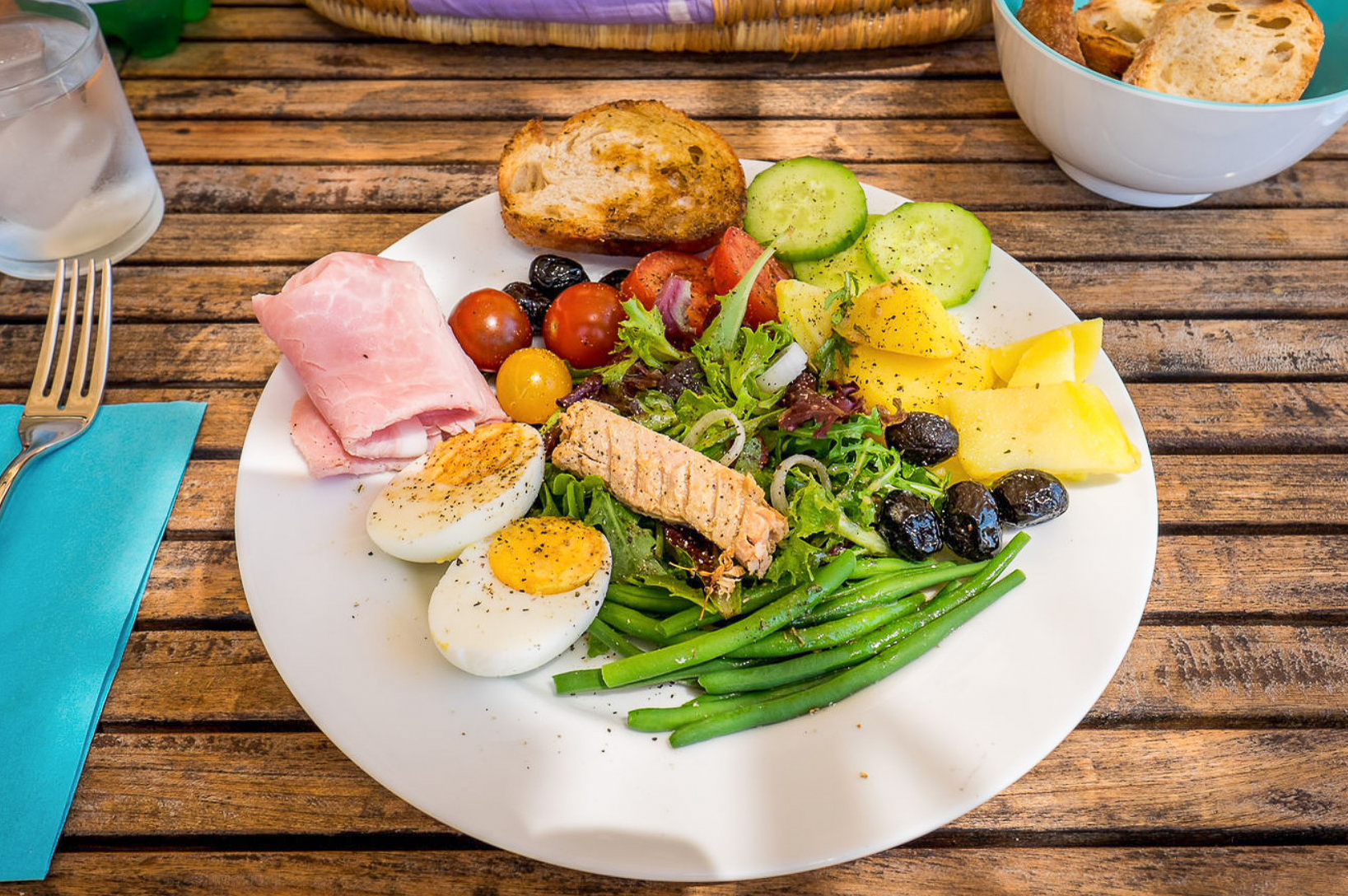
© rob warner photography 2020
Nicoise Salad
Following are the classic ingredients. Amounts and design up to you.
Lettuce – Boston or
Hard-boiled eggs peeled and quarter
Cooked red-skinned potatoes or fingerling sliced about 1/3 inch thick
Cooked haricots verts
Grape tomatoes sliced in half
Nicoise olives
Shallots or red onion sliced thin
Canned tuna packed in oil, drained
A red wine vinaigrette made with a touch of Dijon mustard
Optional – anchovy filets
***************************************************************

We ended our Riviera journey in the Grill Room on the top floor of Hotel de Paris in Monte Carlo. By then we were tired of rich food – actually tired of food in general – but we couldn’t very well forgo a dining experience on the top floor of this gorgeous belle époque-era building with its incredible panoramic view of the Mediterranean. So, of course we proceeded once again to indulge ourselves in yet another memorable Michelin-starred meal. And naturally…there was butter!
It turned out to be memorable all right, but not necessarily because of the food. For reasons long since forgotten (and perhaps even cloudy at the time) the two men got into a loud argument, which was not a totally unusual occurrence. At one point during the disagreement they moved their boisterous “debate” outdoors where they angrily threatened to throw one another off the 8rd floor terrace. The railings surrounding the balcony were not all that high so the threats of doing just that probably seemed entirely realistic to the heads turned in their direction.
But Nancy and I knew it wouldn’t happen. We had gotten used to a certain volatility between these two men whose shared temperament, intelligence and self-confidence were both the reason they became close friends the first day they met, as well as why they regularly got under each other’s skin like no other person in the world. So, we learned over time to ignore the bluster and this night we laughed our way to the ladies room to let them hash it out! Our irreverent acceptance of what had become a staple on our trips always helped diffuse (at least for us) what probably looked like a stressful situation to onlookers. As usual, upon returning to the table “Team Bill and Bob” were already engrossed in another deep conversation, laughing about something that only they understood, whatever argument that so passionately eclipsed our dinner long since forgotten.
***************************************************************
We didn’t know how long we would be living in Europe and wanted to take full advantage of the opportunity we were afforded, so we embarked upon an intense period of travel where I challenged myself to learn as much as I could about different countries across the continent – about their history and about their culture.
All of that education would profoundly influence my future immersion in the culinary world since history is deeply intertwined in both the culture and cuisine of a country.
Because Nancy and Bill lived in Germany, we made several trips to that country. One dark, gloomy weekend in February we traveled to Berlin when the Eastern half of the city was still controlled by the Soviet Union and separated from the West by a concrete wall and armed soldiers. Going into East Berlin was quite eerie and more than a little frightening, especially when we narrowly escaped a border “incident” at Checkpoint Charlie. For some reason, Bob took issue with one of the guards over something that none of us understood. At times he could become volatile when he perceived some kind of threat was imminent. In this situation where there was clearly an imbalance of power in favor of the border guards, Bob felt (I think) that by “standing up to them” he could put things back into a proper balance. Bill realized this tactic would do no such thing and – if anything – would only make the circumstance worse. Thankfully, he redirected Bob away from the confrontation and from what I was beginning to fear might be a night in jail for him or all of us! Whatever Bill said to the East German Border guard diffused the situation and we all breathed a sigh of relief, got back in our car and continued (albeit nervously) our tour of East Berlin.
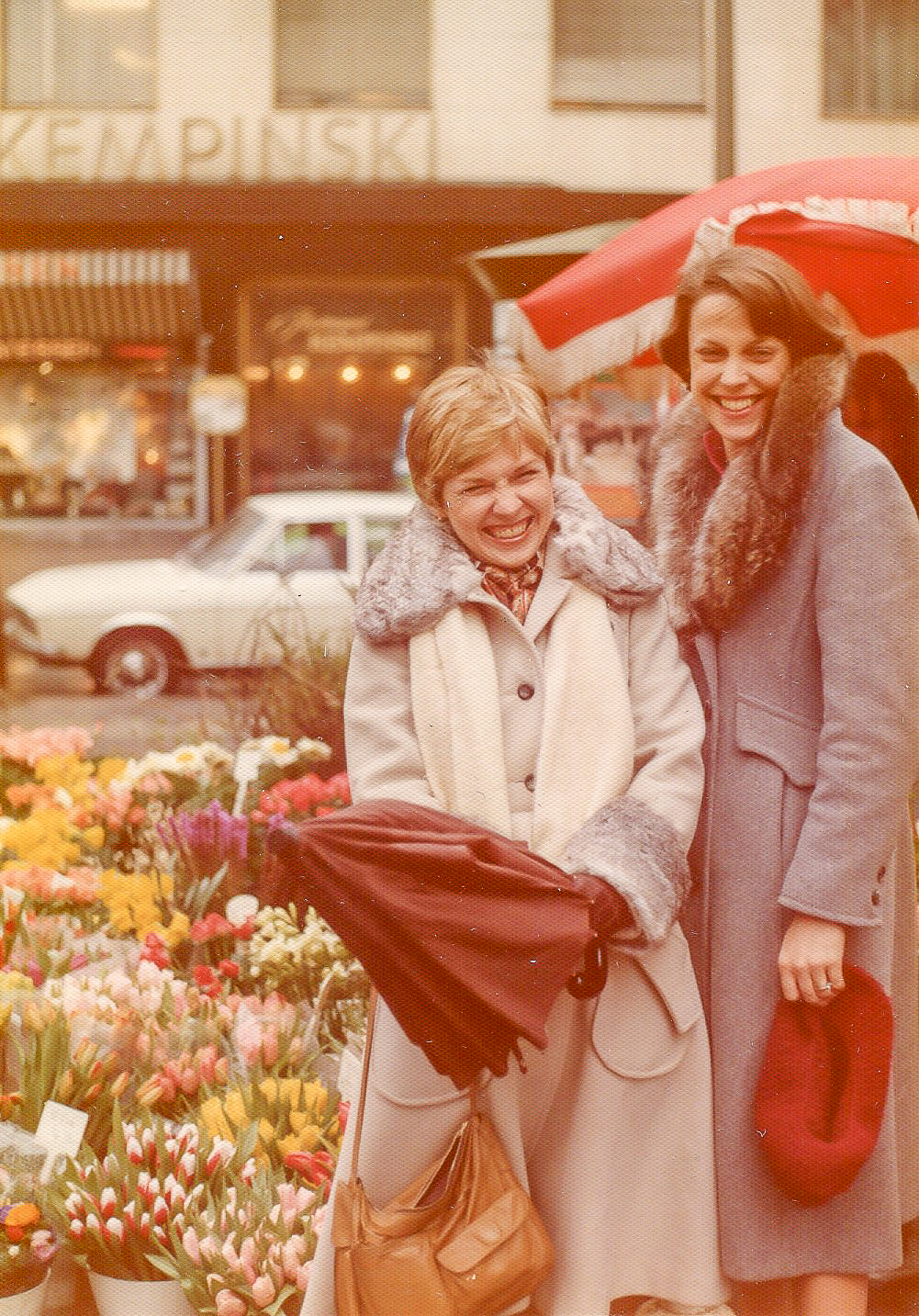
Nancy and I in Berlin
Though East Berlin was interesting, it was also oppressively drab and gray, just like the February weather we were experiencing there. You could still see bombed-out shells of many buildings and because most areas were blocked off to tourists, there wasn’t a lot to see. That fact – plus our anxiety left over from the Checkpoint Charlie “incident” – made us anxious to get back to the friendlier confines of the Western side of the city.
We stayed right in the center of West Berlin at Hotel Kempinski, a glamorous hotel that overlooked Brandenburg Gate, Berlin’s most famous 18th Century neoclassical landmark built by Prussian King Frederick William II which now separated East from West. A certain mood permeated this city that I couldn’t quite put my finger on. Was it danger? Was it anxiety? Or maybe it was just the gloomy, rainy weather. Whatever it was, I found the mood rather mysterious and intriguing. And since we were told that the real life of Berliners takes place mostly at night, we decided to commit to an uncharacteristic (for us) nightclub night-out to soak in some local authenticity. The club we picked was dimly lit, so it was difficult to see much of anything except the spotlight on the musicians whose music was some hybrid of disco and rock. What I did know for sure was that it was loud! Too loud! And since I was never any good at lip reading, I could not decipher what anyone was saying. A piano bar is more my style where the music is soft and the conversation understandable. So, I was not at all unhappy when the group decided to call it a night and go back to the hotel satisfied that we had at least witnessed a small slice of Berlin’s night life.
Good food was always a priority with the four of us when we travelled, and our Germany trips were no different. The traditional German breakfast was substantial: a breakfast of bread rolls, marmalade, hard-boiled eggs, cheeses and various cold cuts. Because we ate late and the breakfast was so filling, we could easily go from breakfast to dinner without stopping for lunch allowing us the time to see all the sights and visit all the museums on our agenda. And since we were only staying the weekend (and Nancy – of course – had a full agenda planned) we had a lot to pack in.
Dinner was our leisurely “review-the day-and-relax” meal. We choose restaurants that served typical German food and wines rather than the “international” cuisine popular in many of the hotel restaurants. To this day I really enjoy good German food. They love their meats – especially roasts – as do I. And with all good cultures come accompanying starches! One of my favorite dishes was spaetzle – a type of egg noodle dumpling – lightly tossed with butter, accompanied by one of their famous meat dishes. In this case it was Weinerschnitzel, a thin, breaded and pan-fried veal cutlet. That combination along with a glass of elegant German Riesling, one of Germany’s superstar wines, was one of my favorite meals.

kids visiting Youngclaus family in Frankfurt
Besides Berlin, we made several side-trips from Frankfurt where the Youngclaus family resided, to explore the many charming villages nearby. One memorable adventure we had with the whole family was a day of medieval castle-hopping on the banks of the Rhine. The medieval castles on the hilltops, the lush green vineyards and the narrow riverbanks painted a romantic picture not dissimilar to the Brothers Grimm books our children so loved. Exploring these amazing castles while imagining the lives of the knights and princesses who had lived there turned out to be the idyllic kid trip. They especially loved the towers – I’m sure imagining them as the home of German fairytale characters like Rapunzel, “The Maiden in the Tower”.
German cuisine also appealed to the kids. Frankfurters and bratwurst were easy choices for both lunch and dinner. I too enjoyed a good brat, especially one grilled with a slightly crispy skin and served in a bun with mustard and loaded with sauerkraut. The number of different kinds of sausages made in Germany is mind-boggling – more than 1,500 different varieties we learned, so there is always plenty different kinds to choose from. And Germans also prepare potatoes in a number of ways – fried, baked, sautéed, boiled, so that was another guaranteed hit with the kids. Potatoes are ubiquitous – paired with almost every German dish – which was perfect for this midwestern gal who never let a fried, roasted or baked potato go to waste!
Probably the most memorable side-trip we made from Frankfurst was a very treacherous snowy drive to Strasbourg just over the border in Alsace, France. When we began our two-and-a-half hour drive the weather was lovely. But by the time we reached Strasbourg, the snow was so intense it was pilling up in huge drifts along the highway making our journey much slower than we anticipated. We decided that Strasbourg would be our only stop – lunch and then back on the road to Frankfurt. The medieval villages we intended to also visit like Colmar and Riquewihr would have to wait for another journey.
Because this is the area thought to be the homeland of my great grandfather (on my father’s side) I was always fascinated by its turbulent history and was really looking forward to this visit. Although Alsace-Lorraine is located in France, it was not so long ago that it had been a part of Germany. Annexed by Nazi Germany in 1949, it reverted back to French control at the end of WWII where it remains today.
I was excited to see it for both its history and my family’s so I was disappointed that our visit would be limited. What was possible to see through the falling snow revealed a city with a very distinctive old-world character. The snow fell like confetti against our faces as we walked through the quaint cobblestone streets in the ancient quarter of the city. Finally arriving at the restaurant Nancy had reserved for lunch and happy to be out of the cold, I chose a dish that would actually become one of my favorites from anywhere in the world. It suited my taste buds perfectly.
The dish –Choucroute Garni – is a traditional specialty of Alsace, France. What arrived at the table was a steaming platter of sauerkraut piled high with a variety of hearty sausages, frankfurters, salted meats and cooked potatoes – a stick-to-your-ribs kind of dish and perfect to be consumed in the height of a blizzard! I had made a simple version of this dish several times for my family using a recipe that my grandfather loved – sauerkraut served with ring baloney and boiled potatoes, but this took things to a new level.

Nancy with plate of Choucroute in Strasbourg at Chez Yvonne many years later
I later learned that choucroute means “dressed sauerkraut” in French. Although “sour cabbage” actually originated in China some two thousand+ years ago, it eventually made its way to Eastern Europe then to Germany, Alsace-Lorraine and France. Various interpretations of the basic recipe emerged from each country, but the Alsatian version is my favorite. In this version the sauerkraut is accompanied by a selection of meats (usually pork) and boiled potatoes. The sauerkraut preparation can vary but always includes onions.
My Choucroute Garni recipe pretty much follows the typical Alsatian recipe except I add more onions. The onions are sautéed to the point of being almost caramelized adding a slight sweetness to the sauerkraut.
Choucroute Garnie
Serves 62-½ pounds sauerkraut
2 ounces slab bacon, diced
2 ½ # pork back ribs (2 ribs per person)
2 cups finely sliced onions
1 clove garlic minced
2 cups chicken stock
¾ cup Riesling wine
1 bay leaf
4 whole black peppercorns
3 whole cloves
8 juniper berries
salt & freshly ground pepper
6 knockwurst
1 pre-cooked Polish Kielbasa
boneless boiled ham (3-4 inches wide) sliced into 6 pieces ¼ inch thick
12 potatoes (approximately 2 inches in diameter)
Drain sauerkraut, reserving juice. Wring out well. Set aside. Heat oven to 325 degrees
In a large casserole (at least 5 quarts) cook bacon over medium heat until golden. Remove, draining well. Leave fat in casserole. Cut ribs into 6 sections – 2 ribs per section. Brown the ribs. Remove.
Add onions and sauté over medium heat for approximately 12 minutes – almost caramelizing. Add garlic and sauté for another 2 minutes.
Add sauerkraut. Add stock and wine. Bring to a simmer.
Add bay leaf, peppercorns, cloves and juniper berries. Return bacon. Add ribs, tucking into sauerkraut mixture. Season with salt and pepper. Cover and bake for 1-½ hours.
Put knockwurst and kielbasa in with sauerkraut for last 20 minutes to heat through, ham for last 10 minutes just to warm.
Meanwhile in a large saucepan, cover the potatoes with cold water. Add salt and bring to a boil. Cook the potatoes until tender when pierced. Drain. Cover to keep warm.
To serve, mound the hot sauerkraut in the center of hot dinner plates. Tuck in the ribs and slices of kielbasa. Arrange ham and knockwurst around sauerkraut with boiled potatoes. Serve with assorted mustards and horseradish.
Note: many different meats are used in different recipes – mostly always a form of pork
***************************************************************
Before we left Strasbourg for our long drive home, we visited the beautiful Cathedral of our Lady of Strasbourg – also know as Cathedrale de Notre Dame – an outstanding example of Gothic architecture and one of Strasbourg’s most famous sights. After admiring the spectacular stained-glass windows, we cautiously made our way back to the car and began the very long journey back to Frankfurt driving through a sea of white in howling winds, dreaming of the warmth of the Youngclaus home, our smiling children and maybe a cup of hot cocoa.
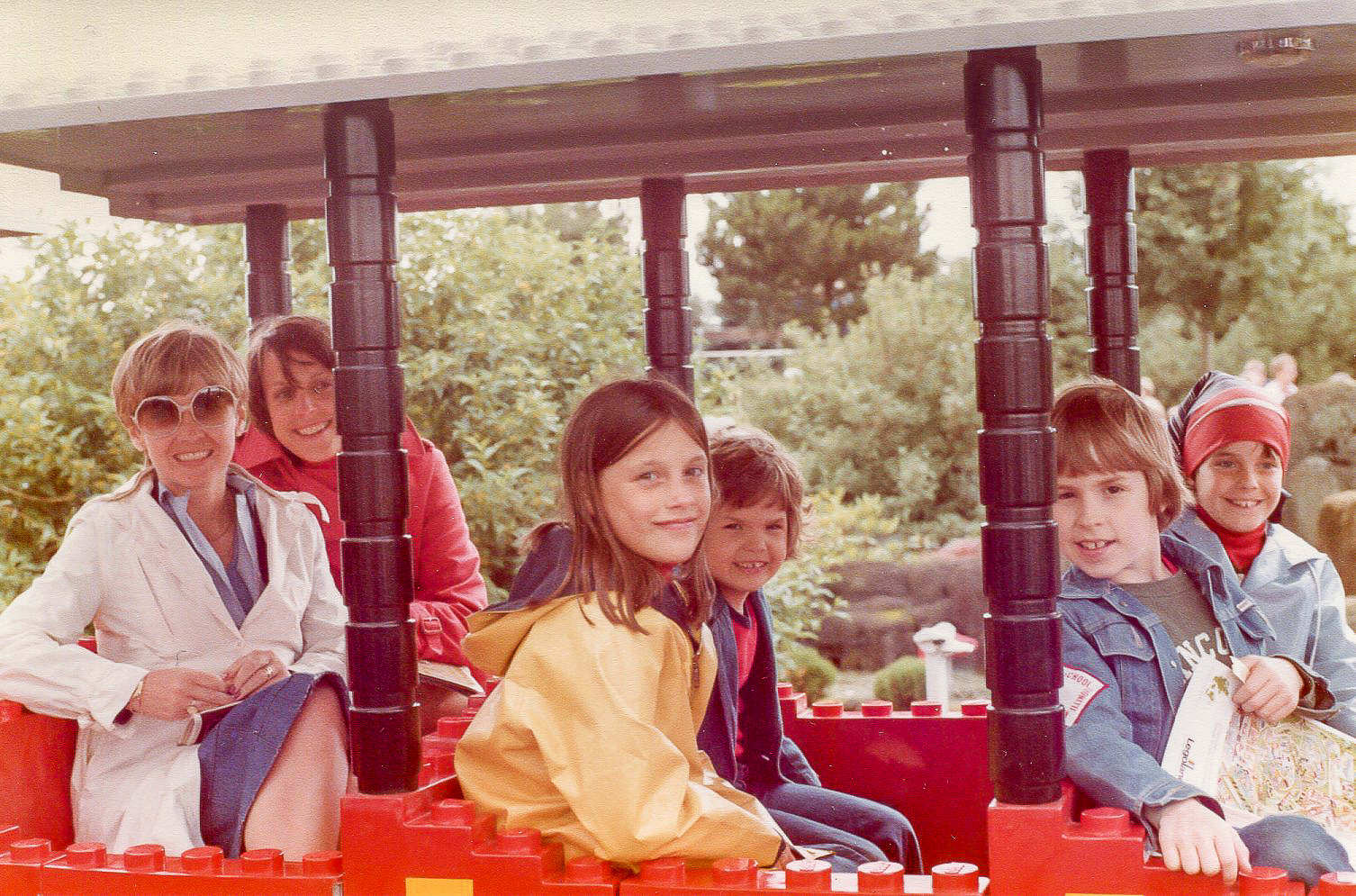
Denmark with Younglaus family – Legoland
Among the highlights of my entire time spent living aboard was a 10-day journey around Denmark that we took with the whole Youngclaus family. By this time the eight of us had become a family of sorts, bound together in a common interest of new adventures and most certainly a love for the humorous aspects of any situation. Laughter was always a priority.
Another reason I remember this trip so fondly is because both Nancy and I were relieved of our planning responsibilities since the Managing Director of Leo Burnett Denmark did it for us! Knowing that four children were accompanying the adults, he made certain to include kid-friendly stops as well as to give us an overview of flat and windy – but breathtakingly beautiful – Denmark with all its lovely farmland and quaint seaports.
We began in Copenhagen, the capital and economic center of the country, then traveled in our red rental van (named Beep by the kids) all the way to the tip of Denmark to Skagen, a port town at the north end of Denmark where the Baltic very dramatically crashes into the North Sea. We also made many kid-friendly stops along the way including a trip to the original Legoland and a visit to Tivoli Gardens in Copenhagen, the second oldest operating amusement park in the world.
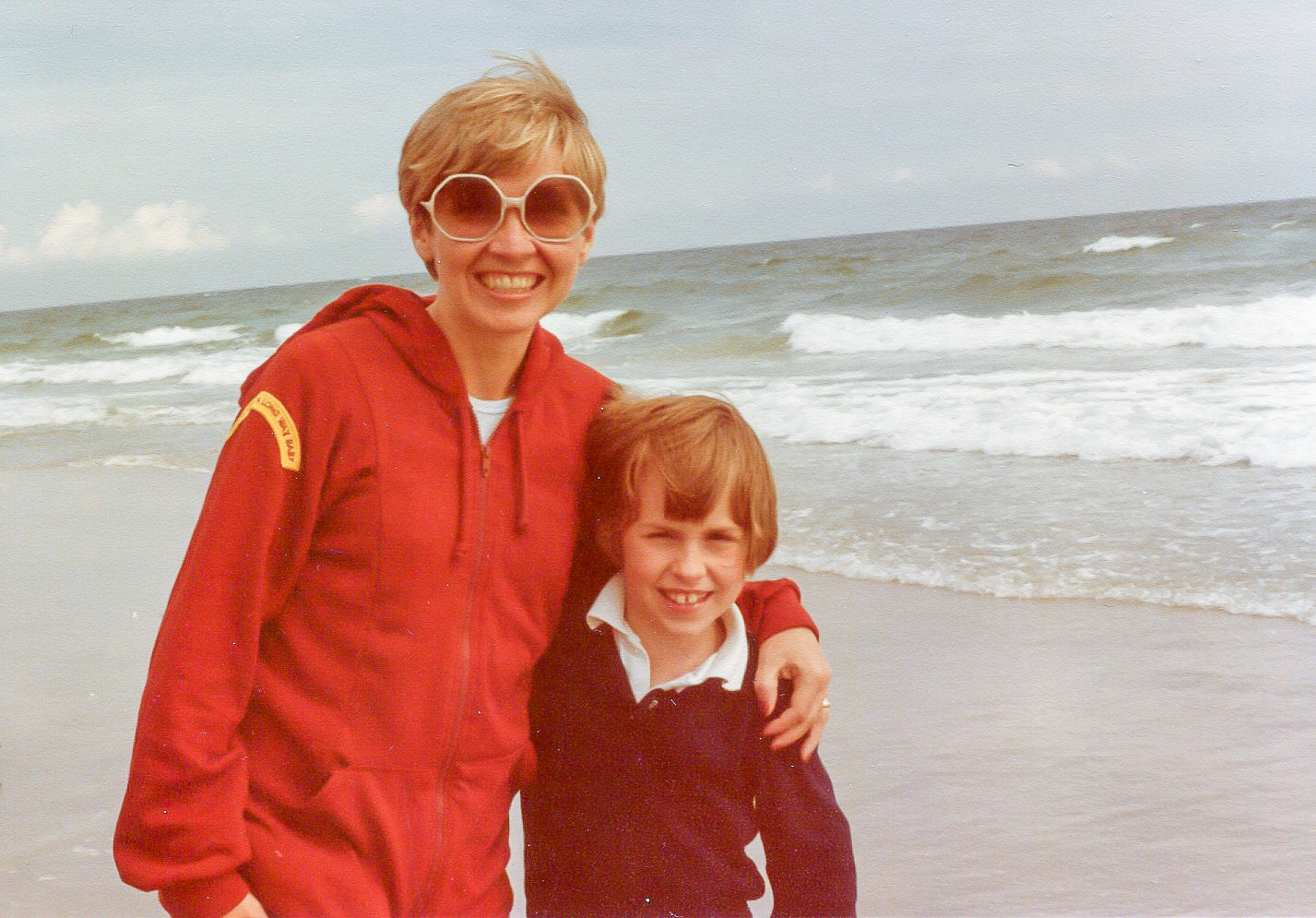
with Robby at North Sea & Baltic Sea
Food and wine, I was learning, reveal more about a country than simply their culinary tastes. Denmark’s food is described as Nordic which emphasizes locally grown and sustainable ingredients. The isolated geography and fast-changing climate that all Nordic countries share given their position in the northern reaches of the European continent helps explain the similarities of their cuisine, though each country and region has its own specialty dishes. In Denmark these often featured root vegetables which are easy to grow in Denmark’s very short summers. Cabbage cultivation is also suited to Denmark’s climate, so you find many dishes based around this leafy plant. And of course, Denmark is surrounded by the sea, so fish is ubiquitous; especially salmon, cod and herring.
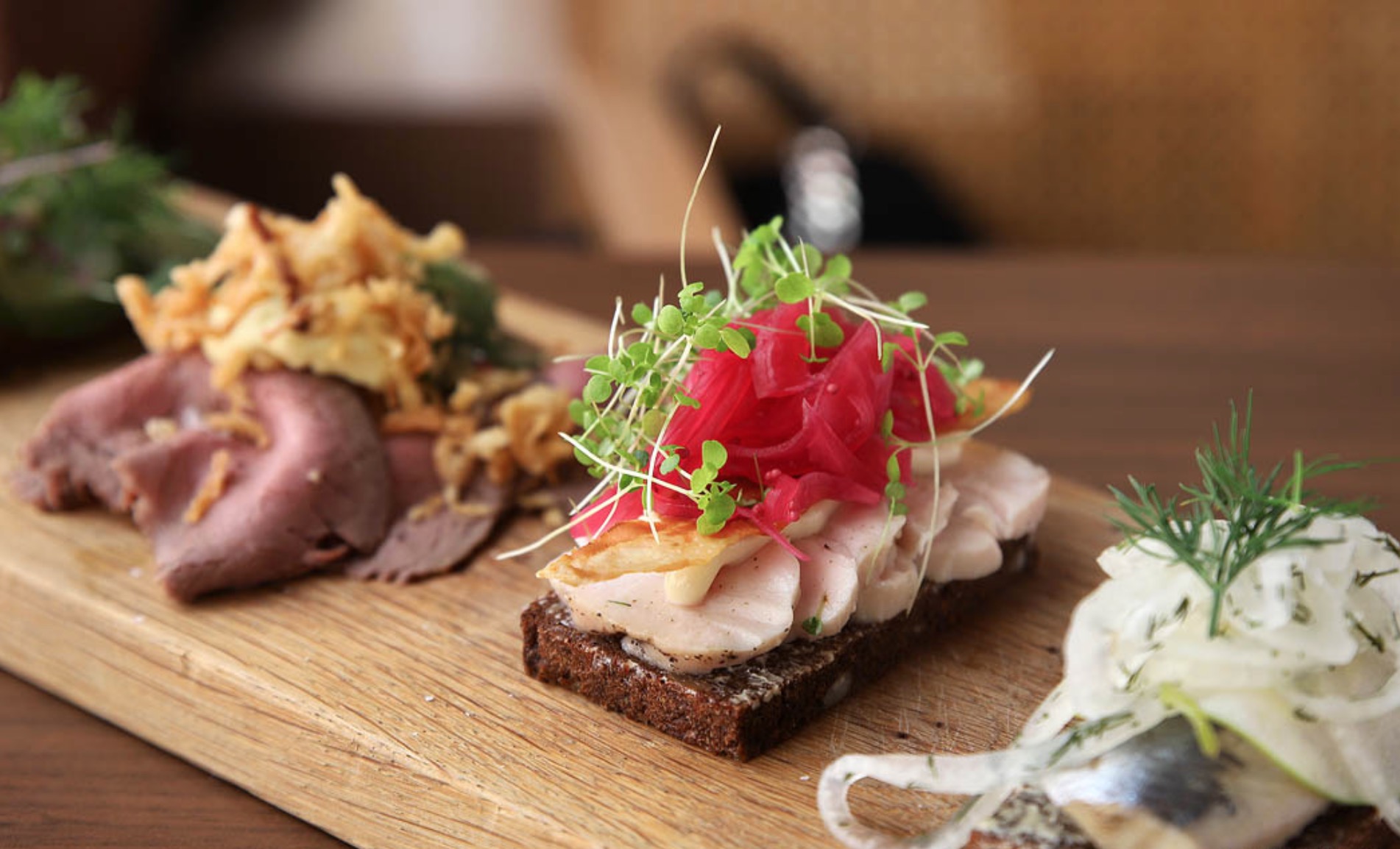 All of these ingredients can be found in one version or another of Denmark’s signature dish, Smorrebrod. An open-faced sandwich using traditional Danish-style rye bread as the base, the toppings vary greatly depending on the season and the region of Denmark you find yourself in. It can be as austere as buttered bread with thin slices of cheese or cucumber, or as complicated as versions that feature multiple layers of roast beef, pickled fish or an assortment of root vegetables slathered with remoulade sauce and garnished with shredded horseradish, carrots, radishes, celery root, pickles, and always arranged in a most artistic way. The main ingredient on my favorite Smorrebrod is one of Denmark’s gifts from the sea – the popular smoked salmon. As New York Times writer R.W. Apple wrote about the dish; “Leave it to the Danes, those post masters of form and color, to turn a sandwich into a still life.”

Smoked Salmon Smorrebrod
A slice of rye bread
Remoulade
Smoked Salmon
Thinly sliced cucumbers
Thinly sliced radishes
Fresh dill
CapersSauce rémoulade
1 cup mayonnaise mixed with 2 tablespoons mixed herbs (parsley, chives, chervil and tarragon), 1 tablespoon drained capers, 2 finely diced cornichons and a few drops of anchovy essence (optional). Some recipes use chopped anchovy fillets.Spread the remoulade on top of a slice of rye bread; artistically arrange cucumbers, radishes and fresh dill on top. Sprinkle with capers
***************************************************************
The Youngclaus were not our own travelling companions during those years we lived in England. But even when we were travelling with others, the lessons from Nancy’s thoughtful planning informed the increasingly detailed itineraries which I began to create for visiting family and friends. True to my obsession with English customs and traditions, any of my England-based trips included plenty of time for my guests to enjoy a totally “English experience.” To me that meant relaxing over a cup of tea at one of London’s tea salons after a busy day of museum-hopping; a pub dinner and a pint of ale at the conclusion of intense driving on the “wrong” side of the road through the Cotswolds; or savoring a typical English dinner in Covent Garden before going to the theatre in London’s West End. No matter what the agenda, those experiences always combined local food and beverages with the day’s activities.
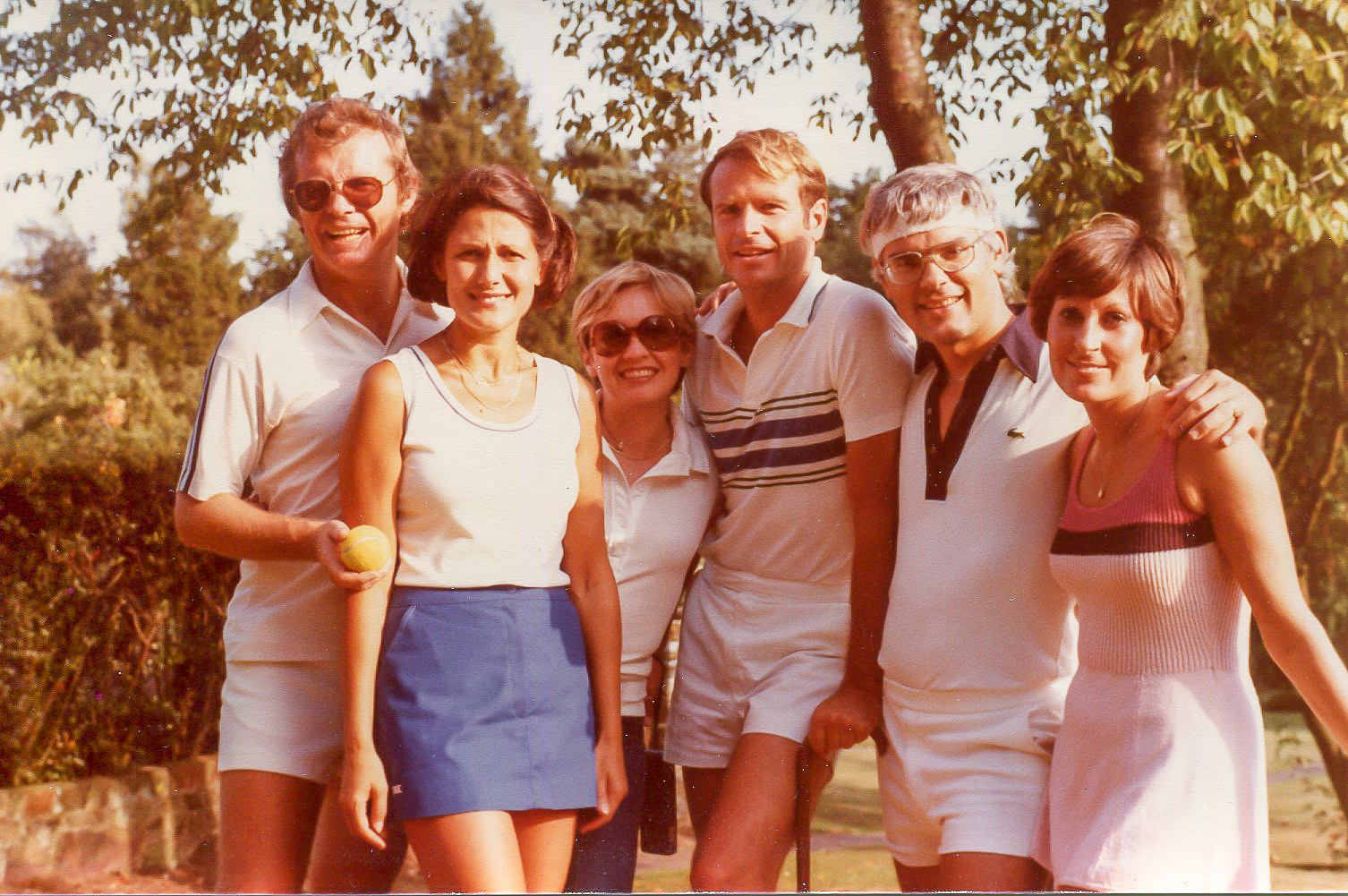
after a game of tennis with the Humphries and visiting guests Claire and Bill Stickney
After a stay with us in England, many of our visiting friends would accompany us to other European countries in the region. I was a veteran tour guide by this time and religiously followed the Nancy Youngclaus principle of injecting quintessential food experiences into whatever town or village we were visiting. Rome, Paris and Venice seemed to be the preferred destination of many and fortunately for me they were all cities I was delighted to return to over and over again, every visit providing me with some new discovery to add to my growing appreciation of my favorite places on earth.
ROME

Trevi Fountain in Rome with Younglaus’s
Rome was a city I visited with many different friends and I will never tire of all that it has to offer. We spent several lovely long weekends there with Nancy and Bill wandering through its ancient cobblestone streets, enjoying a gelato at the Trevi Fountain and lustfully window-shopping on the Via Condotti, one of the most fashionable streets in Rome. And it was they who introduced me to my first taste of regional Italian cuisine at Trattoria Sabatini in the Bohemian district of Trastevere overlooking the picturesque Piazza di Santa Maria. The restaurant was famous for its Roman dishes like oxtail stew, deep fried artichokes (a Roman Jewish dish) and a favorite – Stracciatella alla Romana, an egg drop soup seasoned with parmesan cheese, nutmeg and pepper.

O’Malley’s and the Youngclauses at the Roman Ruins
We took many trips back to Rome with many different friends. Dennis and Mary Lu O’Malley accompanied us there with Bill and Nancy, as did the new friends we met in England, Jean and Paul Barringer from Boston and Chris and Vivian Humphrey from South Africa. We enjoyed many great moments with all of them – visits to many of my favorite spots.

Barringers and the Humphries at the Trevi Fountain
Often new to them, but not to me, but I relished them just the same. It was always a pleasure sipping on a morning cappuccino at Rome’s famous landmark café, Antico Caffe Greco on Via Condotti; or toasting friendship and travel with a pre-dinner Bellini cocktail (white peach juice and Prosecco) at Harry’s Bar (his second location) on Via Vittorio Veneto; or lunching at the rooftop restaurant of the Hassler Hotel where one could savor a bowl of pasta or a plate of beef carpaccio while simultaneously looking out across the rooftops of Rome.
Rome at night provided endless choices for dining as well. Andrea, a small club-like restaurant just off the Via Veneto and famous for its delicious Catalan lobster salad, was a favorite. There was simply no end to the things you could do and the food and drink you could happily consume in this great city. And repeating them over and over again only made them more precious to me. I supposed it made them somehow feel like I was becoming a local in each of my favorite European cities.
PARIS
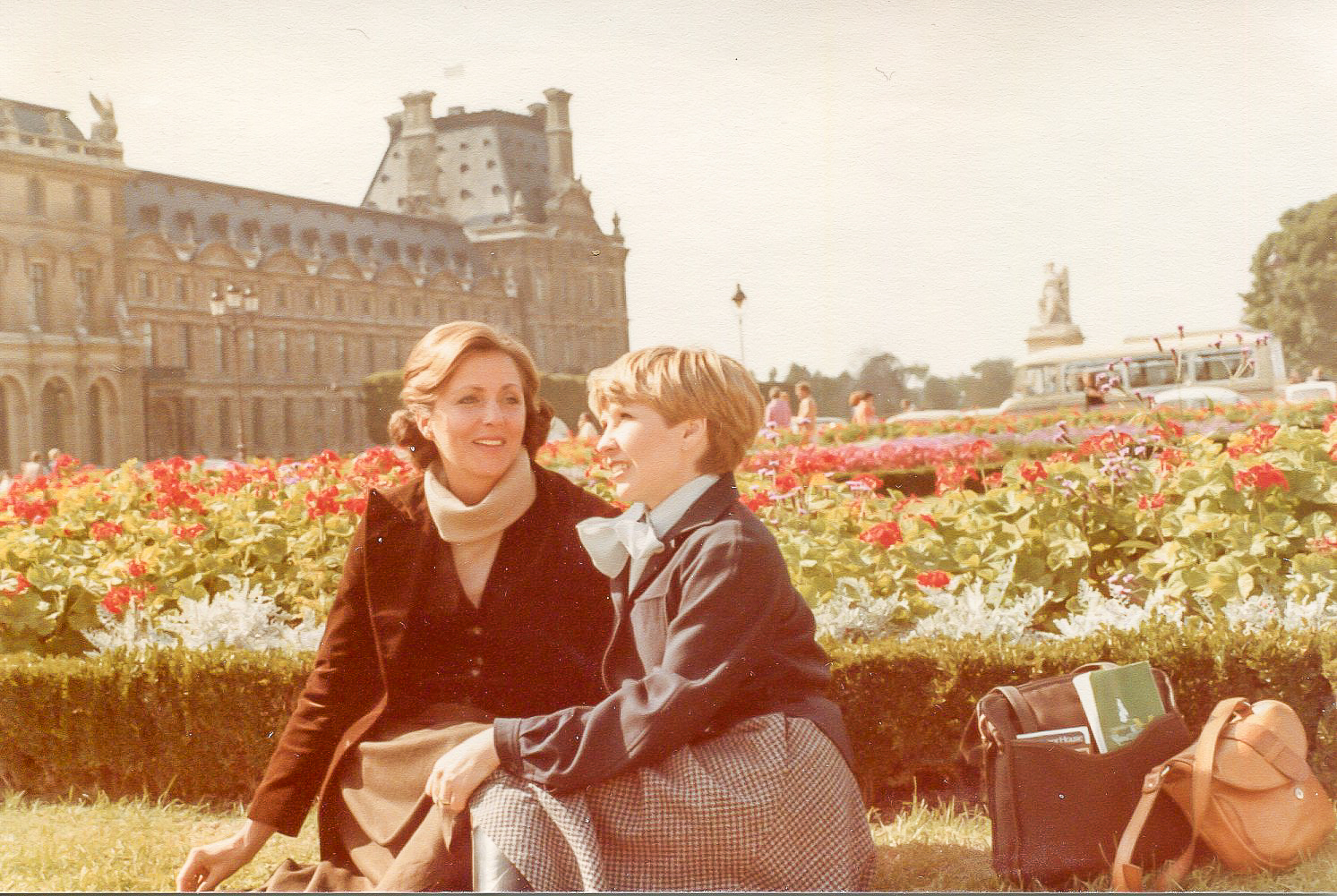
Sheila Bradley and I in front of the Louvre in Paris
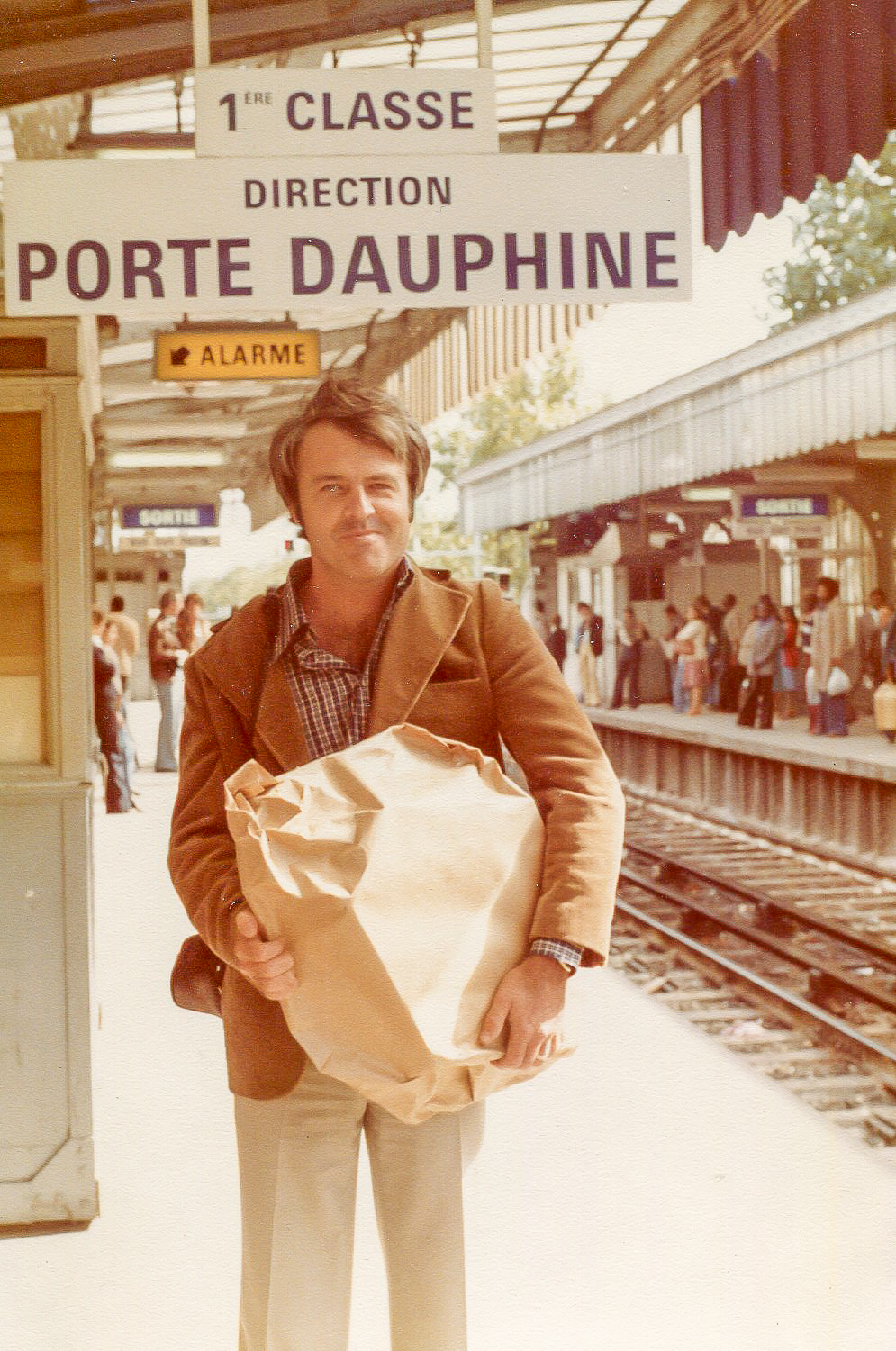
Ed in Paris with Sheila’s clock
We also visited Paris with many different couples – Ed and Shelia Bradley on one occasion and another with Colleen Remsberg. The highlight with Sheila and Ed was the flea market where Sheila purchased an antique clock – not a small one – that Ed had to drag around the city for the rest of the day, perpetually looking for a place to set it down so that he could rest his weary arms. “True devotion” we teased!

Colleen Remsberg and I having lunch at a Parisian cafe
Colleen who accompanied us on one of Bob’s business trips mostly remembers the opulent Michelin restaurant Ledoyen not so much for its food – which was amazingly delicious – but for the bill. The three men who were dining with us decided to play a trick on Colleen and had the waiter present her the bill pretending it was her treat. I will not forget the look on her face when she read it! Pure shock!
Paris is just one of those cities I would visit time and time again – both during my time in England and after. Having a latte at the Caffe Deux Margot (famous as a hangout for the likes of Ernest Hemingway and Pablo Picasso), or walking along the Seine after a pate and baguette lunch at L’Ecluse, a cozy little wine bar that my friend and mentor Leslee Reis introduced me to is always a thrill. It is a city where I can always still find something new – sites and restaurants and museums that I discover with each visit and can’t imagine how I missed them the first time!
VENICE
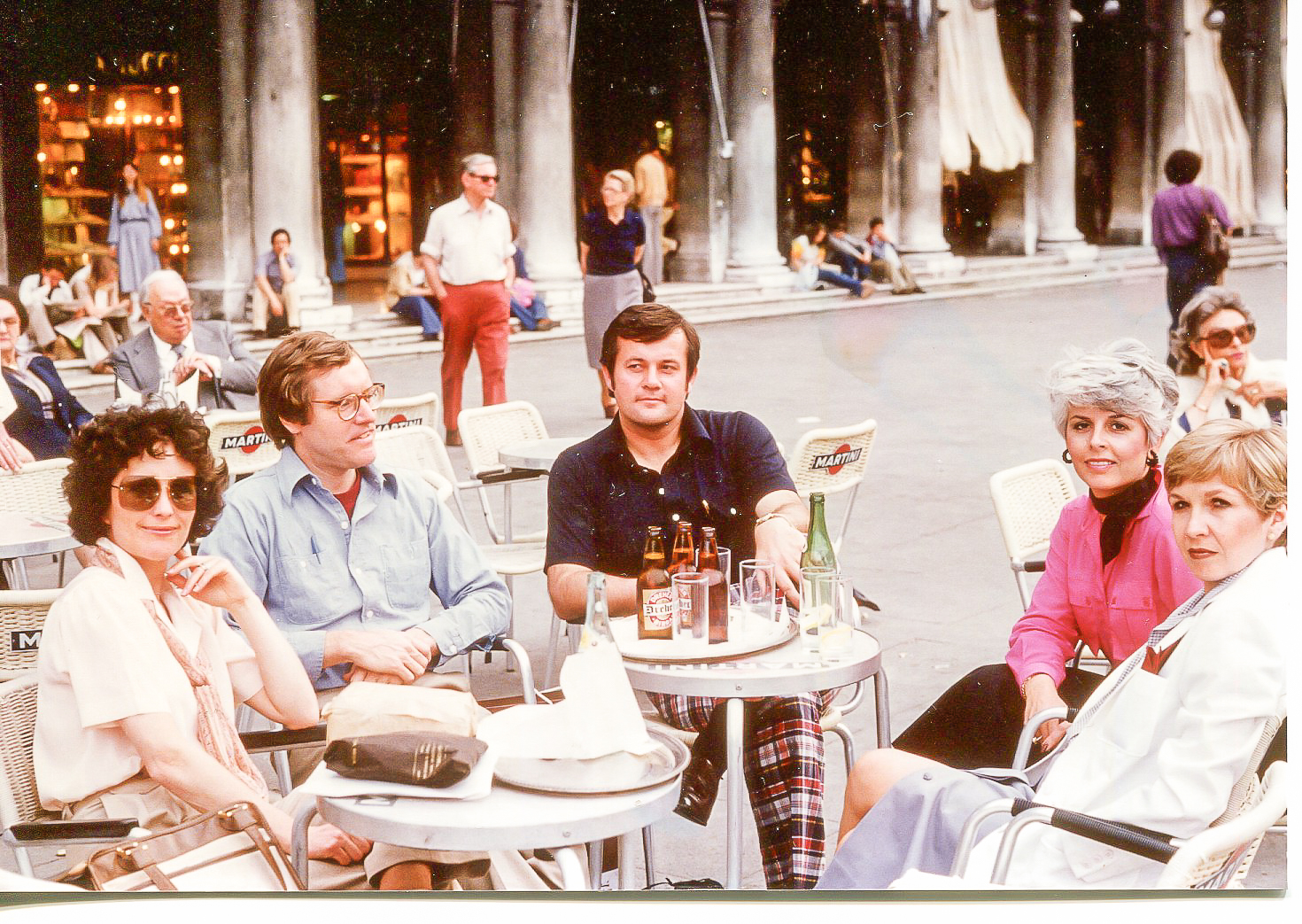
Barnettes and the Nahsers in Piazza San Marco, Venice
Venice was yet another city I found myself enthusiastically returning to. Our first trip was one rainy April when we took our kids there during one of their breaks from school. Piazza San Marco was flooded, but despite having to cross the piazza on wooden planks, Venice still presented itself as one of the world’s unique cities. The very next year I would enjoy Piazza San Marco in the sun with good friends from back home – Ron and Mary Nahser and Joe and Charlene Barnette – enjoying a glass of Prosecco in front of the famous Caffe Florian, the oldest operating cafe in Italy…and actually the world. Mary remembers having a most divine liver dish called Fegato alla Veneziana (Calf’s Liver Venetian style) at Ristorante Antico Martini, a clubby, old world romantic restaurant close to Teatro La Fenice, the famous Venice theater. Even non-liver lovers sometimes enjoy this dish of thinly sliced liver with gently stewed onions. My favorite accompaniment is with soft polenta.
I have been fortunate enough to visit Venice in every season and no matter what weather conditions– rain, sleet or sunshine – its magic always shines through.
***************************************************************
With each succeeding trip, my culinary education would continue to deepen throughout my three years in England. And just as Bob’s transfer to London years before allowed me to begin this journey, his promotion would accelerate it. When Leo Burnett moved him from Managing Director of London to Managing Director of all of Europe, he decided that the agency would benefit greatly from frequently getting all of the European managing directors together in one room to discuss agency strategy. Each meeting would be held in one of the European cities where the agency had offices, and since spouses were included, my culinary education would also benefit from these conferences. While the men sat in windowless rooms discussing agency business, I had the privilege of wandering city streets, visiting museums and – most importantly for my education – having a lunch or a coffee in one of its cafes, all the while soaking in the culture of each unique city.
Every conference had its own personality. Organized by the Managing Director of the host city, the goal was always to conduct company business, but at the same time, to expose the conference attendees to the food, the wine and flavor of their city. The events were usually grand affairs featuring local cuisine and always attempting to outdo the previous meeting. We enjoyed everything from Spanish Tapas on gloriously sunny Costa del Sole in Andalusia; Wiener Schnitzel and Apple Strudel in Vienna; Foie Gras, Duck a l’Orange and Millefoie in Paris; delicious risotto at gorgeous Villa D’Este on Lake Como, Italy and good old hearty Roast Beef and Yorkshire pudding in my adopted hometown of London.
One of the most memorable conferences for me was held in Italy organized by Milano managing director Paolo Volpara who – unbeknownst to me at the time – would eventually become my partner in business and lead me on the culinary adventure of my lifetime. Although I had visited several cities in Italy before these Italian conferences – Rome, Florence, Venice, Verona as well as many of the little towns of the Italian Riviera – the regional aspects of Italian food were still new to me. I had barely an inkling of the great diversity in all of Italy’s 20 regions. But I was soon to get my first lesson from Paolo.
I connected with him immediately. Not only was he smart and charming, but he also had a fantastic sense of humor, my favorite quality in both men and women. This particular conference was held in Taormina, Sicily at the San Domenico Palace Hotel, an elegant Renaissance–inspired hotel with views of Mt. Etna and the Bay of Taormina. I sat next to Paolo at dinner the first evening of the conference. After professing my interest in all things culinary, Paolo pointed out that our menu for the evening featured many typical Sicilian dishes. When I inquired why those were different from Italian dishes in general, what ensued was our very first regional discussion. “Italy is not all spaghetti and meatballs,” he began.
He pointed out that one of the dishes on the menu that evening was particularly representative of the region we were in– Sicily. All 20 regions had been influenced by different factors: geographical position, proximity to surrounding countries and certainly the history of the region (who invaded, and who stayed – all factors that helped to develop each region’s identity). The dish he was referring to, Spaghetti with Broccoli Rabe and Olives, revealed a North African influence. Its ingredients, golden raisins, anchovies and black olives, can be found in many North African Moroccan dishes. Sicilian cuisine, I was learning, has been greatly influenced by many different countries – from North African nations to the Middle East. What an exotic region! And the home of the Italian mafia as well!
All of this fascinated me, and the opportunity to combine two of my favorite things – history and food – was irresistible.
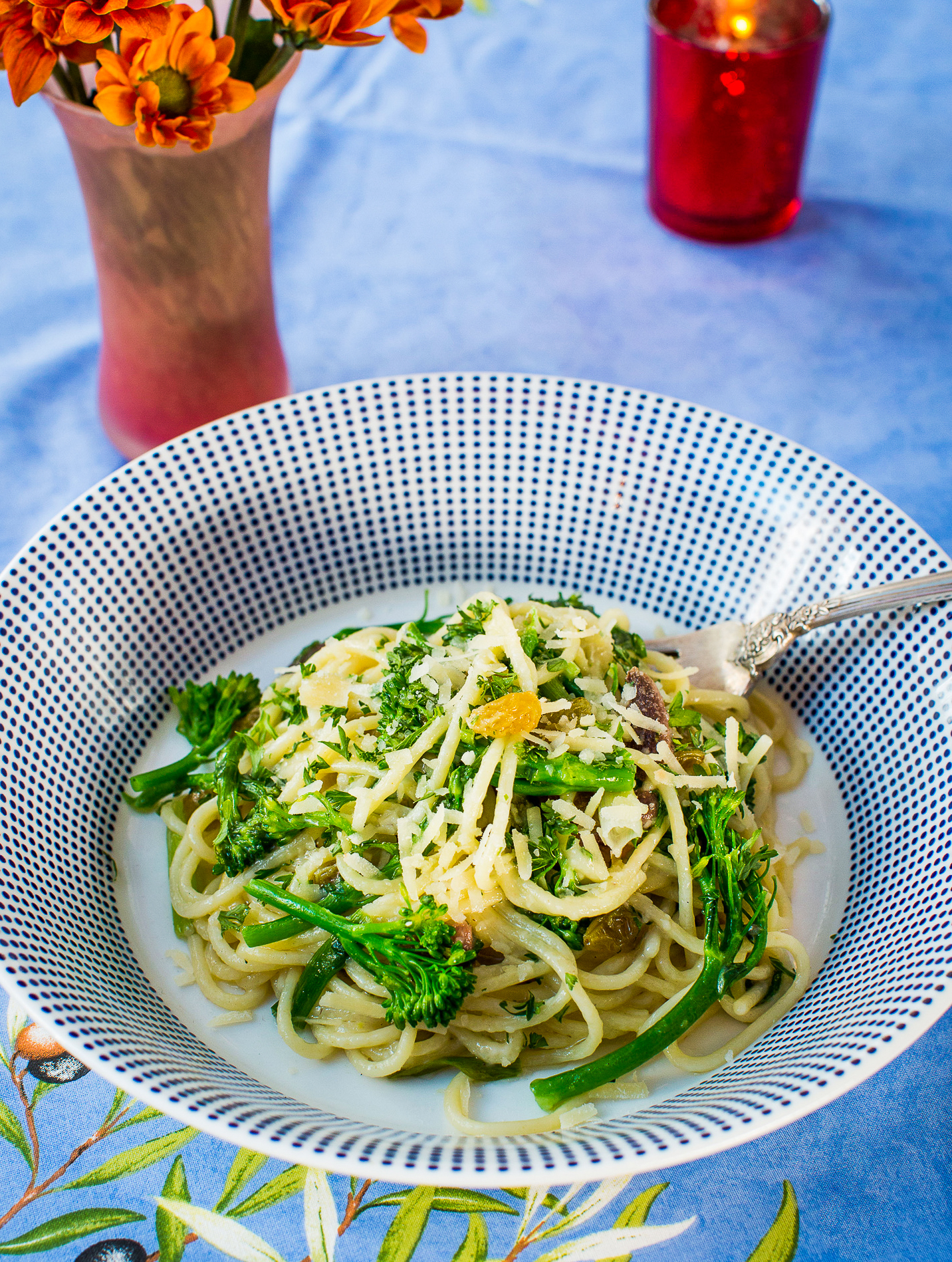
© rob warner photography 2020
Spaghetti with Broccoli Rabe and Olives
Serves 41 ¼ pound broccoli rabe, stems cut into pieces and florets separated –steamed al dente and set aside
¼ cup olive oil
1 large shallot finely diced
1 clove garlic, minced
4 anchovy fillets, chopped
20 oil-cured pitted black olives cut in half
3 tablespoons golden raisins
½ cup chopped parsley
salt and pepper1-pound spaghetti cooked al dente
3 tablespoons grated parmesanHeat the olive oil over medium heat. Sauté the shallots and the garlic for approximately 1 minute. Add the anchovy pieces and stir into mixture. Then add the olives, raisins and parley. Sauté briefly. Add cooked broccoli rabe, salt & pepper. Stir until heated. Mix with the cooked spaghetti. Top with grated parmesan.
***************************************************************

Paolo and I forming our partnership in Glencoe living room
It was shortly after these conferences that we moved back to Chicago, thus ending my three incredible years in England where I not only learned about English cuisine, but the cuisine of many other European countries. My recipe files and my understanding of cultural diversity expanded exponentially during this time. Travel most certainly broadened my horizons, setting me on a path that would eventually lead me to a career in the business of what I love most – the business of food and wine. Paolo’s and my partnership would form shortly after I arrived back in Chicago.
But more than anything, my three years of living abroad fundamentally changed me and the way I thought about and related to the world. My Living in another country gives you a new perspective about all kinds of things. It challenges old habits and entrenched belief systems by compelling you to consider other ways of doing things, other ways of thinking. Travel does the same thing, but on an accelerated timetable. It expands your mind in ways you never thought possible, by introducing you to things you had never imagined existed. My years living abroad and the extensive travel that came with it was a gift that continues to enhance my life every single day.

Wonderful !!!!!!!
Hello darling!
Are you sitting down? Take a deep breath!
IM MOVING TO CINCINNATI this summer/autumn!!
Milder winters. Robust young city. My long time pal, writer, author, UCLA teacher on-line, and his sister have bought a house together in Dayton (45 mins), so I decided to permanently escape these winters and not have to go to MX for 4-5 months. Maybe go away in January some warmer place.
Have you recovered. Surely you’ll stop crying soon 😇
Sent from my iPhone…
>