
Almost immediately after my move to England I became entranced by the customs and festive events of the British people. The rich tapestry of ritual and tradition deliciously woven into all aspects of the country’s social practices captured my imagination and became an inspiration to my own way of entertaining.
One of the first English customs I fell in love with – one that was filled with delightful ritual – was afternoon tea. Shortly after my move to England, one of my husband’s associates invited me to tea at The Claridge, a Mayfair hotel considered by many to be the epitome of timeless elegance. She had been “assigned” by my husband’s office to be my “international relocation guide”, to help me ease into and acclimate to the many challenges of living in a new country.
We met at 4 pm, the proper hour to “take tea”. Sitting amidst the plush old-world décor at The Claridge – the London hotel most closely aligned with British royalty and often referred to as an annex to Buckingham Palace – I was feeling rather out of my element. Enchanted as I was with all things British, proper tea etiquette was at this point beyond me, as were most of the English customs I had thus far encountered.
Fortunately, my hostess sensed my anxiety and turned our conversation into a light-hearted discussion about the English penchant for manners and socially appropriate behavior. “We British,” she began, “can sometimes take the idea of being ‘proper’ to an extreme, as in the rules for ‘proper’ tea etiquette.” She laughingly went on to describe examples of those extremes – behavior that would be considered gauche if not adhered to. “Never blow on your tea to cool it down”. “Do not cradle your teacup in your hands”. Even more horrid; “Unless your tea party is very informal and you are somewhat of an idiot, dunking biscuits in your tea is a complete no, no.” But my favorite was the rule regarding the actual stirring of tea. “To be done properly, the teaspoon must move through the tea in an up and down motion. Never in a circular movement”.
Describing these British idiosyncrasies out loud even made my host laugh and we quickly transitioned to an animated conversation comparing life in the UK and back in the US, followed by me questioning her about recommendations for shopping, restaurants and the great London theatre scene that I had heard so much about. However, when our tea was delivered to the table, it was back to business. Rules were followed, mistakes were made and tea was (eventually) drank, but ultimately my hostess had to admit that even though she often ignored many of the pedantic rules of tea etiquette, she did pay attention to proper management of tea accompaniments; “milk is only added after the tea is poured, never before,”she stated. “Sugar is added last. And never combine milk and lemon as it will curdle.” Would I ever be able to just relax and have a cup of tea? She assured me I was already well on my way.
As usual, I felt compelled to learn more. According to James Joyce, the Irish writer and poet, “There are few hours in life more agreeable than the hour dedicated to the ceremony known as afternoon tea”. Served around 4 pm it was originally intended to fill in the long period of time between lunch and dinner when the later was not served until 8 pm or later. In the 1840’s, according to legend, the Duchess of Bedford was the first to create a more formal and elaborate tea, which included not only a pot of loose-leaf tea (never teabags) with milk and sugar but also more substantial and “fancy” foods like scones, dainty pastries and crust-less sandwiches. And all served with great style and decorum.
I so loved this post-lunch ritual I found almost any excuse to invite friends for tea. It turned out I already had a tea table – a mahogany one – which before my move to England had served as just a table between two love seats but now was put to use in its intended capacity. Soon it became the centerpiece for my own personal afternoon tea ritual; the surface on which I placed little plates of finger sandwiches, sweets, teacups, my new china tea strainer and an English bone china pot of brewed tea all snug in its newly purchased Tea Cosy (an adorable little teapot sweater that keeps the pot insulated and the tea warm) – all the accouterments of my burgeoning tea service collection.
There was no end to my teatime fascination. I even ensnared unsuspecting people into my “teatime web” like the young man who was dropping off fabric samples from the company I hired to make kitchen curtains. Looking back, I can only imagine his total surprise at finding himself sitting across from me sipping tea and nibbling on a crust-less cucumber tea sandwich. “Who was this crazy American lady”, he must have been thinking.
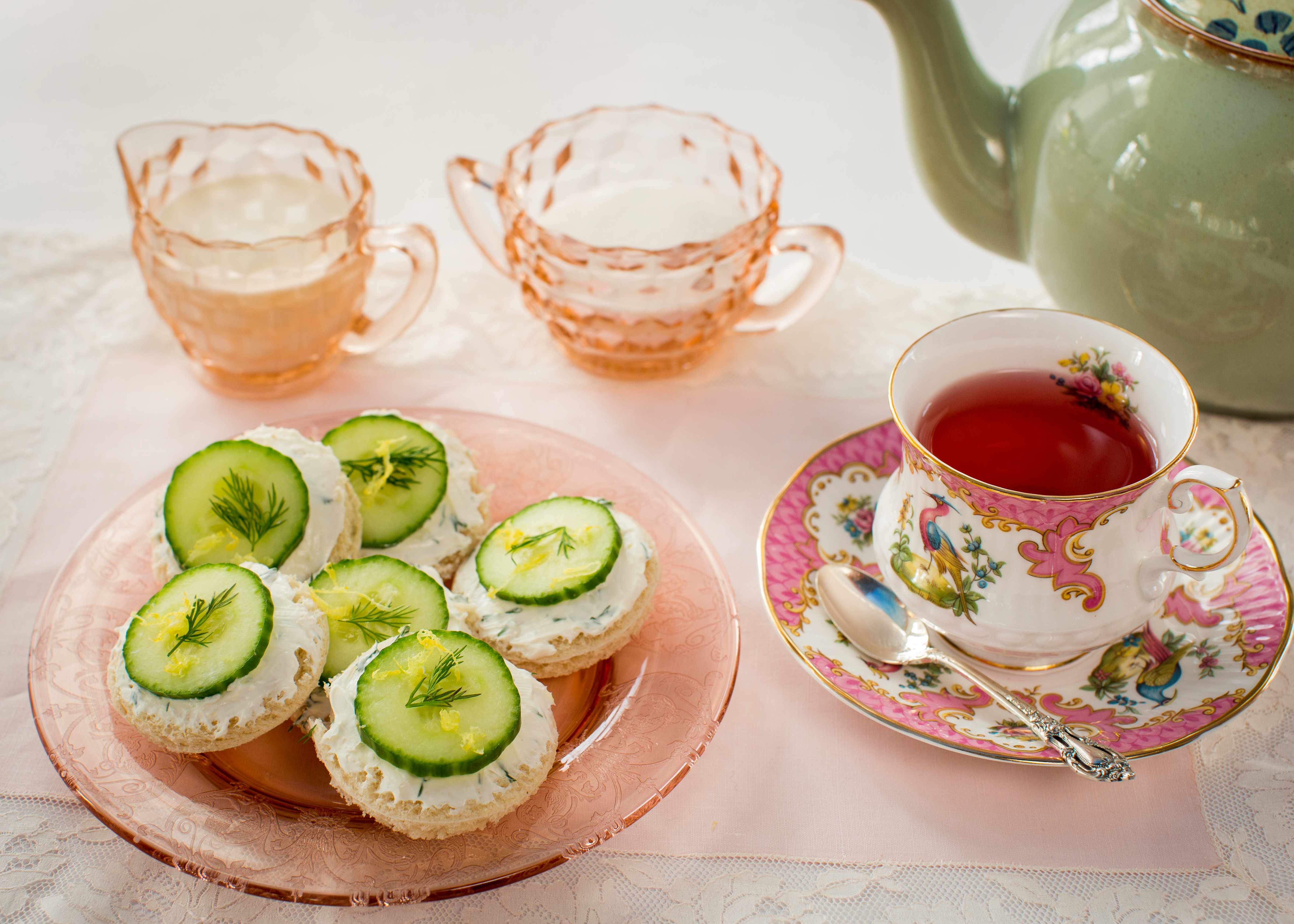
I did not always have appropriate little sweets on hand for these spontaneous teatime occasions, but I usually had the ingredients for finger sandwiches. I could easily whip up egg salad or tuna salad to spread on little cut out squares or rounds from the bread I used for my kid’s lunch sandwiches. I usually also had cucumbers – one of my favorite salad ingredients – on hand. Most of the time I stuck to the traditional cucumber tea sandwich spreading little bread rounds with butter then placing a thin slice of cucumber on top. Totally simple, but somehow totally delicious! But when I had the time and the occasion was not so spontaneous, I would make something a little more complicated like a lemon-dill-cucumber sandwich.
© rob warner photography 2020
Lemon Dill Cucumber Sandwich
Servings 10 – 154 ounces cream cheese
2-tablespoon yogurt
1 tablespoon lemon juice
½ teaspoon lemon zest
1 tablespoon chopped dill
¼ teaspoon white wine vinegar
¼ teaspoon sugar
salt and pepper to taste
1 English (unpeeled) cucumber cut into thin rounds
fresh dill (for garnish)
extra lemon zest (for garnish)White or whole wheat thinly sandwich bread. Using round biscuit cutter or small glass (approximately 2 inches in diameter). Cut bread rounds inside crust area. (Do not include the crust) Set aside.
In a bowl, mix together the cream cheese, yogurt, lemon juice, lemon zest, dill, vinegar and sugar. Mix well until smooth. Add salt and pepper to taste.
Spread rounds with cream cheese mixture. Place one cucumber slice on top. Garnish with a piece of dill and sprinkle with more lemon zest.
***************************************************************
I also became a “tea sleuth” of sorts wandering the streets of London searching for the best afternoon tea locations – oases of Britishness where I could take my visiting American friends to experience this most quintessential of English rituals. After considerable research (of which every moment was savored), I decided the Ritz Carlton, Fortnum and Mason, the Connaught Hotel and The Claridge were my favored locations.
In the end, however, The Ritz Carlton became my tea salon of choice. I couldn’t resist its glittering chandeliers, elegant mirrors and sophisticated ambience. Most days a pianist and harpist provided the afternoon soundtrack to the Merchant-Ivory movie I was starring in, as a formally dressed staff presented a bounty of bespoke pastries and finger sandwiches on handsome three-tiered silver trays. In addition to my favorite cucumber sandwiches, I also became enchanted with the dense – and impossibly crumbly – scones that were invariably accompanied by Clotted Cream (also known as Devonshire cream) and Fruit Preserves.
Clotted cream is amazing. It’s as if a thick rich cream was blended with an equally rich creamy butter. To me it is the height of decadence even more so than chocolate. And then to make the occasion even more indulgent, a glass of Champagne elevated this very elegant British tradition to what is referred to as a Royale Tea. Oh my! I so love this tradition that I have continued my tea party obsession to this day.

My sisters Joan and Karen treat me to a birthday Tea at Fortnum and Mason
I consider my years of living in England as my fancy time – my fairytale years – and the insatiable appetite I had for new tastes and new experiences was never more completely fulfilled than during the British social season. The Season as it is referred to in England, takes place from Spring to the end of Summer and includes an array of prestigious events such as the Glyndebourne Opera Festival, The Chelsea Flower Show, Royal Ascot, Wimbledon, the Henley Royal Regatta and more. The attention to detail in all aspects of each venue – including the food, the beverages, the fashion and the rituals – was awe-inspiring.
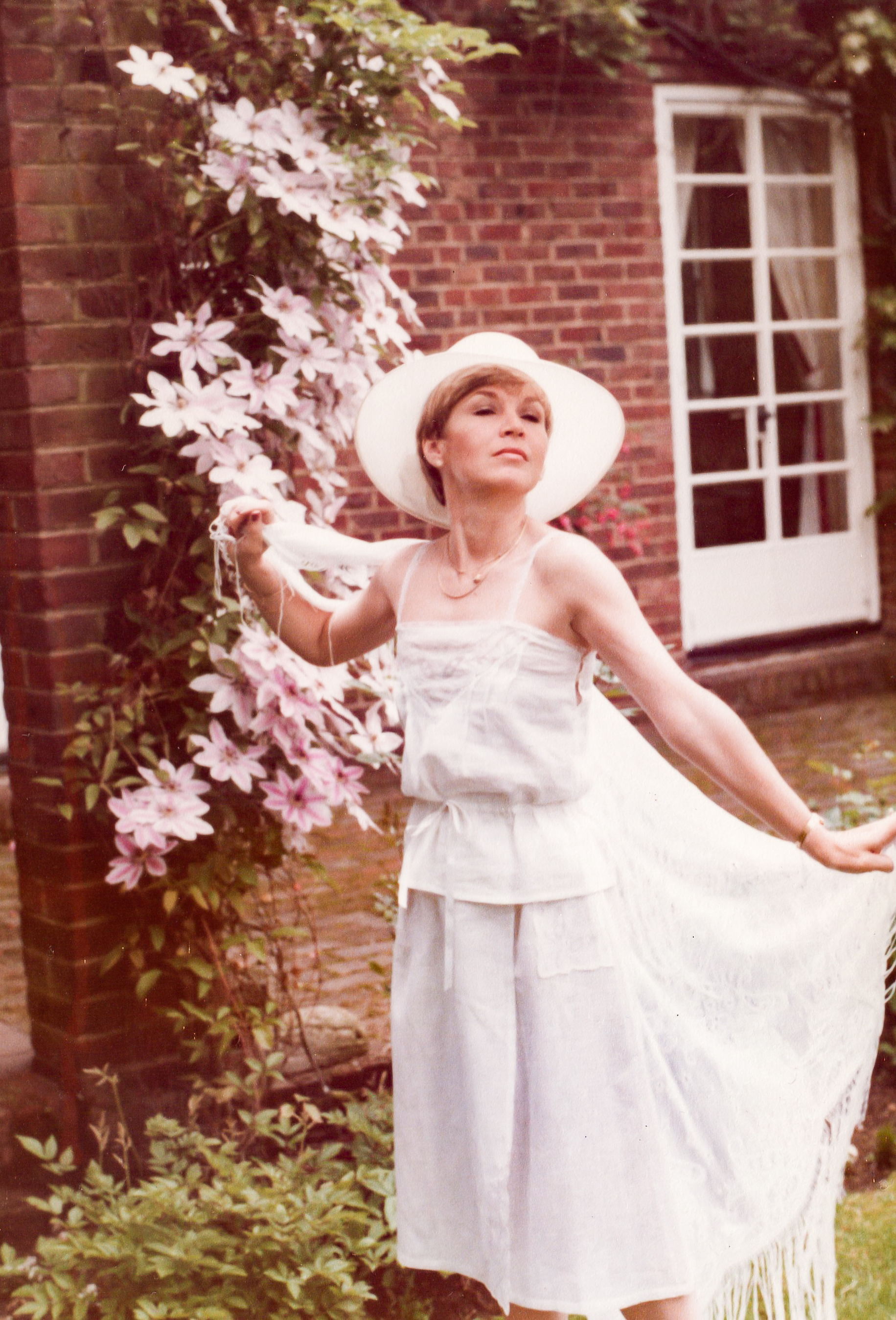
Nancy ready for The Season
Glyndebourne is the English country estate that has hosted an annual summer opera festival in East Sussex since the early 1930s. And it is the perfect example of these mythical Season events that so entranced me. Initially, operas were performed in the house itself, but quickly the event became so popular amongst the British social class that a separate free-standing opera theater was built on-site. Because the theatre is small, there are simply no bad seats and the intimacy and splendor of the event is enhanced at the long intermission where operagoers dine in one of the several glorious restaurants spread around the equally glorious grounds. The restaurants are distributed across the sprawling estate, set amongst fountains, reflecting pools and rolling lawns resplendent with an exuberance of flowers, bushes and flowering trees.
We attended several different operas over our years living in England, but none was more memorable than the one with good friends and opera aficionados Janet and Paul Alms. They had been decades-long subscribers to the Lyric Opera in Chicago, had travelled to New York City to attend operas at the Met, and had timed their visit to the UK to coincide with Glyndebourne. As opera savvy as they were, they always considered this particular performance of Verdi’s Falstaff performed in this incredibly gorgeous and intimate setting one of the pinnacles of their operatic experiences.
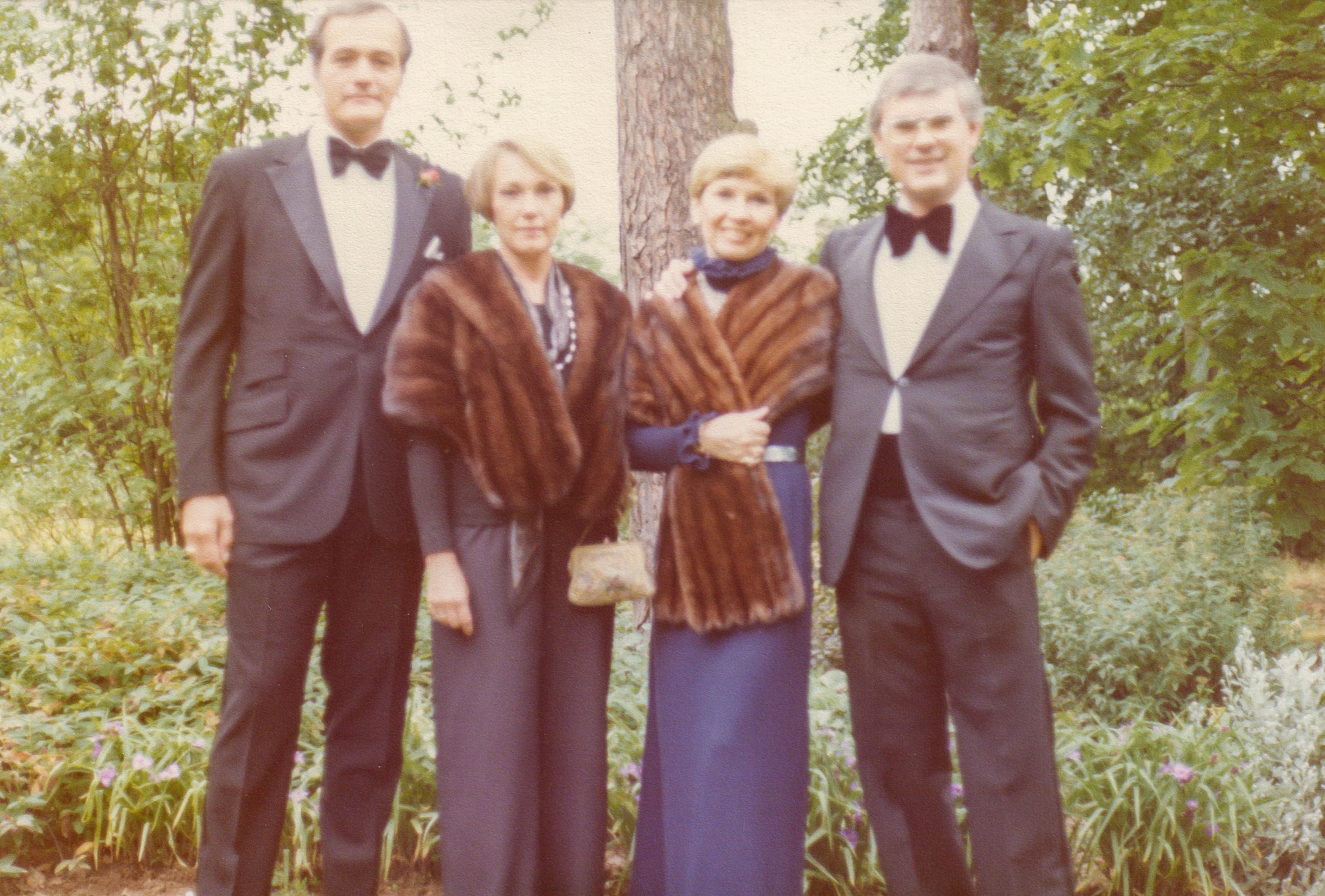
Paul and Janet Alms with Bob and I before Glyndebourne
Though there is no official dress code, formal attire is customary at Glyndebourne, so most of the men wear black tie and the women either cocktail attire or long gowns. Janet and I chose the latter and even threw in a vintage mink stole for good measure. We felt – and unfortunately looked like – mid-Victorian era versions of our mothers. It was, however, in keeping with the spirit of the event and we had a sublime time. Of all the people who came to visit us in England, no one enjoyed the English “pomp” as much as Janet and Paul. Janet appeared “to the manner born” so to speak. Pomp brought out the peacock in her. And after all, she was a Leo, the sun sign known for their love of drama – bouncy show-offs with big hearts – so the vibe coming off her when we attended Season events together was pure, unadulterated joy. They actually attended three events with us – Glyndebourne, Wimbledon and Royal Ascot. Paul, the showman that he was, also loved the drama. A talented actor and singer who had starred in many an amateur production back in Chicago, Paul’s role-playing during these events was always entertaining. His affected British accent and exaggerated British manners were quite convincing, but we knew him for the down to earth guy he was, so his pretense at British royalty threw us into fits of laughter.
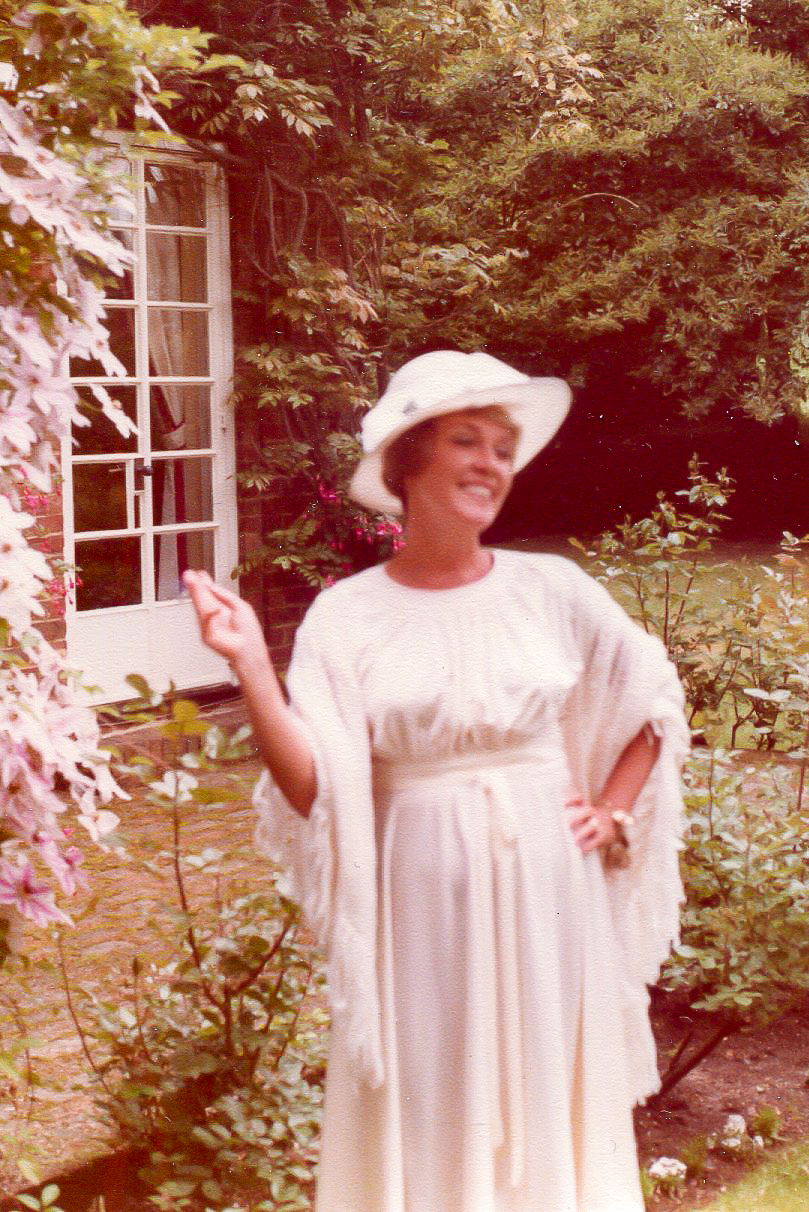
Janet Alms: “to the manner born”
***************************************************************
Intermission at Glyndebourne is also quite spectacular. You either dined in one of its three restaurants or picnicked on the estate’s splendid grounds out of picnic hampers most likely packed by one of London’s famous food stores like Harrods or Fortnum and Mason. Given England’s unpredictable weather, we always chose one of its rain-protected restaurants. Every dish I ever ordered was reliably delicious but the most memorable part of our dining experience – the piece de resistance – was the formally clad and incredibly efficient waiters who served the food wearing pristine white gloves adding to the complete majesty of the whole Glyndebourne experience.
My menu choices most always included some combination of salmon with a cucumber salad; two items I still to this day associate with The Season.

© rob warner photography 2020
Grilled Salmon with Cucumber Dill Salad
Salmon
4 (6 ox.) fillets, skin on
extra virgin olive oil
kosher salt
freshly ground black pepper
Cucumber –Dill Salad
1 English cucumber
¼ cup finely diced shallot
½ teaspoon salt
1/3 cup sour cream
2 tablespoons white wine vinegar
¼ cup chopped fresh dill
½ teaspoon sugar
freshly ground black pepper
fresh dill sprigs
Cut the cucumber in half lengthwise. Scoop out the center seeds the cut each section into thin slices. Place the slices with the shallots in a colander and toss with salt. Let sit for at least a half hour until the water from the cucumber is drained out.
In the meantime, combine the sour cream, vinegar, dill, sugar and black pepper.
When the cucumbers have been drained of water, pat them dry with paper towels. Add to the dressing and cover and chill until ready to serve.
Preheat the grill to medium high. Brush it lightly with oil so the salmon doesn’t stick. Rub the salmon with olive oil and season with salt and pepper. Place the salmon fillets skin side down and gill until golden brown – approximately 5 minutes). Turn the fillets over and continue grilled for done approximately another 3 minutes. Let cool slightly. Serve with the cold cucumber-dill salad piled over the salmon. Top with fresh dill.
***************************************************************
Wimbledon was another Season event I was lucky enough to attend. Having played tennis in the States for quite a few years as a young mom, I thought I knew all about it from faithfully watching the matches on TV. I knew it was the oldest tennis tournament in the world and that it was played on grass courts. I even knew that strawberries and cream was the iconic dish of the tournament. What I didn’t know until I stepped into the prestigious All England Lawn Tennis Club was the electrifying aura and atmosphere that permeated every square inch of what is often referred to as the Mecca of the tennis world. Certainly it was an amazing sporting event, but it was so much more than that. It was yet another example of the unparalleled way the British stage their unique and iconic cultural and social events. I am not an expert in sporting events in general. Nor have I attended that many but this one was so very civilized. Lovely, unobtrusive restaurants and food stands were scattered over the grounds and a sort of quiet, well-mannered atmosphere permeated pervaded throughout.
It was especially thrilling to watch the tournaments on Center Court or Court Number One, the two courts that held the most important matches of the day. Seeing the likes of Jimmy Connors, Chris Evert, John McEnroe and Bjorn Borg – no matter who won the match – was electrifying. In the seventies the Wimbledon dress code for the players was totally white. Now the requirement is “suitable tennis attire that is almost entirely white”. But still no shades of cream or off-white are acceptable. That code goes back to the nineteenth century and was put in place to insulate the genteel British spectators from having to witness any unsightly sweat stains, which are less apparent when an athlete wears white clothing.
Although there was no strict dress code for those attending the event and formal attire was not required as in many of the other Season events, my English friends recommended that dressing “smartly” was important – whatever that meant. “Smartly” may not be a definitive dress code but somehow I felt it was clearly conveyed in the clothing choices of Wimbledon attendees. Gentlemen for the most part dressed in casual but crisp lightweight cotton or tweed sports coats and women wore a variety of light blouses and skirts or informal, sporty dresses. Not a ragamuffin in the group. English manners, of course, were also on display. There was no tolerance for crowd participation, so shouting “Come on Jimmy!!” from the stand would get you a stern look and perhaps even a verbal scolding from the umpire. Instead, the crowd conducted themselves with a respectful silence during play and enthusiastic – but polite – clapping after each point.
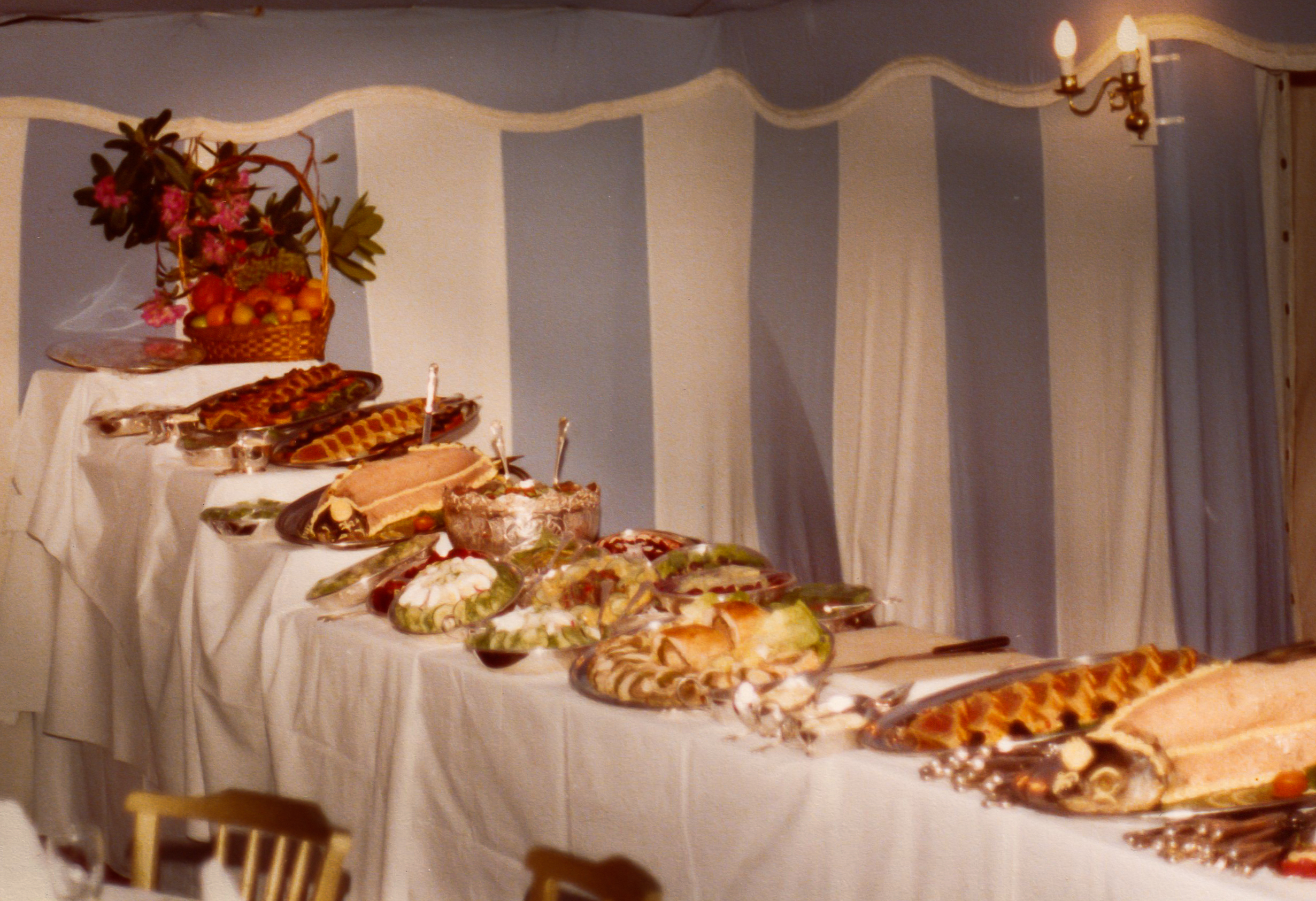
a fancy spread at our Wimbledon party
We loved this event – especially my husband Bob who all three years he was managing director of the London agency, used it as the perfect way to entertain clients. Who didn’t want to attend this iconic event? One year we rented one of the private Wimbledon tented restaurants and provided our guests with a catered lunch and another year we hosted a pre-tennis affair at our home in Oxshott. We were located only a half hour away from the tennis courts. Under a lovely blue and white tent set up near the rose garden on our grounds, clients and friends were invited to lunch on a selection of delicious salads and poached salmon concluding, of course, with strawberries and cream.
Far and away though, my favorite event of the Season was Royal Ascot. Ascot Racecourse is a British horse racing track located in Ascot, Berkshire. It is one of the leading racecourses in the United Kingdom. Races take place there on a regular basis, but Royal Ascot is the crown jewel; a four-day event that takes place every June. Each day the Queen and the rest of the Royals make a spectacular entrance at 2 p.m. in horse-drawn carriages down the racetrack and into the parade ring.
A highlight for everyone is getting a peek at the Queen and members of the royal family once they’ve retired to the Royal Box in the Royal Enclosure. The Royal Enclosure is a two-story-stand with surrounding grounds. To obtain admittance one has to either be a member or the guest of a member. It is the essence of Royal Ascot and an actual invitation into the Enclosure is a very sought after and difficult thing to obtain. Somehow Bob always managed to get one. Here men are required to wear traditional morning dress: black or grey tailcoat, striped trousers, a waistcoat and a top hat, even if it is boiling hot. The dress code for women is not as strict, but they must wear a dress or pantsuit and of course, a hat.
Royal Ascot was different from many other events of the Season in that the general public was also invited. A large portion of the grandstand has no particular dress code, but still – in a confirmation that even the English working class is not above the observation of etiquette and tradition – most of the women still wear “fancy” hats, the signature of Royal Ascot. Gawking at those hats – some outlandishly gorgeous and some just plain wild – was always a thrill. The horseracing I hardly noticed. The best part was playing dress-up and watching the rest of English society swagger and preen. So each year we would don our formal attire and hobnob with fancy folk while watching – or pretending to watch – some of the most thrilling thoroughbred racing in all of England. At some point during the races we would head down to the railings to be as close to the racing as possible – just like in the scene from My Fair Lady. We always brought guests – either English friends or visiting guests from the U.S. And always, I left feeling like a little kid who had just gone to the best dress-up party of her life.
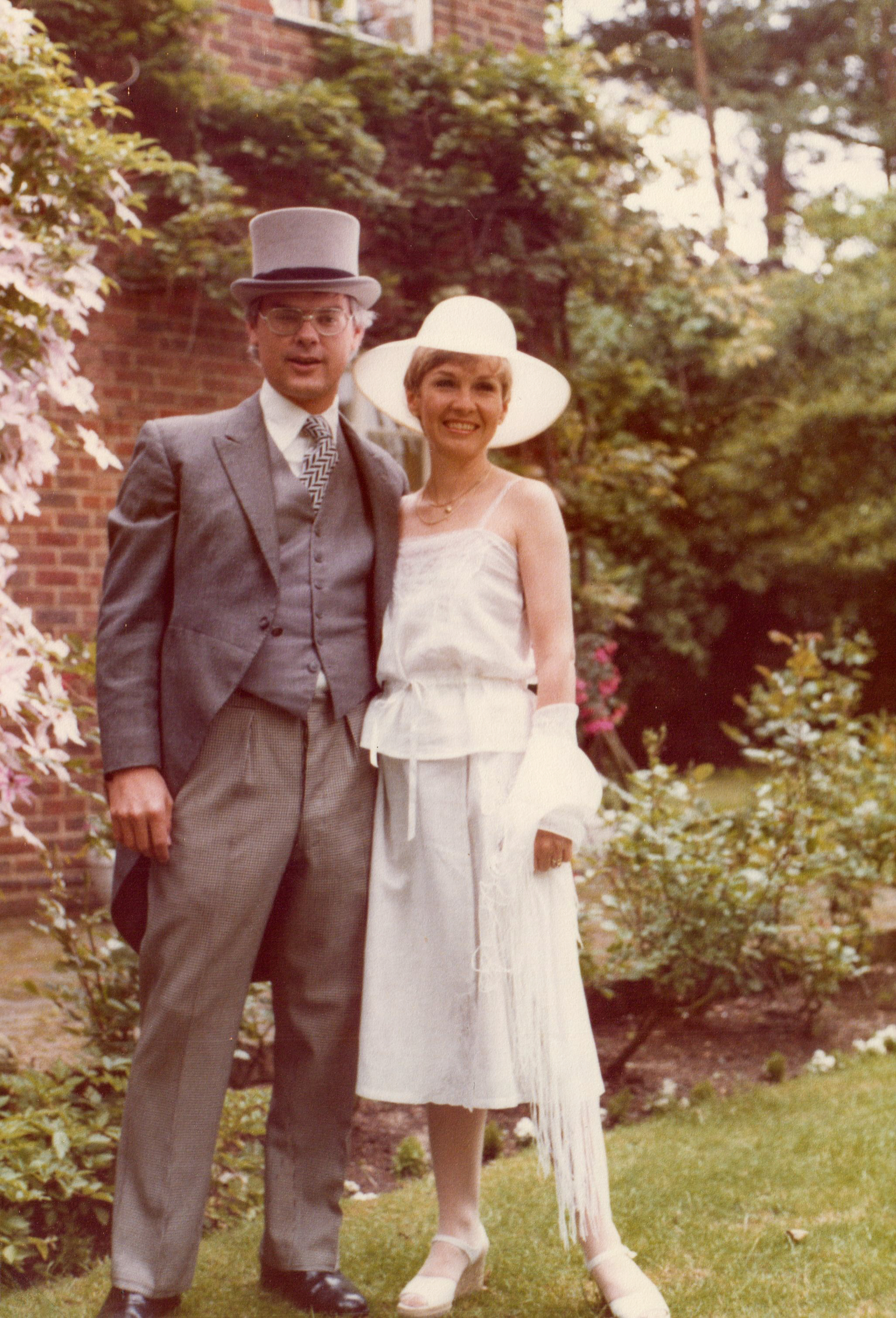
Bob and I ready for Royal Ascot
As with all Season events, lots of different foods are available in the many stands and restaurants throughout the grounds, but it is a beverage that I think of when I recall this glorious event. Champagne is to me the drink that most matches the prestige and gravitas of Ascot. And of course, I felt obligated to indulge.
For centuries The British have provided the world with a template for formal entertaining. I especially loved reading books about the Edwardians whose lavish soirees were quite something to behold serving sometimes up to twelve courses at their most elegant, marathon dinner parties. In recent years the TV series Downton Abby told the story of a wealthy 20thCentury aristocratic family – the Crawleys – during England’s Edwardian period. On occasion the series highlighted a typically grandiose Crawley dinner party where elegantly clad diners (a dowager or two can always be spotted wearing a diamond tiara) are seated around a flawlessly set table resplendent with tall slender candles in the multiple arms of silver candelabras alongside artistically arranged flower centerpieces in all their magnificent glory. Sparkling crystal, plate after plate of elegant bone china and a confusing amount of silverware are always in abundance. As were the many servants – usually outnumbering the guests.
I was certainly not interested in serving twelve courses at my dinner parties, nor did I have even one servant to tend to the details of such an event. No tuxedo-clad footmen were around to fold the napkins in the Bishop’s Miter style (like a bishop’s hat) or to use their Butler Stick to measure the distance from the edge of the table to the glasses, salad and bread plates. In fact, the idea of even sitting through a twelve-course meal is not remotely appealing to me (a good friend once named these-type of marathon dinner parties as “dinner jail), but I loved reading about them. It was like reading a fairytale book for adults.

Dinner party at our Oxshott home
My dinner parties were, of course, far less elegant and certainly not as formal. But…I had learned to pay attention to details. My menus at the time consisted primarily of French dishes. Before I move to England I had spent a lot of time learning to cook Chinese food through classes and Italian food via my mother-in-law, but I eventually began to focus on French cuisine once I met the woman who would become my close friend, Leslee Reis (My Journey Into The Kitchen “Beginnings”). So, it was recipes from either the Julia Child’s book “Mastering the Art of French Cooking” or ones I had collected from Leslee’s French cooking classes that dominated my early dinner parties. Usually I served four or five – maybe six courses beginning with drinks and appetizers in the living room then once seated, an amuse-bouche or soup, followed by a main course, then a sweet and finally concluding with a cheese course.
I often chose soup for my first course, because, well…soup was easy! I had already prepared it earlier in the day and all that was left was to reheat it and ladle it into serving bowls. Vichyssoise was a recipe I used frequently. I liked its versatility. In warm weather it could be served chilled and in cold weather warmed. Leslee’s recipe for Vichyssoise au Cresson is delicious. Not only does it produce a smoothly silky soup but also the addition of watercress (cresson) gives it a slight peppery accent and its lovely green color. According to Leslee it wasn’t actually a French recipe though. A chef at the Ritz-Carlton in New York originally invented it in the early part of the twentieth century. However, that chef, Louis Diat, was French so – as she laughingly stated – who gets credit?
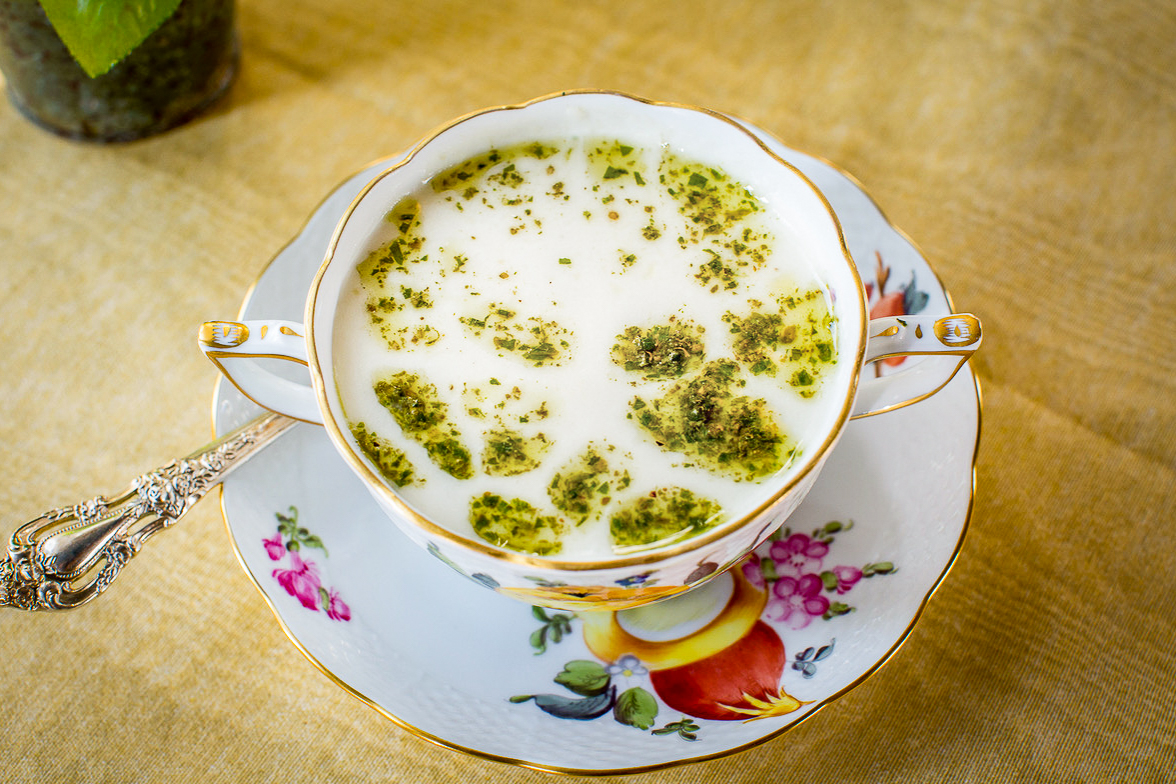
© rob warner photography 2020
Vichyssoise au Cresson
Makes about 7 cups4 leeks
1 medium onion
2 Tablespoons butter
4 medium boiling potatoes, sliced 1/8 – ¼ thick
3 cups chicken stock
1 teaspoon salt (or to taste)
1 ½ cup milk
1 ½ cups half and half cream
handful of watercress, finely choppedSauté the white part of the leeks and the onion, all thinly sliced in the butter until the vegetables just turn golden. Add the potatoes, peeled and sliced, chicken stock, ¾ of the watercress leaves and salt. Bring to a boil and simmer for 35 minutes until potatoes are very soft. Rub the soup through a fine sieve (or food mill), return to the heat; add the milk and half and half. Bring to a boil. Turn off heat and let cool. Rub again through h a fine sieve (or food mill) and chill. Sprinkle with the remaining watercress.
Cold version: you may want to add a little more salt
Warm version: reheat the soup slowly so that the cream does not change consistency
***************************************************************
Despite the fact that my menu was predominately French, I always ended the meal in a very proper English way with the bold flavors of a glass of Port and a small wedge of Stilton. The finest English Stilton is creamy with a subtle, yeasty sweetness and a salty, nutty finish. When paired with a glass of port, it is heavenly. The sweetness of the port and the pungent saltiness of the Stilton is, in my opinion, one of the great wine/food matches in the world.
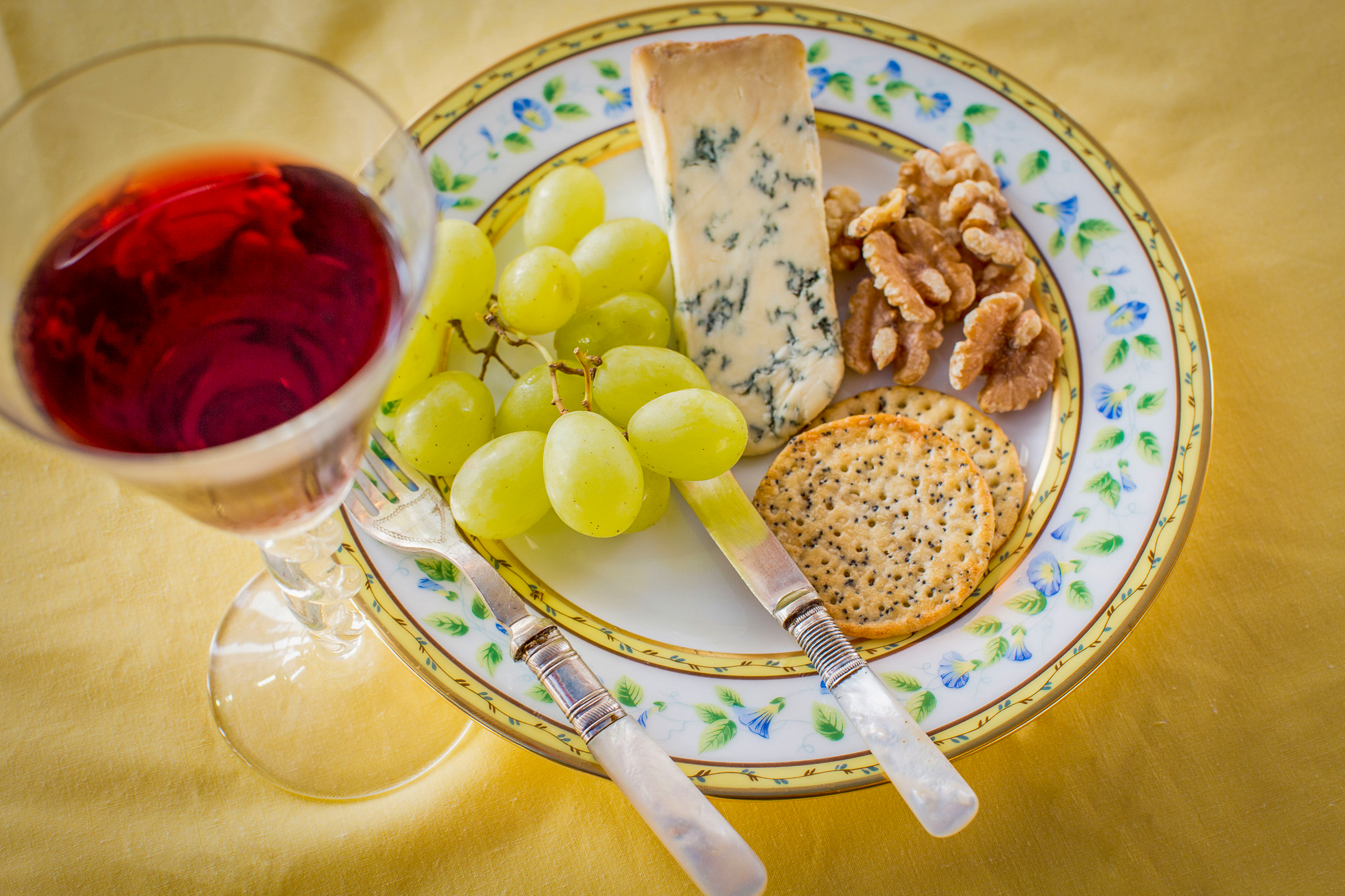
© rob warner photography 2020
Of course, for such an iconic English ending to a meal I had to have equally proper cheese knives and forks. My “antiquing friend”, Jean Barringer of Boston first introduced me to the Silver Vaults of London, a large subterranean market that housed shops selling a myriad of silver items. It was mind boggling to see the number of different pieces of silverware created for almost every food: there were soup spoons for bouillon, for cream soup and for heartier soups; specific forks for various salads, for escargots, for shellfish; knives meant only for particular cuts of beef, only for butter, only for cracking an egg . But since I already had a beautiful set of (generally intended) sterling silver flatware, I limited myself to acquiring a fine set of British cheese knives and forks. The cheese course was – and continues to be – my favorite dessert course, I was determined to find the perfect set. It was here in the Silver Vaults that I purchased them – slender forks and knives with beautiful pearl handles – old and somewhat wobbly – but to me, they were exactly what I was looking for.
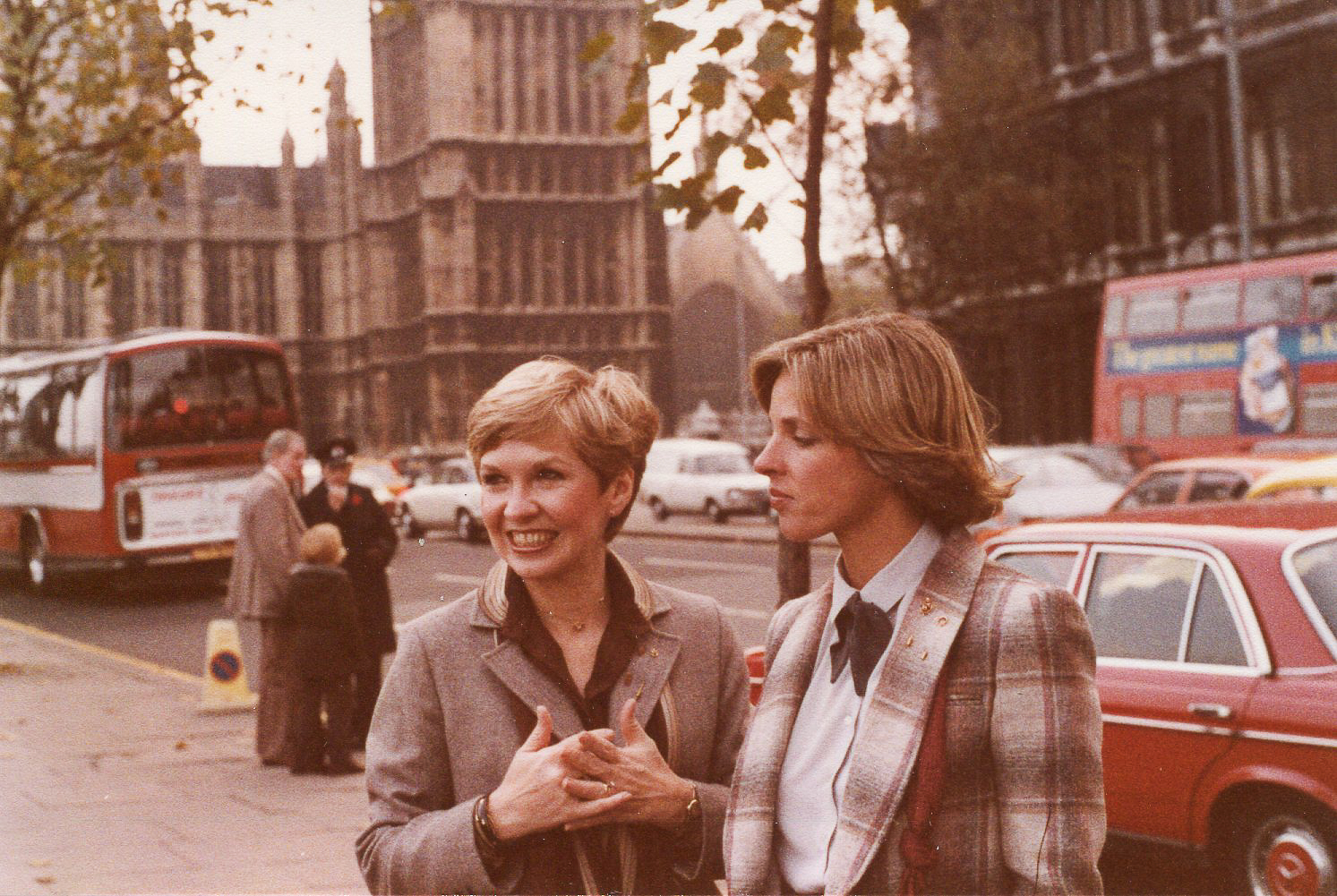
Jean and I on a shopping trip to London
As a small town midwestern girl, the whole English cutlery scene seemed overly complicated – the placement, the number of pieces and the shifting of the cutlery when a course was finished was truly over the top. Yet somehow it seemed to match the whole English entertaining scene. Maybe overly complicated, I still loved it – especially when performed by very formally attired waiters in the elegant country inns we so came to love. It was like performance art!
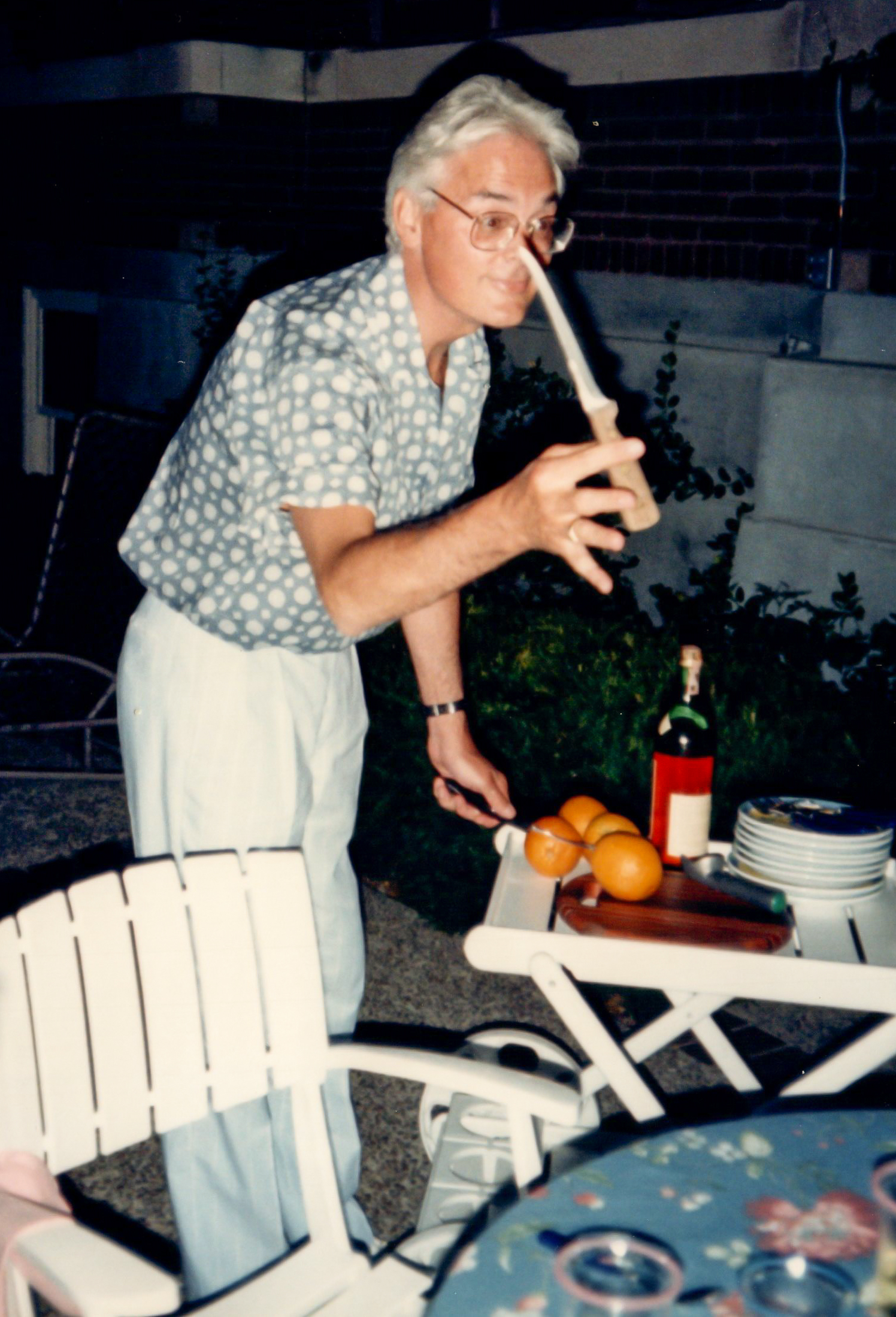
Bob with knife
This very theatrical “changing of the cutlery” became an act – a very theatrical and exaggerated comedy routine – performed by my then husband Bob at the end of our dinner parties. Right before the cheese course was served, he would very dramatically move the cheese knife and fork from the top of the plate where they had originally been placed, down to either side of the cheese plate. It was all done with great flourish and to the delight of not only our American guests but our British guests as well. The British fortunately, are known for their ability to laugh at themselves and I think they got a bigger kick out of it this routine than the Americans!
Whether it is a tea party, a dinner party or a large gathering, the attention to detail I learned so well during my English years, comes to mind when I am in the planning stages of any event. After I returned to the U.S. there was nothing discernably English in my entertaining – or in me for that matter. No English accent, no affected royal airs. I didn’t wear outlandish hats or white gloves when I served dinner. I didn’t have any more reserve or more of a stiff upper lip than before I moved to England. But I was influenced by the years I lived in England in a very profound way.
More than anything else that influence manifested itself in the process of preparing and executing all elements of a gathering – big or small, casual or formal. Through witnessing some of the most glittering, beautifully executed festive activities, I learned that the success of a dinner party, a tea party or really any kind of party or gathering is way more than the food being served. Whether it’s the guest list, the décor, the drinks or the food it is important to tie all elements together into one cohesive unit. If it’s casual, than be casual – if it’s formal then formal is the order of the day – or night.
I also came away from my years in England with a great respect for ritual and tradition. I had already established many family traditions before I moved there, but after England I added elements to each that made them richer – deeper. Rituals mark the most important moments in our lives, from personal milestones like birthdays and weddings to seasonal celebrations like Thanksgiving and religious holidays; to me they become more meaningful with ritual – things that bring special meaning to the participants – especially if they’re repeated year after year.
So whenever I fill my three-tiered silver tray with delicious tea sandwiches, or set my dining room table with lovely bone china plates and sparkling crystal goblets, or plan my Christmas dinner, or organize an extravagant fundraising event or a special program for one of the organizations I belong to, I am transported back to my three years living in England where I learned the true art of entertaining from the British who are considered by many – certainly by me – to be the masters.

Love the writing and the fotos!
You’re so cute!