 It wasn’t until I finally learned how to pronounce Oxshott – the small, wooded English village where my family and I resided for over three years beginning in the summer of 1976 – that I was able to actually get home in a cab from my frequent day trips to London. When I first arrived in England I would be met with blank stares from cabbies when I told them where I wanted to go. “Aak-shaat” I would repeat. “Where?” they would again ask, always accompanied by a blank stare. “Never heard of it,” the exchange would continue. “It’s located in Surrey about 45 minutes southeast of here” I would explain. More blank stares. Though I quickly realized it was my American pronunciation that was standing in the way of my ride home, it took months for me to figure out how to actually make the sounds that got me where I needed to go.
“You must teach your mouth a new way to move and use different muscles in your throat” an English neighbor advised. It felt strange at first – and a little unnatural – but I did eventually learn the proper British way to pronounce the name of my village –uk-shOT. No more blank stares! And although I never did acquire a British accent during my time in England, I did at least learn to tone down the nasal intonations of my midwestern twang enough to get around the country with a little more ease and a lot less self-consciousness.
***************************************************************
I arrived in England in the summer of 1976. My then-husband Bob had come several months before I arrived with our two young children in tow. He was worried that this move to a new country would be difficult for me and that I would greatly miss America, my American friends and the American way of life; so before I arrived he signed me up for a membership in the American Women’s Club thinking this would ease my transition. I went to my first meeting and was met with nothing but complaints about all things British: “why do these saltshakers only have one hole in them?” That was all I needed. I left that meeting, closed the door behind me and never returned. Though I was still a little disoriented in this new country, I felt a warmth and a curiosity towards my new home and – at least for the time being – was ready and excited to embrace the English way of life, one-holed saltshakers and all.
In fact, I presumed I would be using those saltshakers quite a bit, given the bad reputation English food had at the time. Almost universally I had been told the food there was flavorless, overcooked, uninteresting and even unhealthy; and that good restaurants were impossible to find. All of this was especially disconcerting given the fact we would be living in London for two months in a Mews House (a row-house apartment that had been converted from a former stables), that came without a working kitchen while we waited for renovations to be completed on our Oxshott country house. That meant we would dine out for at least two meals a day.

with Candace and Robby in London
During our short stay in the city, I was determined to get to know everything I could about London. Day after day I dragged my 10-year old son Robby and my 6-year old daughter Candace to as many districts of greater London as I could. Before either (or both) of them burst into tears, I also made certain that each day of exploration included a tasty lunch and a stop somewhere that would please them – a visit to Madame Tussaud’s wax museum; watching the elaborate ritual of the Changing ofThe Guards at Buckingham Palace; buying a toy or a teddy bear at Hamleys, the multistoried toyshop whose elaborate displays fascinated them so much so that they temporarily forgot that their obsessed mother was trying her best to scour every nook and cranny of the city they would be calling home for the next few years.
After one frantic morning exploring the many sights at the busy intersection of Piccadilly Circus, we took a break for lunch at nearby Fortnum and Mason, a high-end grocery store founded in 1707. With its wood paneling and plush red wall-to-wall carpeting, I always felt like I was entering a proper English drawing room. Everything about the store was first class, including the male clerks who wore formal double-breasted frock coats and were oh-so-solicitous of your every need.
The three of us were mesmerized as we meandered through aisle after aisle of tin canisters of cookies (some replicating English buildings and monuments), beautiful jams, exotic marmalades and teas in more varieties that I had ever imagined. We eventually found ourselves in front of a small luncheonette-style restaurant at the back of the store. Perched on swiveling stools in front of a pristine counter, the two kids scrutinized the menu hoping to find something familiar. They were not interested in experimentation, so anything that reminded them of home had the most appeal. A cheese toastie with chips (the man behind the counter assured us that we would be getting what Americans called a grilled cheese sandwich and French Fries) was the obvious choice. I however – with the provincialist complaints of those ex-pat women still ringing in my ears – decided to branch out and order what I considered a less ordinary choice. I chose Welsh Rarebit– a dish made with a savory sauce of melted and spiced cheese – rendered exotic with the addition of a little ale – poured over toasted bread. Basically a grilled cheese for adults!
Curious about the name, I learned that this dish was originally called Welsh Rabbit. No one I found was certain as to why it was originally called rabbit instead of rarebit since no bunnies are harmed in the preparation, but whatever its source, I loved it. This “posh cheese on toast” as an English friend called it, became the only thing I ever ordered for lunch at Fortnum and Mason. I had in fact discovered my first “new” British dish.

© rob warner photography 2019
Welsh Rarebit
4 slices of toasted whole grain
2 tablespoons butter
2 tablespoons flour
1 teaspoon Dijon mustard
1 teaspoon Worcestershire sauce
½ teaspoon paprika
½ teaspoon kosher salt
½ teaspoon freshly ground pepper
½ cup beer
¾ cup heavy cream
6 ounces (1 ½ cups) Sharp English Cheddar, grated
2 drops hot sauce
1 whole egg yolkFresh chives, chopped
In a medium saucepan over low heat, melt the butter and whisk in the flour. Cook whisking constantly for 2 minutes. (Do not brown the flour) Whisk in the mustard, Worcestershire sauce, paprika, salt and pepper until smooth. Add beer and mix well. Pour in cream and whisk until blended. Slowly add cheese stirring constantly until cheese has melted and sauce is smooth. Add hot sauce. Mix well. Take off the heat and whisk in the egg yolk. Serve immediately over toast
***************************************************
My husband and I tried to balance our restaurant choices between those that served “familiar food” with those that introduced the family to new tastes and new dining experiences. Fish & Chips was not new to my husband and I, we just knew it by a different name. Growing up in Wisconsin, a Friday night Fish Fry was one of the ultimate Wisconsin experiences, so battered fried-fish fell into the category of “familiar food.” Familiar, but with one exception. In Wisconsin the most popular accompaniment was tartar sauce. In England the preferred seasoning was malt vinegar. I eventually came to prefer the lemony, nutty, caramel flavor of the malt vinegar and agreed with the British that it was an even better and much lighter match to golden, crispy fried fish. My first English condiment conversion!
On nights when nostalgia for America was at its height, we headed to the Hard Rock Café, a Mayfair London restaurant opened a few years before we arrived by two young Americans (Isaac Tigrett and Peter Morton) who decided to tap into the growing popularity abroad for all things American. Not realizing we were dining at what would become an international chain of restaurants, we were all content to sit amongst the U.S. rock and roll memorabilia that covered the café’s walls and feel reconnected with our home country for a few hours while highly amplified rock and roll played in the background. On these nights America seemed no further away than the cheeseburger in front of us.
Our intense London restaurant exploration grew to include a whole variety of different cuisines as well as different types of restaurants ranging from the extremely casual all the way to what my children referred to as “fancy-fancy.” The Connaught Grill was one of those fancy-fancy restaurants – an establishment that introduced them to a level of sophisticated dining they had never before experienced (and certainly didn’t appreciate at the time!). Since my husband had stayed at the Connaught Hotel and had eaten in the restaurant multiple times before our arrival, the wait staff treated him like an old friend. They were just as welcoming to my children, adjusting menu selections to plainer, more kid-friendly fare and always greeting them as valued clientele who might be paying their own check one day.
It was also here that Candace began investigating restaurant bathrooms. Having to sit quietly for long stretches of time as her parents discussed their day and leisurely dined and wined for what I’m sure felt like an eternity, she would inevitably excuse herself to go to the lady’s room. Many times. After twenty minutes or so I would begin to worry so I would send her brother to make sure everything was okay. Standing outside the Ladies Room he would whisper through the door hoping to draw her out. Without fail, she was inside strolling from one side of the room to other; carefully assessing the décor of each facility. Candace’s favorite was the Ladies Room at the extremely elegant Le Gavroche, a fine French restaurant in Mayfair whose gorgeous bathrooms (loos as the Brits called them) are to this day frequently mentioned in their reviews. Even at age six Candace had good taste! After a whole summer of close inspection, we teased her that she could do a comprehensive “restroom review” for the London Times.
As the summer wore on, I was beginning to question the negative comments I had heard about the restaurants in London. We had truly enjoyed so many different dining experiences – ones that featured cuisine from India, the Middle East and France and what was most frequently referred to as International cuisine. To the contrary of what I had heard, I was having a rather positive experience. However, for the most part we were eating at high-end restaurants or enjoying familiar American food at casual dining spots. It was time, I thought, to find some everyday English restaurants and try some of those “tasteless” dishes we had been warned about.

The Grenadier
The Grenadier, a London pub originally built in 1720 as the officer’s mess for the senior infantry of the British army, was one of our first “English experiments.” Tucked into a quaint cobblestone mews in a very wealthy and secluded area of London – Belgravia – you were greeted with a colorful blue, red and white outside entrance complete with a bright red sentry box just to the side of the front door. The menu was a combination of casual English pub food like sausages and fish & chips as well as more upscale iconic dishes like Beef Wellington.
Being a history major, I was drawn to restaurants with a past ones that had a story to tell. Walking through its dimly lit rooms past an antique pewter bar surrounded by Grenadier memorabilia (the Grenadiers were a British Army regiment dating back to before the Napoleanic wars) was always a transporting experience. At any moment I expected to turn a corner and stumble into a candlelit room where the Duke of Wellington would be sitting next to the fireplace hunched over a plate of steak and ale pie, drinking a pint of cask-drawn ale. In actual fact, the Duke who at one time lived nearby, often frequented the restaurant and is still very much in evidence with both his famous signature dish (Beef Wellington) and a backroom named…the Wellington.
The Grenadier is also renowned as one of London’s haunted pubs. The collection of signed bills attached to the ceiling is a reminder of the story behind the haunting. A young Grenadier officer named Cedric was said to be caught cheating at cards and subsequently beaten to death by his brother officers. It has become a tradition to affix bank notes to the pub’s ceiling in order to pay off Cedric’s debt and allow him to rest in peace. However, every September near the date of his murder, his spirit comes back and haunts the pub. According to the staff his debt must still not be paid off since he continues to play pranks on both the customers and the staff – things like broken glasses on the floor, rattling windows and a whole array of ghost sightings. My family even got into the spirit (pun intended) when on one particular evening my mother-in-law cut into her Roast Duckling and – much to her embarrassment – flipped the entire bird right into her lap. After her initial horror at breaching proper British etiquette we – and the staff – had a good laugh about the whole episode and unanimously blamed the incident on Cedric.
We so enjoyed the English food at the Grenadier that we felt emboldened to continue our “English experiment” and tackle one of the most upscale English restaurants in the city. Rules, opened in 1798 as an oyster bar in the Covent Garden district, now serves – in addition to oysters – classic, iconicly British dishes. It is truly an institution, the oldest restaurant in London whose history has been celebrated in novels like Evelyn Waugh and Graham Greene and movies and TV shows – most recently in the hit TV series Downton Abby.
Its opulent décor of dark wood, red leather booths, red and gold carpeting and rich antique gold walls covered with drawings, paintings and cartoons embraces you into its illustrious historical past the minute you enter. Besides thoroughly enjoying the very English classic dishes like Steak and Kidney Pie or Roast Beef with Yorkshire pudding cooked to perfection, I am always immediately enchanted by the spirit of the past. Drawings and photos of famous patrons known to have dined here – including novelists, artists, actors, political figures and royalty – are hung throughout the restaurant. It was always a thrill to think I might be sitting in the very seat that Lawrence Olivier or Charles Dickens occupied.

Celebrating my birthday at Rules
As I discovered recently when I dined there with my two sisters, my niece and brother-in-law during a trip we all made to London, Rules is still serving excellent food. Amazing when you think that it has been a restaurant for over 200 years, spanning the reigns of nine monarchs. As we entered that night, two very distinguished British gentlemen who were also about to dine there, congratulated us on our restaurant choice. After a brief chat we learned they had been coming here since they were young men and thought of it less as the fine London restaurant that it is, and more as their local watering hole. Nice to know that Rules is not just considered “the spot” for the rich and famous and tourists wanting to steep themselves in the past (you do feel like you are dining between the pages of a Jane Austin novel) but is still revered by its own British citizens. I, of course, ordered what I always order there, the Roast Beef and Yorkshire pudding. And it was just as wonderful now as it was then.
As the summer wore on and we ate at many restaurants that featured classic English food, it was becoming clear to me that I was becoming a real fan. “Tasteless” was not a word I would use to describe any of the dishes I had enjoyed. Maybe my midwestern roots made me open to a culture whose food is both traditional and hearty. Brought up on dishes like pot roast, stews, battered fried fish, meatloaf and pork chops, I felt right at home ordering Roast Beef and Yorkshire pudding, Steak and Kidney Pie and Shepherd’s Pie.
No matter where we went to dinner, every night before we went back to our mews house, my husband would take us on a drive past Buckingham Palace to say“Good Night to the Queen.” Always it elicited squeals of laughter and an excited waving of hands as we circled past the handsome wrought iron gates of the palace. After a whole summer of “Good Night to the Queen,” it became customary that Robby and Candace would demand this tradition even after we moved to the country, but would come back into London for dinner. In a nation where rituals were deeply engrained in the culture, we decided it was entirely appropriate that this became our very own family ritual.
***************************************************************
Living in England was an expansive period for me – a time when I spent hours reading about England’s vast and complex history and visiting its numerous museums and monuments. I loved meticulously exploring the many beautiful towns and charming villages that wove their way through the dramatic valleys, patchwork hills, and ancient forests contained within the borders of this small but powerful island.
As a history major at the University of Wisconsin I was always drawn to any mention of English history. Its glorious and fascinating past was something to behold – so much so that I often had to pinch myself to believe that I was actually living in the country that produced the likes of Winston Churchill, Henry VIII and Queen Victoria. It was also home to three of my favorite authors: William Shakespeare, Jane Austen and Charles Dickens; most of whose entire works I had read, some multiple times. And oddly, I felt perfectly attuned to the character of its citizens. I admired their stiff upper lip, I related to their emotional reserve, and I loved their sense of humor, which often revolved around the absurdity of everyday life. I suppose it always brought to mind my father, since his sense of humor had a slapstick-kind-of-British element to it. Life’s many odd moments were always funnier to him than any clever joke with a witty punch line.
Beyond learning about the historic and cultural origins of my new country, my culinary journey quickly took on a different character from my years as a new mom in the suburbs of Chicago. Instead of classes and cooking buddies I became an observer, a food adventurer, a nomadic sponge soaking up new tastes and investigating unfamiliar ingredients and styles. In doing so I eventually discovered that the idea that British cuisine was inferior to that of its European cousins was in my experience thus far a fallacy. In just the few months I had been in London I had been continually surprised by unfamiliar tastes and textures that often felt like exotic versions of the comfort food I was raised on as a girl growing up in Wisconsin years earlier. It was an incredibly exciting time for me, and these discoveries spurred me on to continue my culinary explorations when we moved out of the city of London to our new home in the country.
We settled into to our house just in time for the children to begin classes at the American Community School in Cobham. Since our kitchen was still in the throes of renovation, we had no choice but to continue dining out. Unfortunately, our choices were more limited in the country than the ones we had in London, though we did discover many excellent little restaurants. One we especially liked, a lovely steakhouse in the nearby suburb of Weybridge, was the place my kids made their own discovery – a new favorite dessert – profiteroles. Though French in origin, these little crispy balls (French choux pastry) filled with ice cream and garnished with a yummy rich chocolate sauce can be found on dessert menus all over the country. In some way, they fell into the category of “familiar food” because back in the Midwest we just called them Cream Puffs.
However, these were different to Robby and Candace – fancier and “way better” since here they had ice cream inside rather than Cool Whip. Both kids to this day consider profiteroles to be an English dessert since, of course, England is where they discovered it.

Holiday profiteroles at Convito Café and Market with peppermint ice cream
© rob warner photography 2019
Profiteroles
½ cup water
½ stick butter
pinch salt
½ cup flour
2 eggsice cream
chocolate sauceHeat oven to 425 degrees
In a saucepan combine the water, butter and salt and bring to a boil. Reduce the heat and add the flour all at once and stir with a wood spoon. Cook until the mixture has formed a ball, has a sheen to it and has pulled away from the sides of the pan. Transfer to a mixing bowl and let it cool about 4 minutes. When cool enough not to cook the eggs, using an electric mixer, beat in the eggs one at a time. Add second egg after first is totally incorporated. Do the same with the second egg.
Transfer mixture to a pastry bag that is equipped with a large straight tip and pipe 1-inch balls onto a parchment lined sheet tray. When done, smooth the top of each ball with wet fingers. Leave at least one inch between balls. Bake in pre-heated oven for 20 – 25 minutes. The balls should be light and airy and dry in the center when baked. Cook on a rack.
When ready to serve, cut a “lid” off the top of each profiterole, fill with ice cream, place “lid askew on top and drizzle with warmed chocolate sauce.
***************************************************************
Once we were finally moved in and our renovations were complete, I began to immerse myself into English country living. During the week when my kids were at school, I would either read from one of the many books I had purchased about England or I would walk to the Oxshott station and take the train into London for the day. I did this as often as three days a week – usually catching a train as soon as I got them off to school and arriving home in time (barely!) to meet them when they got home from school – but sometime staying the whole day then going to dinner with my husband.
I loved walking the chaotic and winding London streets – many of them thus so due to the medieval cow paths that marked their origin. My sense of direction has always left a lot to be desired, so I would usually get hopelessly lost, but it never really mattered. I would always discover some new monument or interesting little neighborhood that encouraged further exploration. Eventually my solution to getting lost was to memorize those zigzagging walkways by using museums or stores as my guideposts. Amazingly enough I can still navigate London by using the “old guidepost method” stored in my head.
My days in London usually included at least one museum or art gallery visit and – depending on the weather – a short ramble through one of London’s beautiful parks where I would just sit quietly and admire the splendor around me. It was during these London excursions that I first began to realize how much I truly enjoyed my own company. Since I was always one to schedule every minute of her day, it was a wonderful change not to have a list to check off. These meandering adventures freed me from all that. It became a reflective time for me – one that I savored then and still do. It is amazing how many insights and ideas can come when one allows themselves a little calm and quiet.
***************************************************************
To understand a country – its cuisine, its history, its culture – I believe it is critical to study all aspects. In-between visiting London’s many monuments like Trafalgar Square, the Tower of London and Westminster Abby, I continued my exploration of London’s amazing shopping opportunities. London has a totally unique collection of diverse and interesting stores from famous department stores like Harrods in Knightsbridge, Selfridges on Oxford Street and Liberty’s in Soho; to uniquely British luxury boutiques along Bond Street like Aspreys and Smythsons; to all the countless little specialty shops housed in the Burlington Arcade, which extends from Piccadilly through to Burlington Gardens. There wasn’t a shop whose aisles I wasn’t willing to wander through for hours.
Shopping was mostly a solitary affair for me except when I escorted my American visitors to buy china, crystal and other British collector’s items. Visitor favorites were the precious handcrafted Halcyon Days enamel boxes, and foodstuffs and tinned teas from the famous Food Halls at Harrods or the iconic Fortnum and Mason. And almost every one of my visitors demanded they not leave England without their very own Coalport-Bone-China-Three-Piece-Strawberry-Basket (complete with sugar bowl and creamer!). It seemed to be the perfect souvenir to bring home from their English adventure. My guess is that- like mine – their strawberry basket still sits in a cupboard collecting dust except for when the rare occasion calls for a lovely Sunday brunch buffet. Once filled with beautiful red strawberries, it becomes the focal point of the buffet – invariably eliciting admiring comments from the guests and requiring a story or two about the owner’s English sojourn and thus justifying it’s not-so insignificant expense and the difficulty of getting it back to the U.S.
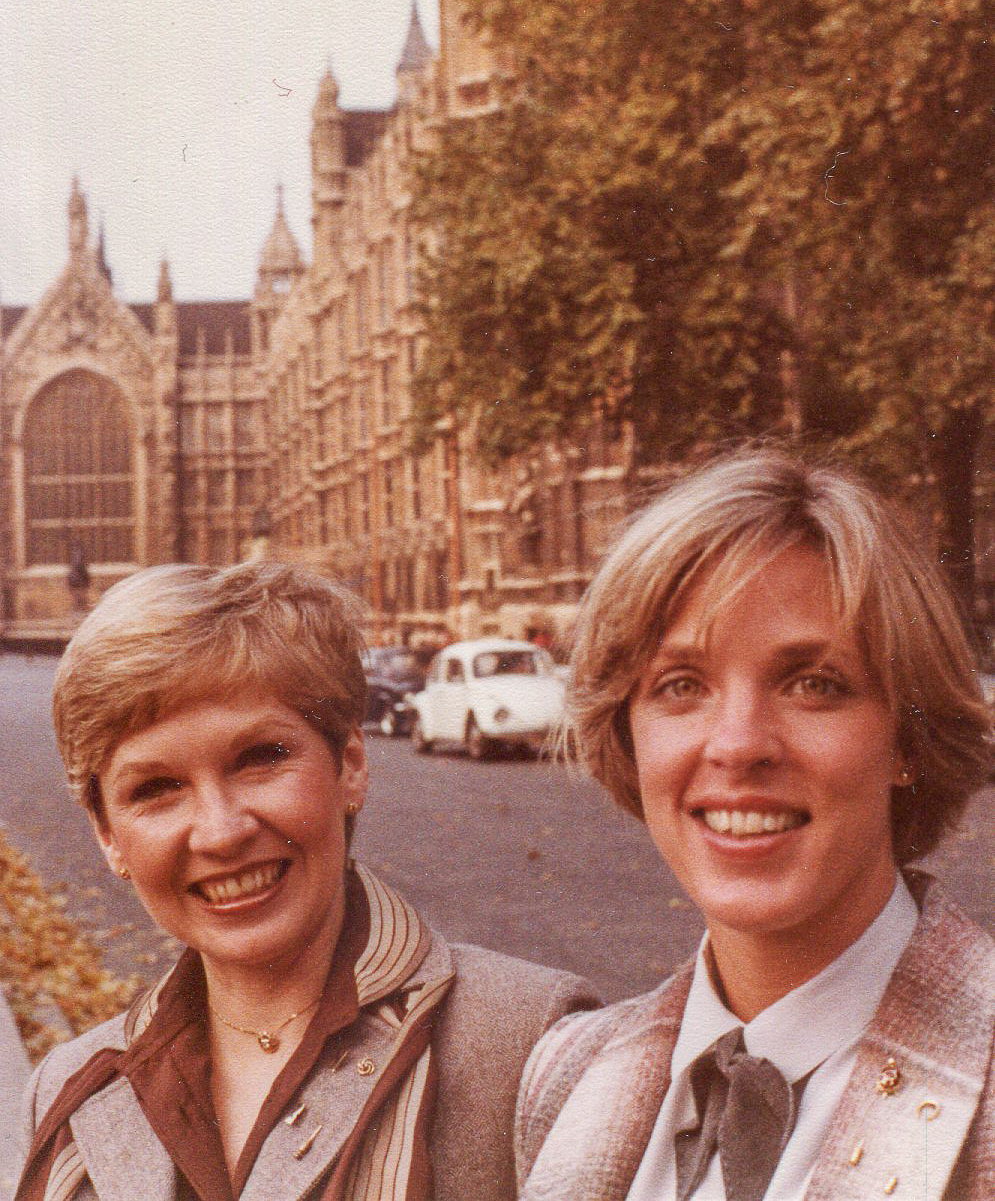
Nancy with Jean Barringer
“Antiquing,” was different for me. I knew very little about antiques other than the fact that I loved the rich beautiful patina of old furniture and the character of many smaller collectible objects, so solo journeys were few and far between. Fortunately I quickly acquired an “antiquing buddy” who shared my passion but knew much more than I did about where to find them and how to access their value.
I met Jean Barringer through the American school that our kids attended. An American expat from Boston who lived in nearby Cobham, she was smart, energetic, had a great sense of humor and flawless taste – I liked her immediately! We began our shopping days in London at the outdoor markets. Bermondsey, located on the outskirts of London, was our favorite. It opened every Friday and had the reputation for selling mostly genuine antiques. Vendors displayed their wares on row after row of tables where you could find everything from jewelry and antiques to just plain bric-a-brac.
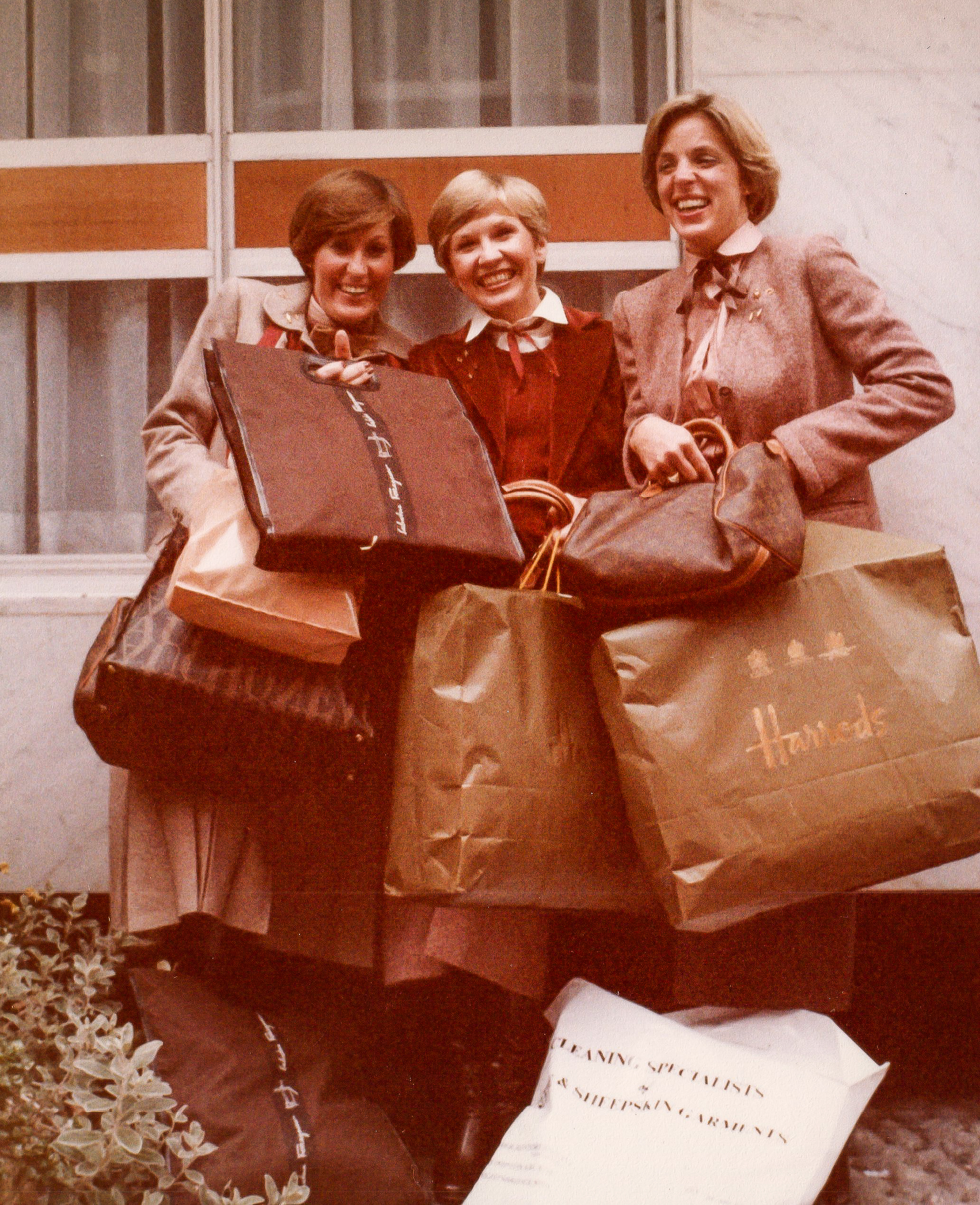
Vivian Humphries, Nancy and Jean Barringer
Jean was much more knowledgeable than I was, so I stuck close to her side hoping to find hidden treasures. She was the first to warn me to be careful though. “If something looks too good to be true,” Jean would advise, “it usually is.” Over the course of our shopping days together Jean also tried to teach me the art of negotiation, or more simply put, how to haggle. I was never really very good at it though, so I just simply focused on enjoying the search. But despite Jean’s counsel, I wasn’t always so lucky in my purchases. I still have a pair of ceramic Staffordshire dogs that I later learned were not at all worth remotely what I paid for them. Regardless, they’re pretty darn cute so when I look at them, I dwell not on their diminished value, but rather the great time I had while finding them with Jean.
Our antiquing foray continued into the Surrey countryside. Jean was a genius at finding little out of the way shops. Even if we came home empty-handed (which was rare), we always had a grand time. When lunchtime rolled around, we paused our search for antiques and headed to the nearest pub. Initially it was just because no matter where we were – be it the outskirts of London or far out in the countryside – there was always one that seemed to be across the street or two doors down from wherever we happened to be standing. But after many hearty lunches in these most local of establishments, we started to think of ourselves as aficionados of these regional watering holes and made it a point to always choose the coziest and most intimate pub in the area. And though the venues would change, what we ate became quite predictable. The “Ploughman’s” was our favorite pub lunch so named because it was the farm laborer’s lunch of choice. Though it varied slightly from pub to pub, it always included a savory hunk of cheese (usually a very sharp English Cheddar), thick wedges of crusty bread, plenty of butter and some kind of chutney – my favorite being the ubiquitous Branston Pickle.

Branston Pickle is a jarred chutney first made in the village of Branston by Crosse & Blackwell. It is a delicious sweet and spicy chutney made from a variety of diced vegetables and a perfect match to a good tangy & nutty English Cheddar. I tried making it from scratch just once. After working with what must have been 25 different ingredients, I decided that making chutney is not worth the effort since there are so many excellent (and probably better) jarred varieties.
The more pubs we went to, the more I realized I had discovered yet another amazing nook in the English culinary universe. This wasn’t American “bar food” I was eating, but thoughtfully (and economically) created dishes that featured only the things a Pub could do well, source fresh and serve quickly. As a restaurateur, I now know that understanding your strengths, your limitations and what your clientele’s desires are is the first step to being successful. Sitting across from my new friend Jean with a pint of beer (OK, a glass of wine, but I could just never drink beer no matter how much is made the experience authentic) I found myself becoming more and more incredulous at the bad reputation English food had on the other side of the Atlantic.

Now that I fancied myself a pub regular, the history major in me succumbed to the need to research its origin. Pubs were once described by the 18thcentury Member of Parliament and famous British diarist Samuel Pepys as “the heart of England.” Pub (short for Public House) culture continued to fascinate me and my obsession with it extended far beyond my afternoons with Jean Barringer. No one living in England (even us expats) did not have a favorite neighborhood pub. Not long after arriving, our family’s became the Cricketers. Located near our home in neighboring Cobham, Cricketers had a cozy bar with a lovely outdoor garden open in the summer months. We came with our kids for Sunday lunch or with guests from America whose English experience was, we felt, incomplete without a pub visit. On weekends I usually had something more substantial than bread, cheese and chutney and my favorite dish was Shepherd’s Pie. A traditional meat pie made with ground lamb and topped with fluffy mashed potatoes, it was never a disappointment. The kids usually ordered “bangers,” traditional pork sausages served with “chips” and of course, plenty of ketchup. “Sharing” their fries with Mom was always a requirement.

Bob, Candace and Colleen Remsberg at Cricketers Pub

My parents having a pint at a pub in Shere, Cotswolds
Now that I had become quite comfortable in the neighborhood pubs of the English countryside, a whole other universe of upscale London pubs opened up to me. No matter where or how expensive it was, my favorites were always those that enveloped you in warm wood and shiny brass as you entered into their cozy, informal world, the most handsome of which were the ones with etched or frosted glass windows – reminders of the golden age of the Victorian pub. There was one such pub near my husband’s office just up from Trafalgar Square – called the Marquis. The building dates back to Charles II’s reign and is said to have been the haunt of Charles Dickens whose residence was close by in Covent Garden where he spent the final years of his life. To honor him there is even a “Dickens’ Corner.” It is pretty amazing how many pubs claim that Dickens was a patron. I often wondered with all that pub time how he could have been such a prolific writer? I guess many of the characters one finds in pubs would offer plenty of material for whatever novel he was about to write.
***************************************************************
Now that I had confirmed for myself that British food was not the vast culinary wasteland some people had made out to be, I decided to tackle the British cuisine of the English Country Inns. It didn’t take long to discover that the food served in these inns was pretty similar to the food in more formal London restaurants like Rules (wild game, steak and kidney pie, etc), but served in a less formal – though always very proper– setting. The big difference was that the Inns rented rooms and therefore had a lived-in feel that gave these places a certain feeling of homey intimacy. My favorites were always steeped in history, usually served the country’s finest craft ales and always served the most iconic of British dishes. Bucolic views, exposed beams and four-poster beds were generally all a part of the mix as well. The Lygon Arms in the heart of the Cotswolds, the Mermaid in Rye and the Withies in Compton were just three of the historic inns that never failed to provide a totally English experience.

The Withies – built in the 16thcentury and located in the tiny hamlet of Compton – was close to my home, and our “go-to” Inn experience. We never stayed there overnight, but dined there frequently with our American visitors. I loved the formal-yet-friendly atmosphere it exuded – presided over by the “oh-so-very-British” tuxedoed waiters. I also loved the coziness of the low-beamed ceiling, the gleaming wood paneling, the exposed brick walls and the collective glow from the wall sconces scattered throughout the room. All those details seemed to capture a nostalgia in me for days gone by – days when Inns welcomed weary journeyers as they traveled from city to city and where mystery and intrigue were as much a part of the menu as the ubiquitous Yorkshire pudding.
And in these Inns even more so than in pubs, I recognize the similarities of classic English cuisine to good ole’ midwestern comfort food. Lots of roasting and stewing and battering in both. At the Withies I usually ordered something with beef or their delicious Calf’s Liver and Bacon, another dish that can be found on menus on both sides of the ocean. The Withies liver preparation included crispy bacon, mashed potatoes, sautéed onions and a savory grain mustard sauce, which brought out all the complex flavors of the dish.
I find that I am one of the small minority of people that adore liver when it is properly prepared. But I almost exclusively order it out because in its raw state I am always put off by its weird appearance and slippery feel. So these days I let my chefs do the cooking and have accommodated this zealous group of liver aficionados by keeping it on the menu of every restaurant I have ever owned. It has never been our biggest selling menu item, but it draws a certain devoted crowd who would be terribly disappointed if it were ever removed from the menu.
Below is my favorite version with bacon and yes, mashed potatoes. It is based on the one I enjoyed at the Withies Inn.

© rob warner photography 2019
Sautéed Calf’s Liver with Bacon
4 slices (approximately 1 pound) quality calf’s liver sliced ½ inch thick
salt and freshly ground pepper
½ cup flour
3 tablespoons olive oil
8 slices bacon
1 whole onion cut in rings about ¼ inch slices
2 cups mashed potatoes
1-tablespoon grain mustard
¼ cup veal stock
¼ cup Chianti (or other similar red wine)Sautee the bacon until crisp, drain on paper towel and set aside. Make your own recipe for mashed potatoes – keep mashed potatoes warm. Salt & pepper the onion rings and sauté for about 2 – 5 minutes in olive oil – set aside and keep warm
In a small pan, heat the Chianti over medium heat reducing it slightly. Add the veal stock & mix well. Add the grain mustard. Set aside and keep warmThe moment before sautéing the liver, season slices on both sides with salt and pepper and dredge in the flour shaking off excess flour. Place the olive oil in a fry pan over high heat. Sauté the liver slices approximately 1 minute per side.
Plating:
To serve, spoon approximately 2 tablespoons mustard sauce in middle of plate.
Arrange ½ cup warm mashed potatoes in a mound on top of sauce.
Place liver slice on top of mashed potatoes, then two slices of the warm bacon. Top with the onion rings.
Drizzle mound with balsamic glaze including rim of plateP.S. See why I don’t make this at home?
***************************************************************
In my first weeks in England I quickly came to understand that though Americans and the British spoke the same language, disparities existed. Learning how to pronounce the name of my village was only the beginning. Discovering my new country by reading its history, exploring its towns and villages, and engaging in its traditions and activities allowed me to begin to recognize the interconnectedness among people and countries. There were certainly differences, but I began to realize that these disparities were exactly what made my new world so interesting.
Living in a foreign country can be an intimidating experience. As an expat, maneuvering around the many different customs and nuances of a new country is full of challenges. My new friend Jean and I talked frequently about the demands and importance of becoming what we called a ‘global citizen’ and how critical it was to remain open to new situations and ideas.
Eventually I came to cherish and embraced those demands. The adjustments in mindset, tastes and customs could be difficult and frustrating at times but learning about food and culture could never be a burden to me. It was thoroughly enjoyable exploring and tasting everything from fancy-fancy international cuisine to English pub food. From dining in the most upscale restaurants to sitting on a swivel stool in front of a lunch counter. I came to England as a midwestern gal who marveled at the difference between her small Wisconsin home town and the big city of Chicago, but not much beyond that; to a woman who was afforded the experience of immersing herself in exotic tastes and cultures not only of her adopted foreign country, but of the world at large.
It was during these three years in England that I began to grasp the learning process that best suited me. I first needed to get a total picture. Research and study were essential. Then came the experience. And then – perhaps most important for me – reflection. My “steeping” time I have come to call it, was when I sorted through everything I had experienced and came to my own conclusions. This was the template, the pattern I would follow in most everything I did from this point forward – in my personal life and certainly in my business ventures. It was a confidence building process and one that has suited me well over the years.
That first year in England was extraordinary but I was long from completing my culinary journey there. Yes, I had debunked the myth of bland British food, but England had much more to teach me!

Nancy, as usual, you have transported me to England and I have enjoyed the trip immensely. I look forward to more of your time there. It is so enjoyable to read such a well written blog.