
Driving up Sheridan Road on Chicago’s North Shore is a picturesque journey in any season, but it is particularly majestic in the fall. The thick canopy of trees lining the road occasionally reveals a peek of Lake Michigan and envelopes one in the warm, earthy richness of autumn. So many different trees, so many different leaves, all diverse in shape, size, and depth of color, yet in perfect complimentary harmony. I often find myself absent-mindedly searching my subconscious for the perfect name for each leaf color. Over the years it has become a game that I look forward to playing anew each fall season. Yellow is never just yellow, it is lemon meringue, banana split, saffron, or simply lemonade. I am always amazed at the variety of shades within each major color category – burnt orange, brown sugar, caffe latte, pale persimmon, sumptuous sienna. Not so surprisingly, food words tend to dominate my list, though I will occasionally get stuck on a leaf that I can’t quite classify within my existing vocabulary of autumnal colors. It is then that I wish I had my artist sister Karen with her color-palate-brain sitting beside me.
This expansive glossary of color applies not just to leaves, but also to the lifeblood of my world, food. Squash is a perfect example of an autumn veggie that has a variety of color variations that continues to grow exponentially each year. They range in color from shades of green and yellow to orange and amber to even gradations of white. Speckled or striped versions also exist. They can be round, oval or shaped like a shell or even a trumpet. Their warm and comforting flavor speaks to me of the quintessential taste of autumn. Even with all these new versions available, I tend to come home to my favorites – the ubiquitous acorn and butternut – and have made many dishes using both for my market as well as my own personal dinners. Is there anything better or more delicious than the sweet, nutty flavor of a baked acorn squash half with just a dot of butter and maybe a sprinkle of brown sugar?
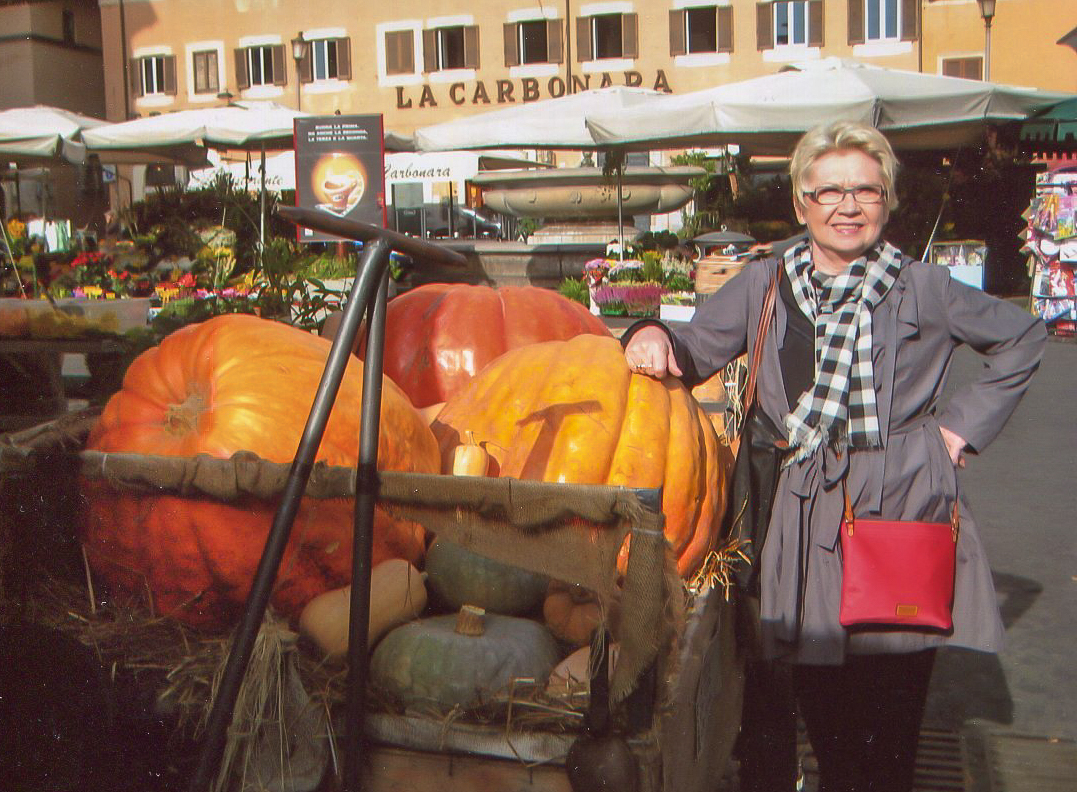
In Rome with giant squash
The most versatile squash in my opinion is butternut squash. It is delicious cooked, steamed, baked, roasted, sauteed or pureed. Relying on its sweet, moist and nutty taste and its dense texture, I have created many recipes with it, though Butternut Squash Gratin (My Journey into the Kitchen – Christmas Changes) is probably my favorite. Another is a Savory Butternut Squash Soup which I make with a little ginger and nutmeg that adds a sweet and spicy flavor to the soup. I usually serve it in soup cups as a first course sitting around my dining room table, but one Thanksgiving I had it at a friend’s house served in her living room in little demitasse cups. Guests found it easy to sip from their little cups while relaxing and enjoying a glass of Champagne. Brilliant I thought. So clever.

© rob warner photography 2023
Snappy Butternut Squash Soup
Serves 61 (2 ½ pound) butternut squash, peeled, seeded & cut into 1-inch pieces
2 tablespoons olive oil
2 tablespoons butter
1 large carrot, chopped (about ¾ cup)
1 medium onion, chopped (about 1 cup)
Pinch ginger
Pinch cayenne
Pinch nutmeg
4 cups homemade or store-bought chicken stock
Salt & pepper to tastePreheat oven to 400 degrees. Toss the squash in olive oil and spread out on a large sheet pan. Roast for 30 to 35 minutes.
In a large pot, melt the butter over medium-high heat and sauté the carrots and onions until lightly browned (about 5 to 10 minutes). Add the ginger, cayenne and nutmeg and stir into vegetables. Add the squash and chicken stock and simmer for 10 minutes.
Using the blender of your choice (an inversion blender is ideal), blend until smooth. If too thick, add a little more chicken stock.
Garnish with créme fraiche.
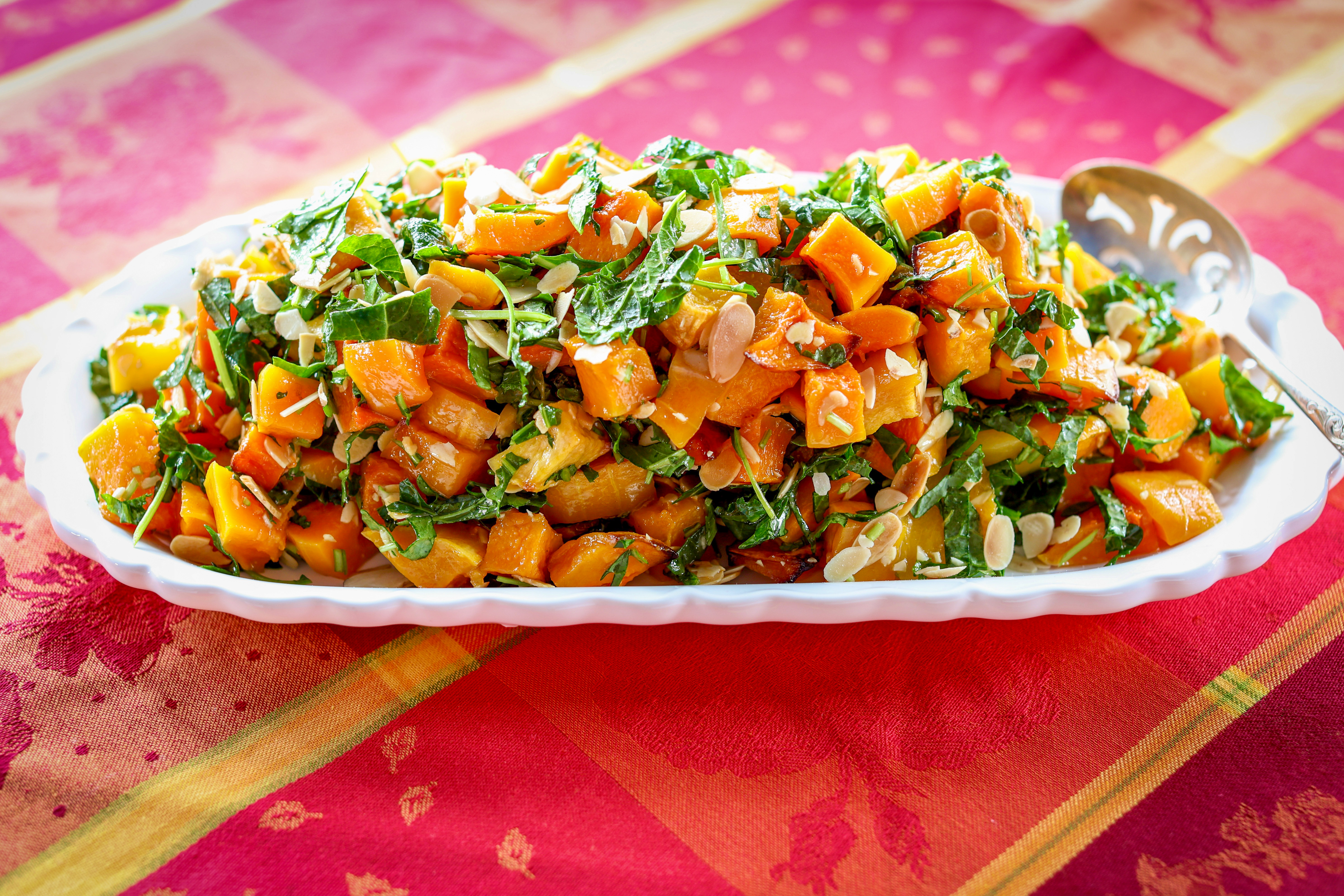
Another popular dish that we serve at Convito is this versatile butternut squash, kale and almond combination which works equally well as a side dish or a vegetarian main course. It can be made ahead of time and heated up in a microwave just before serving. Many of our customers buy it for their lunch.
© rob warner photography 2023
Kale & Butternut Squash Sauté
6-8 servings (as a side)
3 small butternut squashes
4 cups baby kale
1 clove of garlic, minced
salt and pepper
3/4 cup almonds, sliveredPreheat oven to 400 degrees.
Peeled squash, remove seeds and cut into 3/4 inch cubes. Toss the squash in olive oil, spread out on a large sheet pan and roast for 30 to 35 minutes.
In a large pan sauté kale with garlic, salt and pepper over medium high heat for about 1 to 2 minutes until it wilts.
In a large bowl combine squash with kale mixture, toss with almonds and serve.
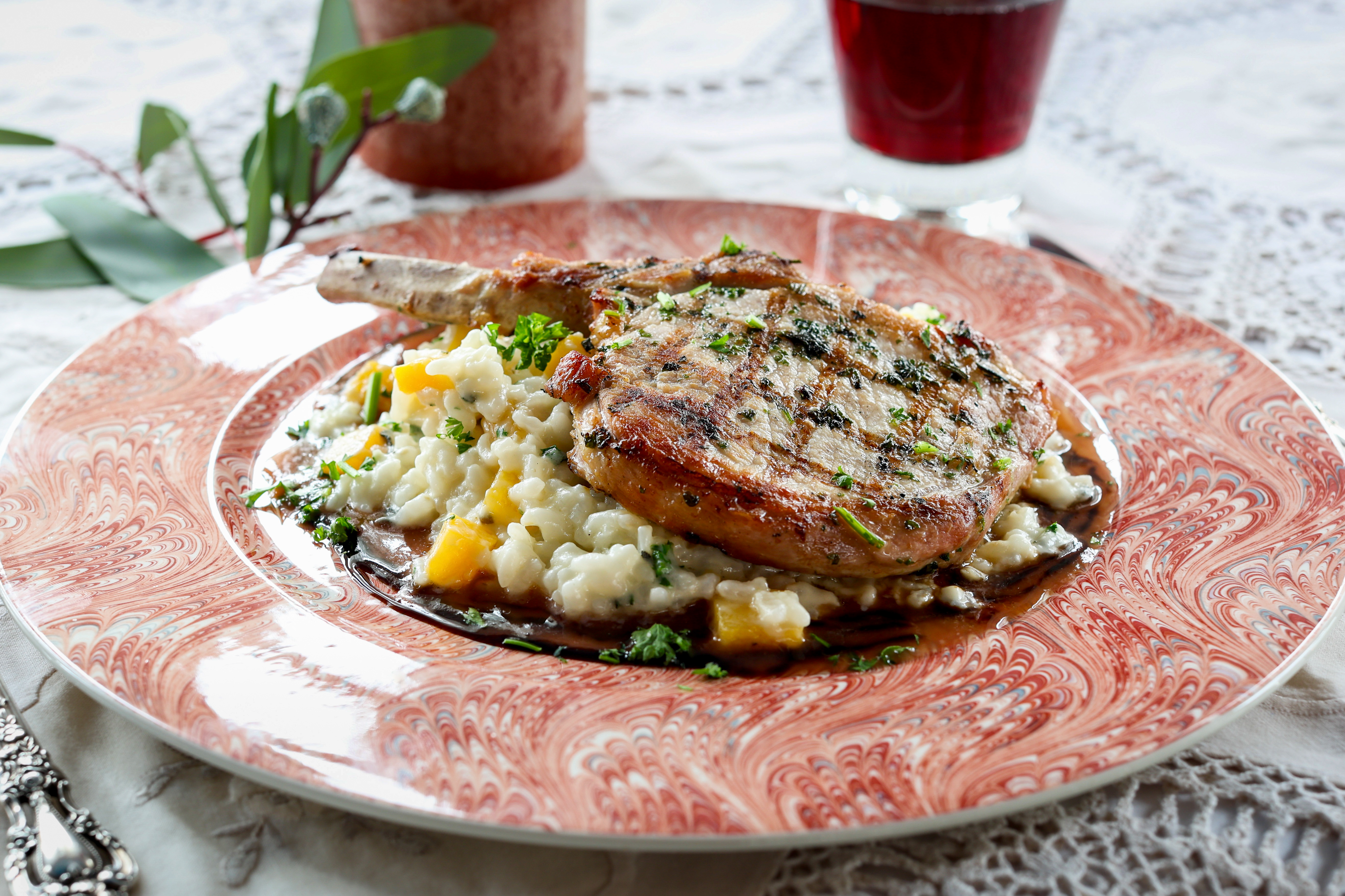
My new favorite however, is our Butternut Squash & Sage Risotto. Risotto’s versatility extends through all seasons depending on its preparation, and this version is what I like to think of as elegant comfort food, perfect for cooler seasons. But when I replace the squash and kale with asparagus & lemon zest, risotto becomes a harbinger of Spring. Or fresh tomatoes and basil will transforms it into a celebration of Summer. Risotto is both simple or complex, the star of the meal or a complimentary side dish. What I love about this particular recipe is that it can be either. Recently Convito’s chef, Jorge Plata, has been serving it as a side dish next to a grilled pork chop with Chianti jus – a wonderful combination.
© rob warner photography 2023
Butternut Squash and Sage Risotto
Serves 61 medium butternut squash (about 1 pound)
10 sage leaves, diced
5 cups chicken stock
2 tablespoons butter
1 tablespoon olive oil
3 tablespoons finely chopped onion
1 ½ cups Arborio or Carnaroli rice
½ cup dry white wine
1/3 cup Parmesan cheese
salt and freshly ground pepper to tastePreheat oven to 350 degrees.
Peel, clean & dice the squash into bite-size pieces. Place squash on an oiled bake sheet and roast in the oven until slightly browned and tender (about 5 to 8 minutes), then set aside.
In a saucepan, bring the chicken broth to a light simmer.
Melt the butter with the olive oil in a heavy-bottomed skillet over low heat. Add the onions and sauté over medium heat until soft, approximately 2 minutes. Add the rice and stir until well coated. Add the wine and stir until absorbed.
Slowly add the simmering broth ½ cup at a time. Continually stir the rice, always making certain the rice is not sticking to the bottom of the pan. Add just enough broth to keep the rice moist This process should be done over medium heat. (Approximate cooking time is 30 minutes).
About 20 minutes into the process, add the squash and the sage to the rice and continue to stir constantly (if you run out of broth you can use hot water).
When the rice is a few minutes away from being al dente, turn the heat off, add the Parmesan and combine with the rice. Taste for salt and pepper and serve in bowls immediately.

Harvest Dinner with friends
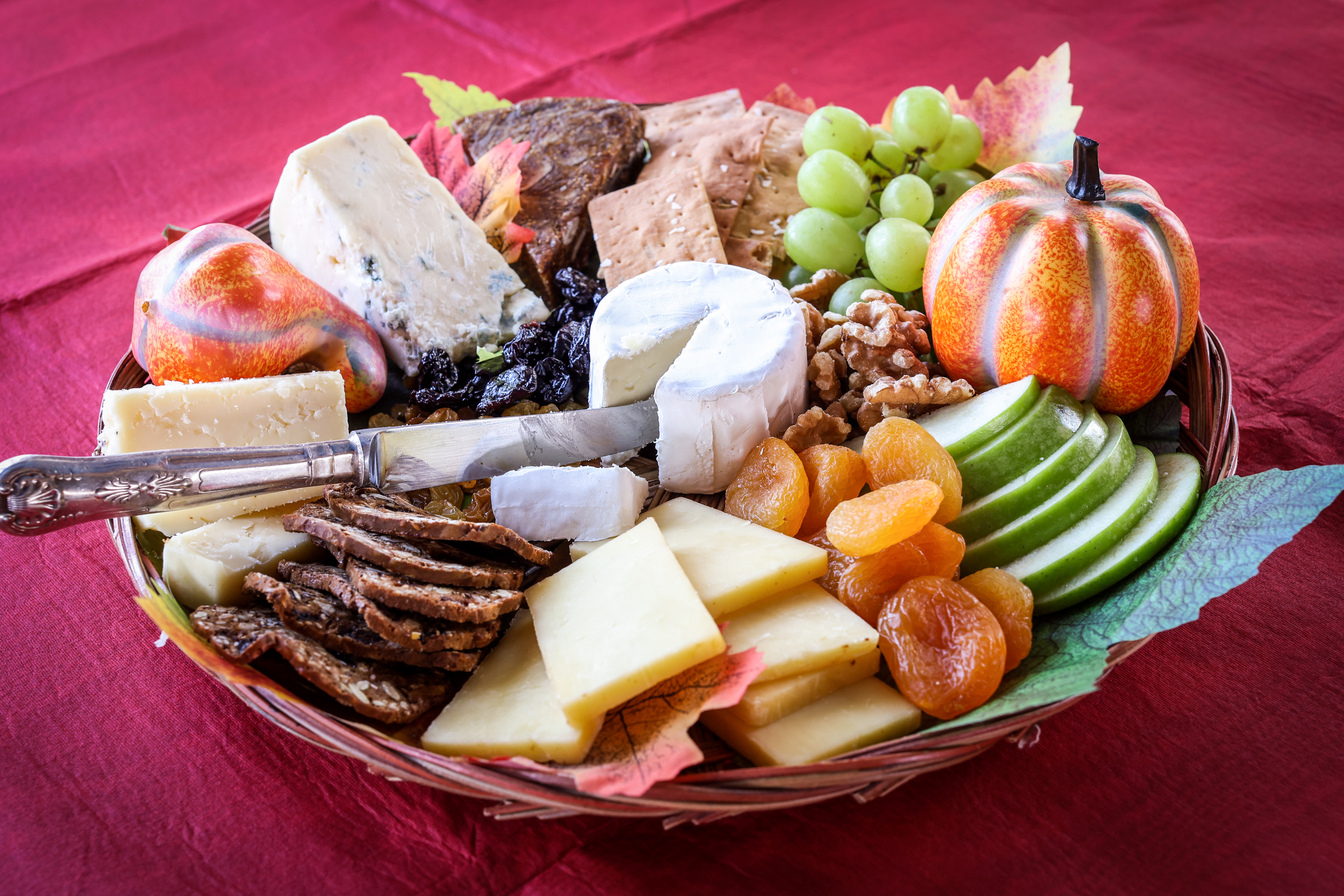
I have made my squash risotto many times for dinner parties hosted in September or October when fall ingredients are still plentiful at my local farmer’s market. If I serve more than one course, I begin with a mushroom farro soup (Tuscany III – A Region for All Seasons), another one of autumn’s signature tastes. I’ll then pair the risotto with pork chops, followed by a cheese course as dessert. In honor of the season I arrange the cheese (my favorites are aged cheddar, a soft cheese like brie, a gorgonzola and a goat cheese) with baby pumpkins or gourds as an autumnal accent. I will then add slices of green & red apples and pears, a scattering of figs, some dried berries, apricots and grapes, as well as a variety of crackers. I have also served crème brulee made with puréed pumpkin, cinnamon and nutmeg, another superb way to end a fall meal for guests with more of a sweet tooth.
© rob warner photography 2023
***************************************************************
Fall is my very favorite time to travel, especially to Europe. The weather, for the most part, is more predictable – not too hot, not too cold and the tourists have begun to abate. My fall travels have mostly been to England, France and Italy but one year I was lucky enough to go to Zurich, Switzerland with my son, Rob and his wife Angie during Octoberfest. We spent a few glorious fall days wandering the city’s streets, checking out museums and of course, eating well.

Cheeses, wurst and rösti were our staples. I couldn’t get enough of rösti, essentially a potato pancake with a French-German name made from pre-cooked potatoes, held together with melted butter. It is the national dish of Switzerland and is served with almost every meal. We always checked because if it didn’t come with the course, we ordered it as a side. Anyone that knows me well, knows that I have never met a potato dish I didn’t love, and rösti is right up there with my French Fry obsession. Even though I really like almost any kind of potato pancake or hash browns, rösti is my favorite. Its almost ethereal in its simplicity, made with only ingredients: potatoes and butter! How could that be anything but divine?!
The best version of rösti we had during our trip was at the restaurant we dined in on our very last night – Haus zum Ruden, housed in a beautiful guild house on the Münsterbrücke bridge, close to the town hall. The building dates back to 1348, as does the unique 11m-wide wooden barrel-vaulted ceiling in the Gothic Room. Dishes are usually classics like the dish I ordered – Zurich-style veal and mushroom ragout in a cream sauce. The rösti served was so tender and oh so flavorful. A great way to end our visit.
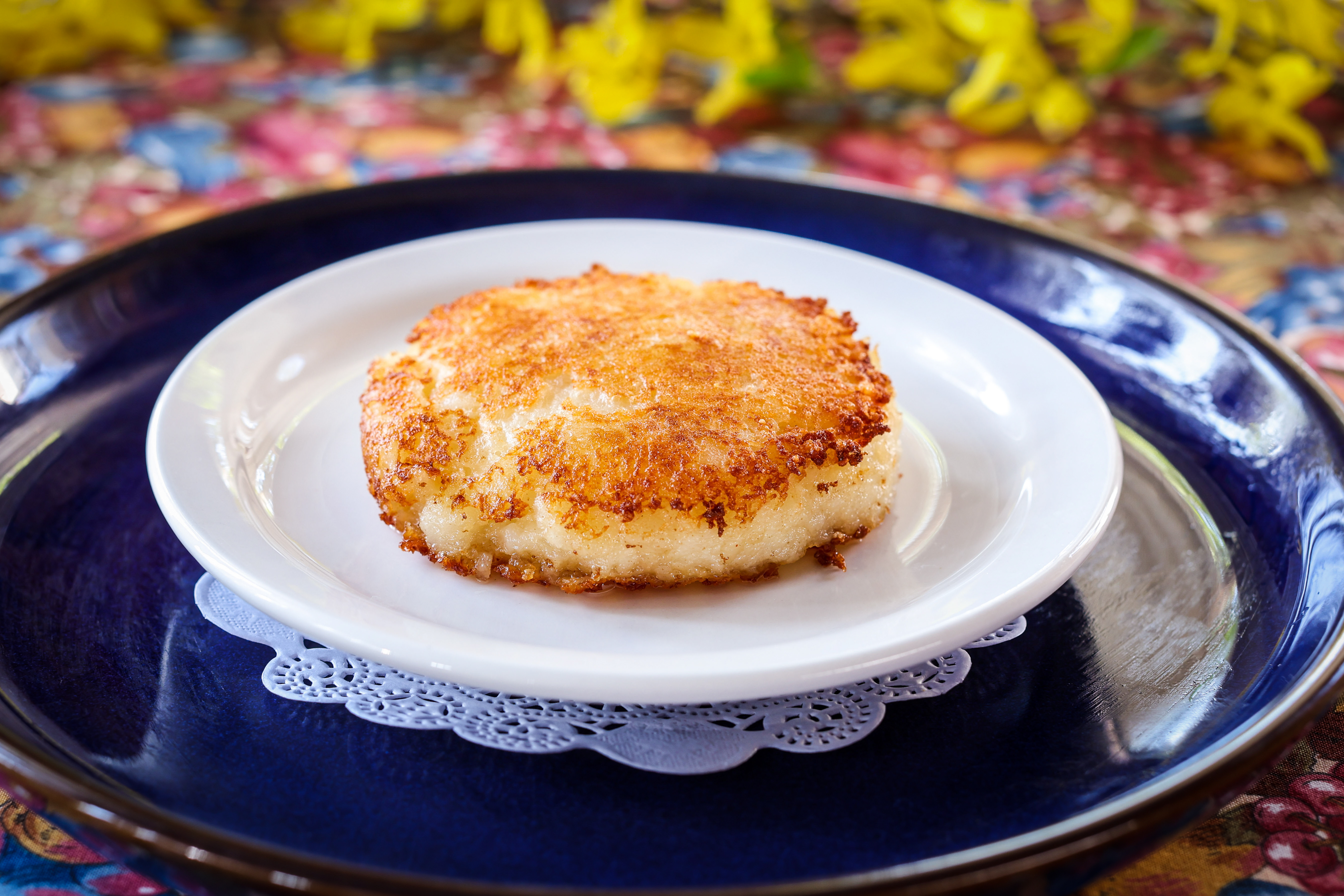
© rob warner photography 2023
Rösti
Serves 2 – 41 pound Yukon Gold Potatoes (approximately 2 medium potatoes)
Kosher salt
6 tablespoons unsalted butterIn a small saucepan, cover the potatoes with cold, salted water. Bring to a simmer and cook at a simmer for approximately 25 minutes or until you can just pierce the potatoes with a sharp knife.
Drain the potatoes and allow them to cool at room temperature. Then cover and refrigerate until fully chilled (recommended 8 hours to 3 days). *I was told by the friend who gave me this recipe that using cooked potatoes in making rösti makes all the difference – you don’t have to worry about oxidation, the pancake cooks up quickly and the internal texture and flavor are different – much better than when using grated raw potato. Chilling retrogrades the starch firming up the potatoes just enough to make grating them into nice strands – not a pile of mush)
When ready to cook, peel the cold potatoes. Grate them using the large holes of a box grater, into a bowl. Season with salt and pepper to taste. Stir to mix.
In a 10-inch cast iron skillet, melt 3 tablespoons of the butter over medium-high heat until the butter foams. Add the potatoes and form them into a disc about 1 inch thick using a spatula. Cook until golden brown and crisp on the bottom (approximately 10 minutes). Lower the heat, if necessary, to prevent scorching.
Slide Rösti out of skillet onto a large plate (not always that easy the first time you try it, but have a spatula ready and make peace with imperfection!). Plate the remain 3 tablespoons into the skillet, bring to a foam. Plating a second plate on top, flip to invert rösti and slide back into skillet and cook until golden brown and crisp on the second side – approximately 10 minutes longer. Fold any bits that have come loose back into the disc helping the rösti maintain its circular shape.
Slide onto a serving plate and serve in whatever portions you see fit.
Even though I am not a fan of beer (too many of my University of Wisconsin memories are of the stale beer smell in all the fraternities – especially after the weekend parties) Rob and Angie insisted that we stop at a massive Oktoberfest tent (the ultimate beer garden) just outside of the main train station to enjoy a beer and some typical Bavarian food specialties.

Festivities were in full swing during our stay and I learned that Octoberfest originated in Munich, Germany to celebrate the marriage of the crown prince of Bavaria. Today it is celebrated all over the world especially in German speaking countries, but also in German communities like the one in Chicago’s Lakeview neighborhood where for many years once I had grandchildren, our family would gather during my son’s Christmas visit to eat brats & sauerkraut, have a beer in a one liter steins and dance to Der Ententanz (aka The Chicken Dance) with the little ones.
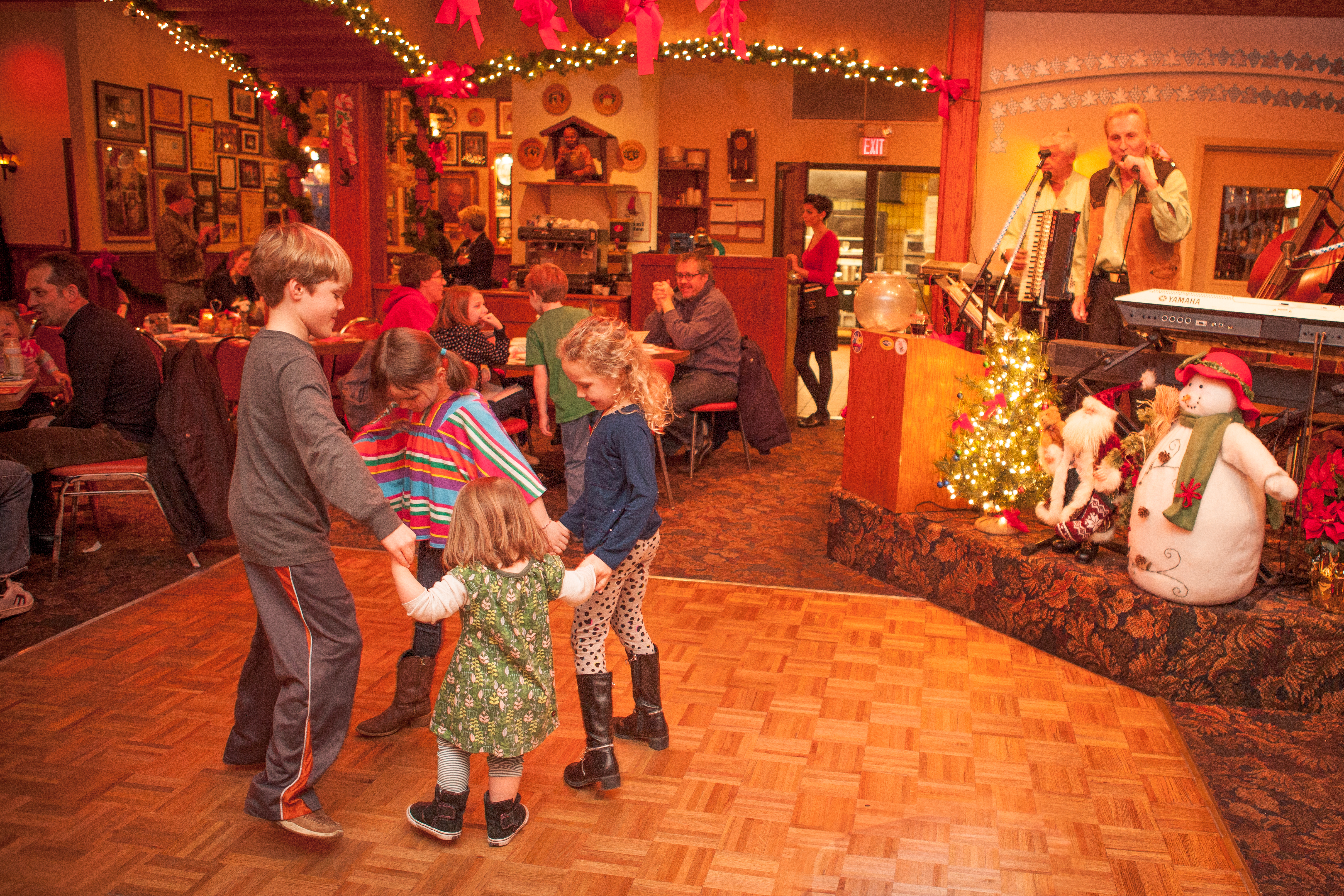
Over sixty percent of the Swiss population speak German as their main language and these two countries also share borders, so it is no wonder that their cuisine has so much in common. I truly enjoyed the food I had during my Zurich visit as I did during my travels to Munich, Frankfurt, many villages and towns along the Rhine and Alsace-Lorraine (a historical region located in modern-day France but created in 1871 by the German Empire). There is something fundamentally autumnal and cozy about German food – especially their many sausage and potato dishes – which reminds me of the comfort food I ate growing up in Wisconsin.
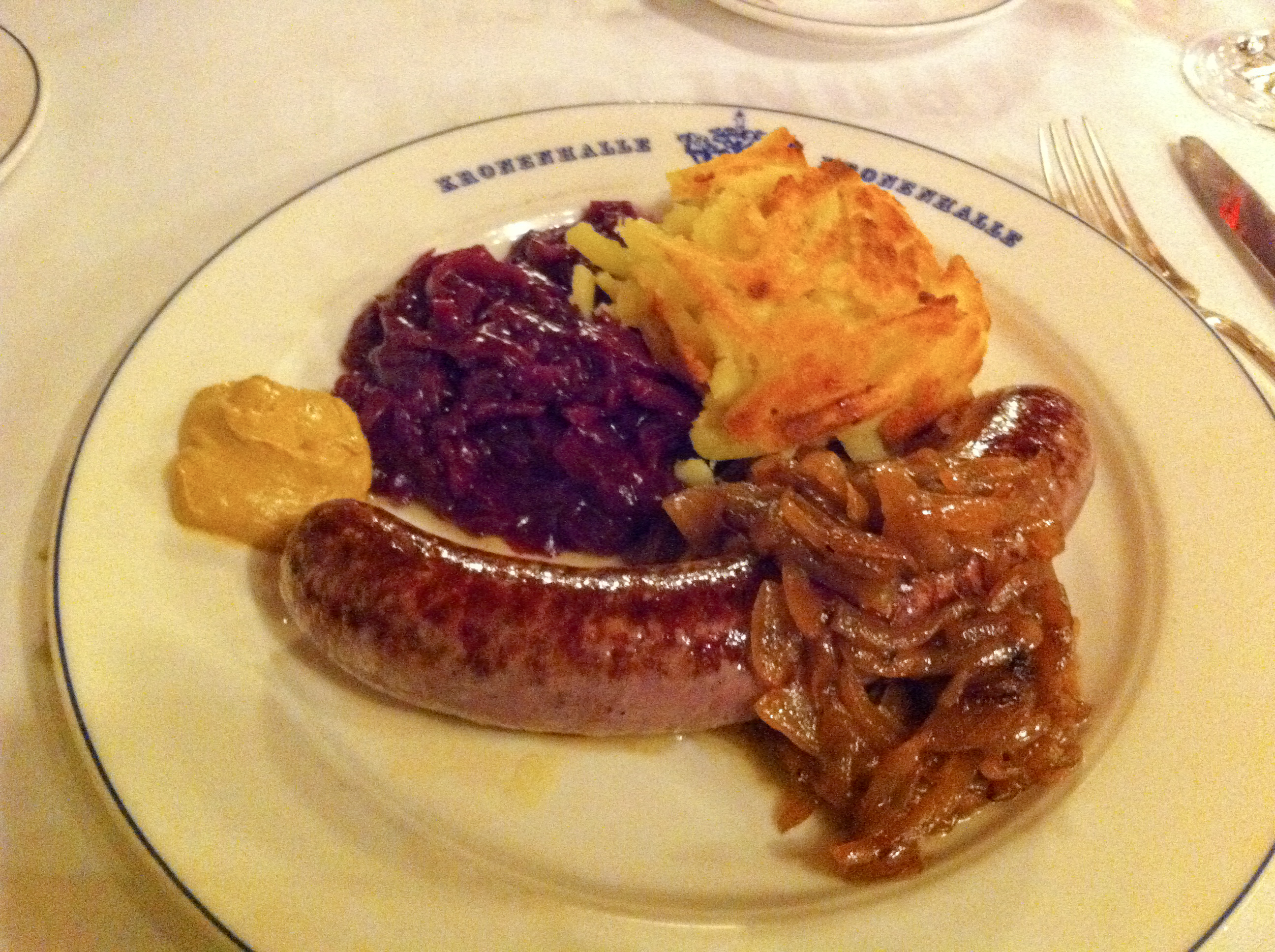 When it comes to that style of food, sausages are at the top of my list. Switzerland and Germany boast hundreds of different types – over 1,500 different ones – from the commonly known bratwurst to the lesser known knochwurst to the smoked Bierwurst to many I had never heard of (like the Regensburger Wurst, a boiled sausage with fine pork fillings). The history of sausage originates from a desire to preserve as much meat from the hunt as possible and may have its roots in ancient Greece. But it is the Germans who have clearly mastered the art of sausage-making. Not only does each region have their own special sausages, but many families have their own special sausage recipes.
Schnitzel is another popular German dish that I love. Similar to the Italian Vitello Milanese, both are flattened pork which has been floured then breaded and deep fried. Most of these meat dishes are served with some kind of potato dish, but also frequently some sort of cabbage, another typical German ingredient. One of Germany’s most popular and famous cabbage dishes is sauerkraut (A Seasonal Journey: Summer (and the livin’ is easy), but a lesser known and equally delicious one is Rotkohl, a sweet and sour braised red cabbage with apple, cloves, juniper berries, vinegar and sugar. It is the perfect accompaniment to a Sunday roast beef and almost any kind of sausage.
***************************************************************
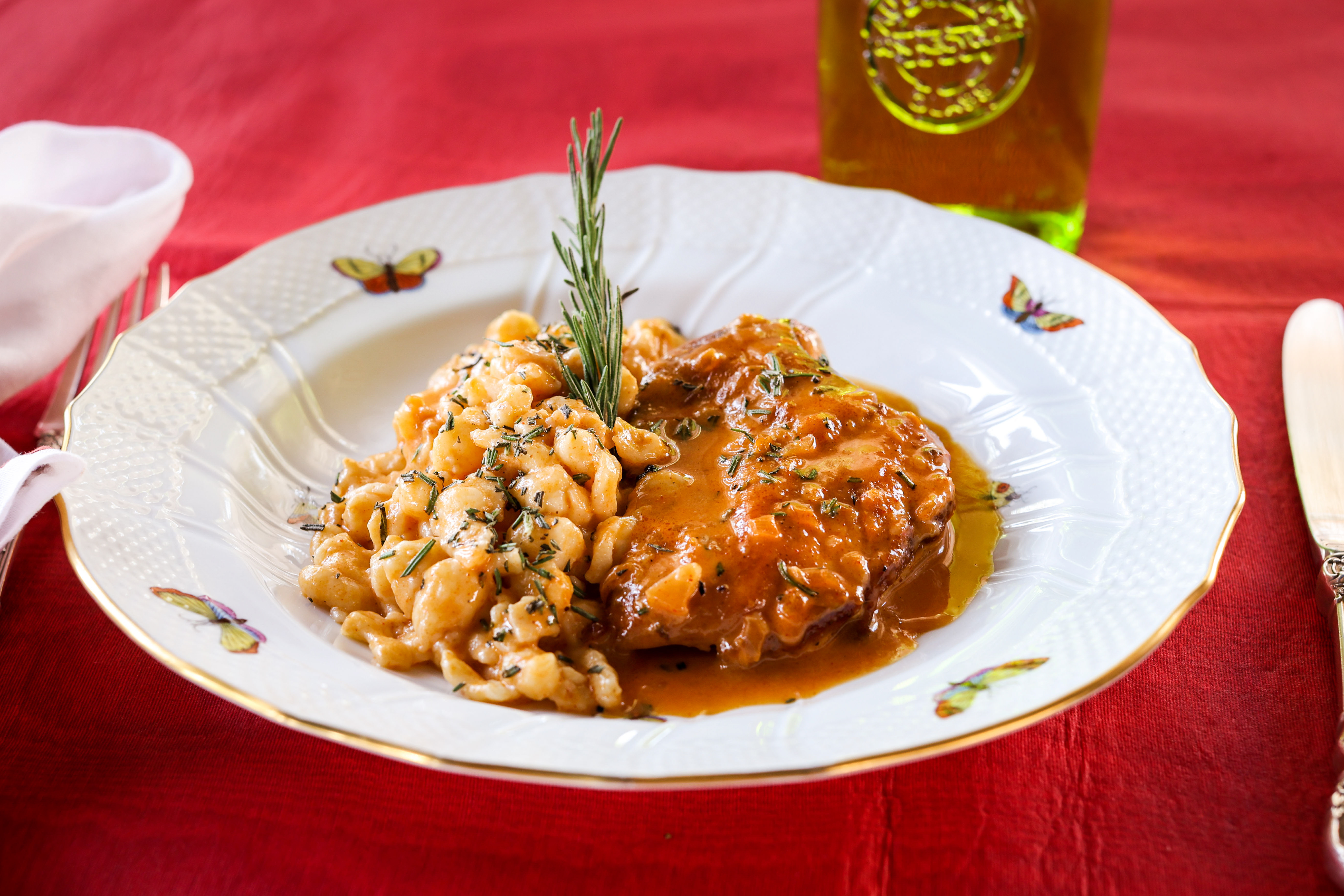
Though I love all the above dishes, there has always been something extra special about Spätzle. More associated with Hungary than Germany, it is perfect for fall. Perhaps the ultimate comfort food, spätzle falls somewhere between a noodle and a dumpling and is found in the cuisines of Germany, Austria, Hungary and Alsace to name just a few. The spätzle dish I am most familiar with is the one my former mother-in-law made to accompany her Chicken Paprikash. It is a Barocci family recipe which I made frequently (the recipe was even printed in Abby Mandel’s Chicago Tribune column after she had it at my house) and has been handed down to my son who prepares it at least three times a year – for his wife’s birthday as well both his daughter’s fall birthdays: Isis in October and Neko in November. They request it each year!
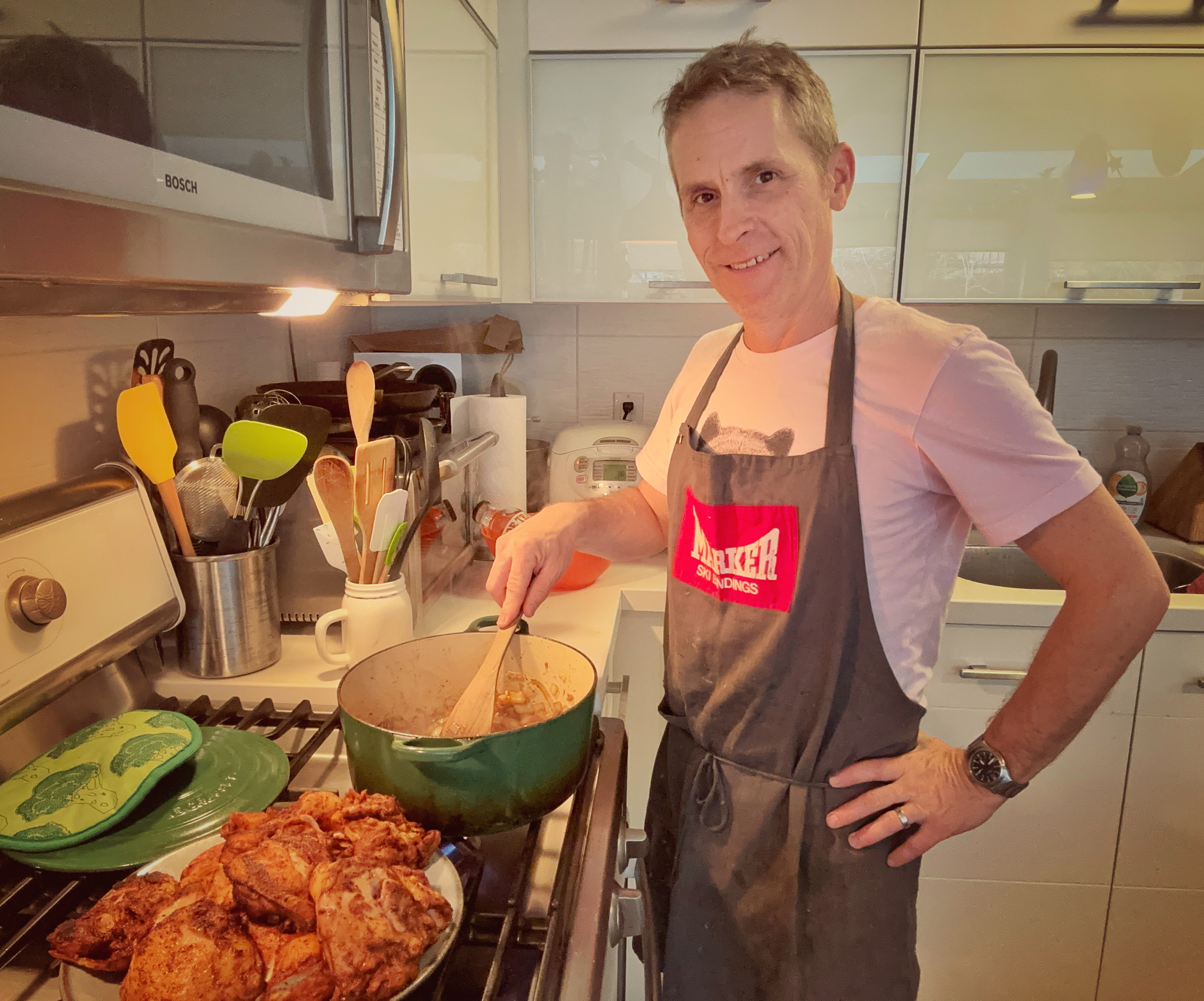
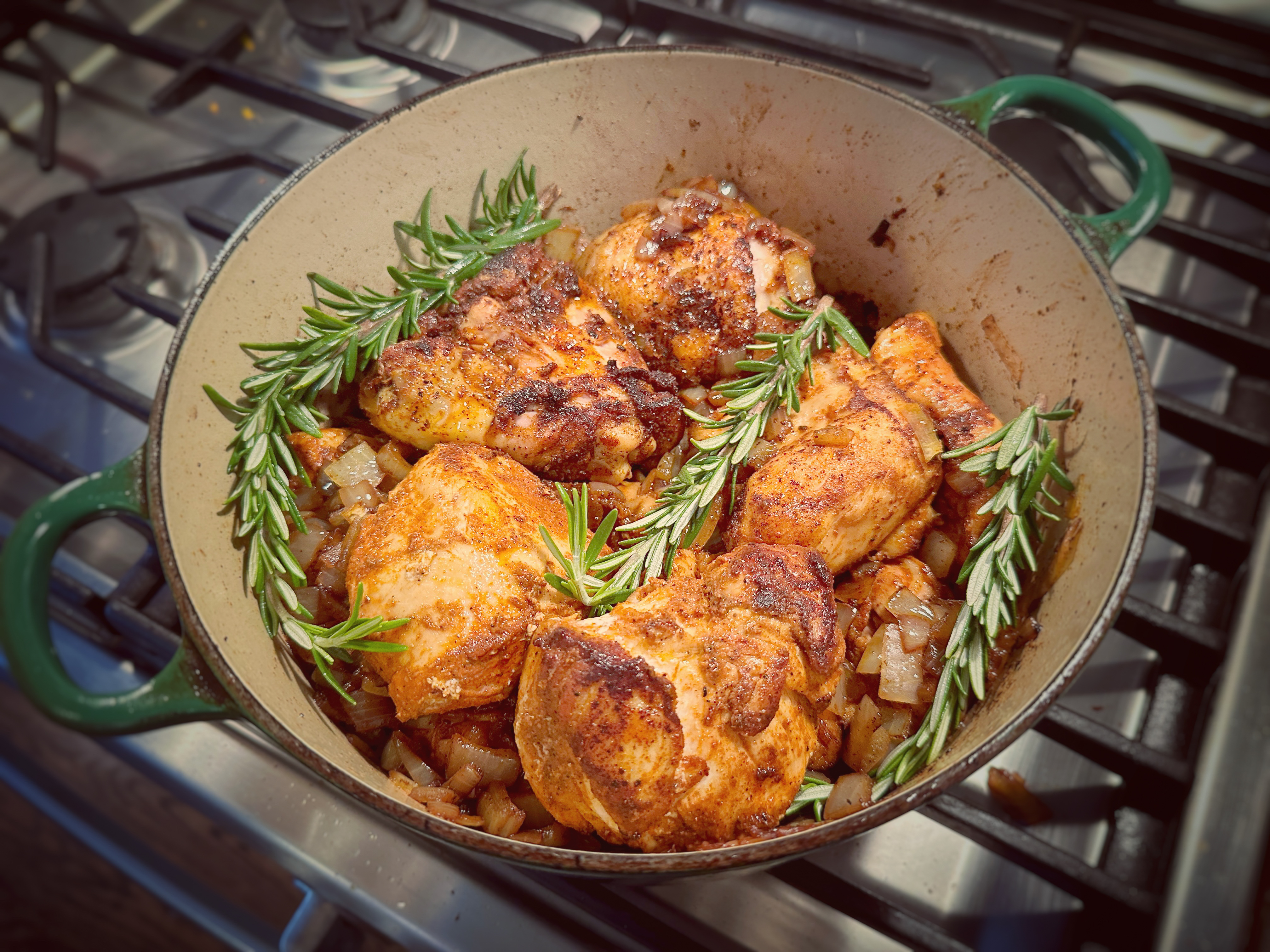
My mother-in-law, Mary Barocci’s parents were both from Croatia which was a part of the Austro-Hungarian Empire for centuries, so many dishes like Chicken Paprikash were passed on to the other nearby countries. She always served her Chicken Paprikash with spätzle swimming in an absolutely delicious creamy gravy. My son makes a dairy-free version (below) that is just as delicious as Mary’s original.
© rob warner photography 2023
Chicken Paprikash
Serves 62 tablespoons sweet Hungarian paprika
2 teaspoons salt
½ teaspoon freshly ground pepper
1 large frying chicken, cut into 8 pieces (or whatever pieces you like best)
2 tbsp unsalted butter (or non-dairy substitute)
2 tbsp olive oil
2 medium onions, chopped
2 sprigs fresh rosemary
¼ cup flour
¼ cupwater
1 ½ cups milk (or non-dairy substitute)Mix paprika, salt & pepper in large plastic bag; add chicken. Shake until well coated.
Melt butter with the olive oil in a large Dutch oven over medium-high heat. Cook chicken, turning once, until browned, about 2 minutes per side. Transfer chicken to plate.
Add onions to pan, stirring often until brown, about 5 minutes. Add rosemary and chicken to pan. Cook, covered, over medium-low heat until chicken is cooked through, turning the pieces once midway, about 30 minutes. Transfer chicken to a platter and set aside.
Combine flour and water in small dish until smooth. Stir into pan juices. Cook over medium heat until thickened, about 1 minute. Gradually add 1 cup of milk, stirring constantly until thickened, about 2 minutes. Add remaining milk as needed for a thick, rich gravy. Remove rosemary sprigs. Return chicken pieces to gravy. Serve with spätzle mixed with the gravy.
Spätzle
Serves 62 ½ cups flour
½ teaspoon salt
½ teaspoon baking powder
2 eggs, lightly beaten
½ cup milk (or oat milk)
½ cup waterCombine flour, salt & baking powder in a bowl. Mix together with the eggs, milk & water. Gradually add to the flour mixture and mix well. Dough must be firm enough to maintain its shape.
Bring a large pot (3 to 4 quarts) of salted water to a boil. Place pieces of the dough in the a spätzle maker* and slide back and forth into the boiling water. Cook in boiling water for 1 to 2 minutes or until spätzle floats to the top. Drain in a colander and toss with a little olive oil or butter to keep from sticking together.
Plate the chicken and spätzle, cover both with the gravy and serve.
*Alternatively, you can place dough in a colander and force it through the holes or place dough on a wooden board and cut or break off small pieces with a spoon into the boiling water, but I strongly suggest getting an inexpensive spätzle maker since you will make this dish many times over
Food often is how we express ourselves and sharing recipes – especially family favorites – is not just about the exchange of a list of ingredients and instructions. The backstory of a recipe transcends the simple act of cooking and becomes an act of sharing an intimate memory. My relationship with Mary Barocci’s Chicken Paprikash recipe is as much about the process by which I originally obtained it as it is the delicious dish itself. Mary was an instinctual cook whose idea of exchanging a recipe was just to tell me what the ingredients were without amounts or any explanation of the process of combining and cooking them. Is “a little” a teaspoon, half a teaspoon, a pinch? Much of her cooking was the “taste-as-you-go” kind, so getting one of her recipes with precise measurements and instructions was almost impossible. If I really wanted to capture the taste of a dish she was preparing, I would have to follow her around the kitchen religiously recording every move she made, ingredient amounts and cooking times. I was finally satisfied with this particular recipe after several afternoons spent closely shadowing her, incessantly asking questions and craning over her shoulder trying to understand the secrets of what would become one of our family’s favorite dishes.
Those afternoons spent with Mary in her kitchen were probably the closest I ever felt to her and was when I began to understand how cooking together builds a certain intimacy in a relationship. Working together in a small space toward a shared goal requires a language of collaboration, both overt and instinctual. There are not that many people I like to cook with, but when I do it invariably nourishes the relationship I already have with that person.
***************************************************************

Aann Yonkers, Dorene Centioli-McTigue, Linda Calafiore and Nancy
Just recently in Seattle I cooked with three Les Dames friends who get together every few years not only cook together, but also to enjoy one another’s company. Each one of us usually makes a suggestion as to how to improve upon the dishes we are each individually making. After I asked Ann Yonkers, my friend from D.C. to taste the mushroom-farro dish I was preparing, she suggested it needed “something” – maybe an herb. She then stepped out into our host, Dorene Centioli-McTigues’s herb garden, brought in a sprig of rosemary and added it to the dish. Voila! It brought out all the flavors and added a depth that the dish didn’t have before.
We all took turns tasting the delicious tomato-pancetta pasta sauce Linda Calafiore (who I originally met in the Chicago Chapter of Les Dames, but now resides in Carmel, California) was making, suggesting a little addition of chili pepper flakes or more salt or a little tweak here and there. Nothing drastic – it was already on its way to fabulous. But there is something so intimate about the process of tasting and sharing opinions with friends and family during the cooking process.
***************************************************************
All the kitchen partners I have had over the years have one thing in common – a passion for both food and cooking. Nancy Harris is another Les Dames friend who used to live in the same Chicago building as me. We frequently consulted one another when trying to create recipes for our dinner parties or Les Dames events, and we always shared them once we were finished. She’s a very creative cook and someone who always helped me improve upon on my ideas.
My sister Karen and brother-in-law Jeff are also terrific cooking partners. It’s an understatement that the three of us love to eat – and eat well – so naturally food is always a part of our time together. When I’m in Connecticut cooking in their kitchen – usually creating one of my new recipes for them to taste and to give me their opinion – I often begin preparing it in the kitchen alone. I have by now become familiar with the location of the cooking utensils and pots and pans. However, their ingredients cupboard is a real challenge. It is gigantic, tall and impossibly deep and is filled to the brim with just about every product category imaginable, but I have yet to understand the logic of its organization! After a few minutes of trying to locate Dijon mustard (or whatever I might be needing that day), I give up and call Karen. In she comes, opens the cupboard, shuffles things around usually comes up with multiple options of anything I have asked her to find. The last time I was there Jeff arrived during this process ready to perform his sous chef duties and spotted the mustard assortment on the counter. “Kar”, he said accusingly, “I’ve been looking for that horseradish mustard for months!”
We all had a good laugh because we each know – especially Jeff – that he is generally the one responsible for their chock-a-block cupboard. He has always found it difficult to buy just one item in a category and loves nothing more than to experiment with new tastes. So, their cupboard is a veritable treasure trove of tastes!
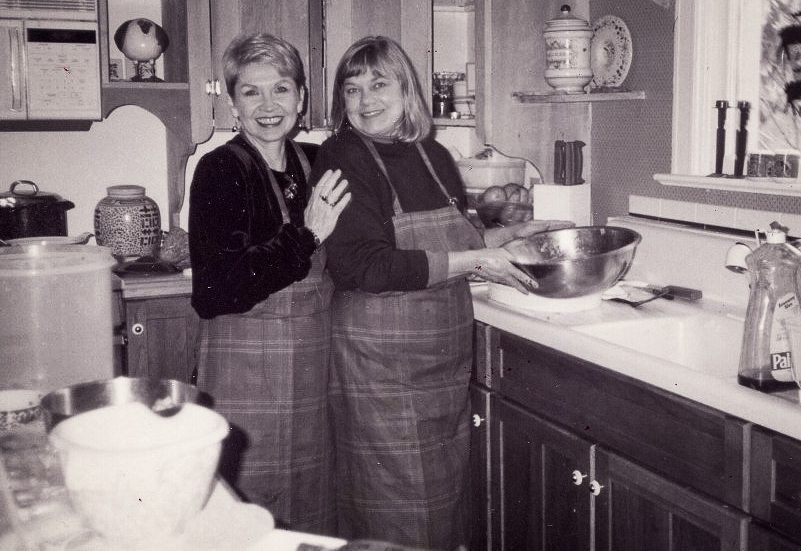
Karen and I in her kitchen
Another person I love cooking with is my son. He genuinely enjoys the whole process of preparing, cooking, and – of course – eating the food and he has a real talent for putting flavors together. We have cooked together many times and though we no longer reside in the same cites (he lives in Brooklyn with his family), we often discuss food over the phone. Sometimes he requests a recipe for an old family favorite or one of the dishes I created at Convito that he had while he was still living at home or that he ate while visiting. He is the editor and formatter of these blogs (in addition to his full-time job as a cinematographer), so he often comments on rough drafts and always gives great suggestions on the recipes I submit for each of my blog posts.

Rob & I cooking together in Umbria
In our family, his multi-tasking abilities in the kitchen are legendary – speedy and extremely organized. For the most part I am usually an incredibly organized person, but when I’m cooking I tend to leave that part of me behind. I have no idea why, but when I finish a task, rather than clean up the items I just used – knives, measuring cups, etc. I simply move on to the next task leaving behind a total mess. My kitchen always ends up a disaster, the complete opposite of Rob’s. Recently when we cooked together, he was surprised – maybe astounded is a better word – at the whirling dervish I become in the kitchen and trailed behind me putting pots and spatulas in the sink to soak, wiping down counters and putting ingredients back where they belong. He told me later how funny he found it that me of all people (a devoted maker-of-lists, keeper-of-tidy-houses and all-around organized lady) would leave her kitchen a total mess after making a meal. His strategy is to clean as he goes so that he doesn’t have a massive clean-up to face after the meal is eaten. I now try to be a little better and clean up before I begin another recipe – but if I don’t, I can count on Rob to finish the task. My kitchen is never cleaner or more organized at the end of a cooking session with him – a bonus to our having such a good time.
***************************************************************
Thanksgiving marks the end of the fall season for me, and the meal is one of my favorites. Classic dishes like roast turkey, gravy, stuffing, mashed potatoes, veggies, cranberry sauce and pumpkin pie are served all across the U.S. on that special day of celebration, however, according to culinary historians, those dishes were not among the ones served at the historic meal that brought the pilgrims and the Native Americans together – our very first Thanksgiving. Though turkey may have been on the menu, venison roasted over an open fire was a more likely choice. Turkey – if it was served at all – was wild turkey, probably roasted or boiled along with other game like duck and goose.
Culinary historians also believe that seafood was a big part of that first harvest feast. Because easily harvested mussels clung to the rocks up and down the New England coast and lobster and clams could be found in abundance, it was thought that all three were most likely served as a part of the meal. Corn – a native variety harvested by Native Americans and likely prepared in the form of cornbread – also seems a likely addition. Unfortunately, there was no original “Thanksgiving Menu” left behind so we can only surmise the contents of what we now like to romantically imagine as the first grand harvest banquet, but we can be sure that much of what we so fondly associate as standard Thanksgiving fare today did not appear until much later.
Sadly seafood did not continue as a part of our modern-day menu, but instead new and delicious dishes arrived over the years to the Thanksgiving table. Stuffing is perhaps the most famous of the non-originals, but now with-obligatory additions. Although it can be traced back to Roman times, the iconic Thanksgiving-stuffing (which at its most basic is made with dried bread, celery, onion, and sage) was not mentioned in American cookbooks until well into the 18thCentury and it was shortly after that when the real debate begins. Is the proper name “stuffing” or “dressing”? And is it cooked inside the turkey or baked separately? The answer to these questions are probably determined by which side of the Mason-Dixon line you grew up in, but however you define it, it is my favorite Thanksgiving side-dish, especially when smothered in turkey gravy.
In 1863 during the Civil war, President Abraham Lincoln made Thanksgiving a national holiday. But no matter what part of America you’re from or what’s on the menu (or whether you serve stuffing or dressing!), Thanksgiving has become a food-focused holiday where we all toast the blessings of the past year. The spirit is the same whether we celebrate a successful harvest with mussels and venison as our ancestors did, or a modern family reunion with roast turkey and mashed potatoes. We’re lucky to be here, and what better way to do that than over a table laid out with a huge spread of comfort food.

My Thanksgiving table
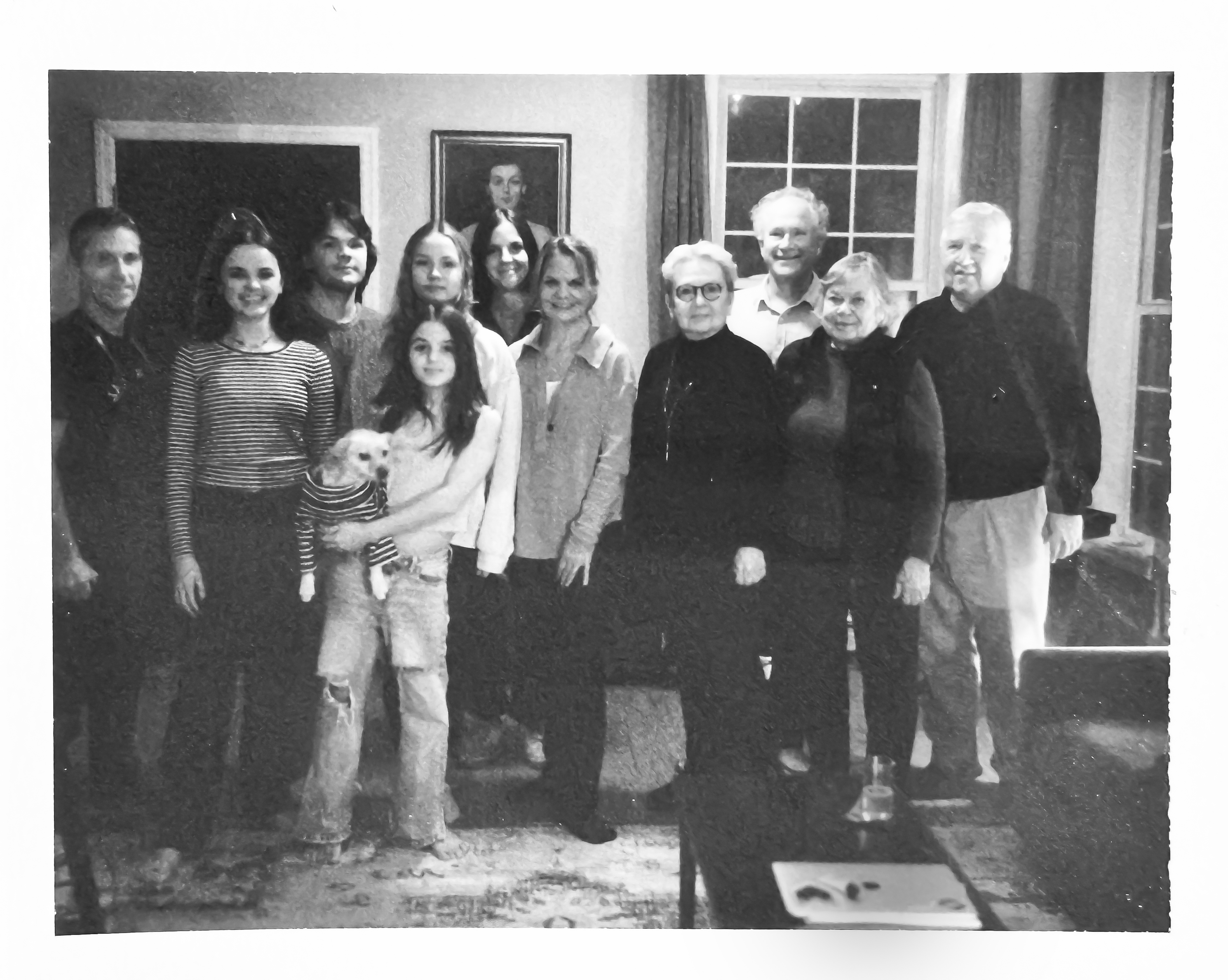
The family in Tivoli
Though I used to host this familial gathering, over the past decade or so I have relinquished those duties to the next generation. For many years I would join my son-in-law’s family – the Warners – at either his house or one of his brother’s homes in the Chicago area. But my past two Thanksgivings were spent at my son and daughter-in-law’s home in the Hudson Valley. Like me, my children cook a very traditional Thanksgiving meal but allow for creativity with unusual side dishes and desserts.
Before I arrived in Tivoli, NY for Thanksgiving Day, I spent a few days with my sister Karen and her husband Jeff at their home in Connecticut where we prepared a few things to bring with us. Always creating, Karen invented a deliciously spicy cranberry sauce made with jalapeño peppers and ginger, as well as her reliably amazing pumpkin pies. My contribution to the meal was my crowd-pleasing sausage and leek stuffing and a fantastic Brussels Sprouts slaw.
For years I used to make a Waldorf Salad to accompany our meal. This fresh, crunchy and sweet salad made with apples, grapes, celery, walnuts in a creamy lemon mayo was a staple for me growing up. It originated in the 19th century at the Waldorf Hotel and was ubiquitous for many years, but tastes have evolved away from this type of dish, so I had been on the lookout for something different for many years.
Then on one visit to Brooklyn to see Rob, his wife Angie and my granddaughters Neko & Isis, we ended up at the legendary Cobble Hill restaurant Frankie’s 457. Rob suggested we share a Brussels sprouts salad which he promised was more amazing that it sounded. After my first bite I f***ing loved it! At the time, I had never thought of serving raw, shaved Brussels sprouts, but I immediately adapted their concept and refined it to my taste. Frankie’s version includes a bit of shaved cheddar cheese and what I think was pancetta. I make mine with shaved Parmesan and crispy prosciutto. Because the idea of a salad made from Brussels sprouts sounded a little crazy, I really didn’t know how it would be received at Convito. It took a few months to catch on, but it eventually became wildly popular – so much so that customers even demand it in months where Brussels sprouts are far from their peak. Clearly Frankie’s was ahead of its time and – thanks to their inspiration – we were too!

© rob warner photography 2023
Bella Brussels
1 ½ # Brussels sprouts
2 cups julienned prosciutto sautéed
6 oz. shaved Parmesan
1 cup olive oil
½ cup white balsamic vinegar
2 tsp. sugar
¼ tsp. nutmeg
1 tsp. saltMix olive oil, vinegar, sugar, nutmeg and salt in a small bowl.
Thinly slice the Brussels sprouts using a mandoline.
Combine Brussels sprouts, prosciutto, and Parmesan, add vinaigrette and toss.
Another tradition that many assume was a part of that first Thanksgiving meal is serving pie for dessert. But the truth is that the pilgrims lacked both the butter and wheat flour necessary for making any pie crust. The creamy, custardy pumpkin pie we know so well today – spiked with cinnamon and nutmeg and topped with a dollop of whipped cream – did not appear in a cookbook until the late 18th Century and was inspired by the open-faced fruit pies popular in France and England.
Our Hudson Valley Thanksgiving meal ended with the two of the most popular and iconic Thanksgiving pies – pumpkin and apple – baked by two great family bakers of different generations.
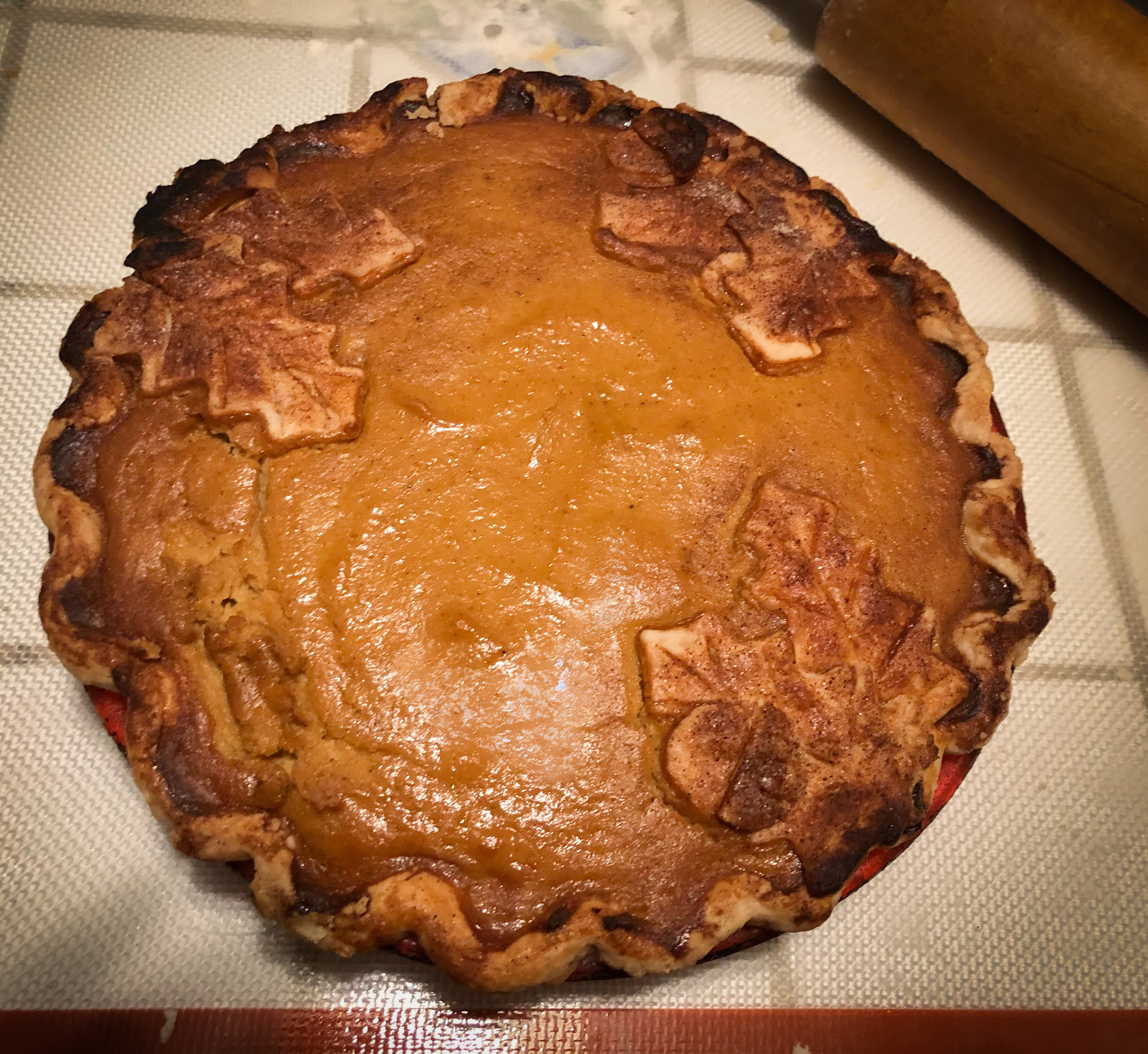
Sister Karen’s pumpkin pie
My sister Karen brought her legendary pumpkin pie which is not only delicious, but also features her artistically pinched crust with the embellishment of two pie-crust leaves. All of her pies look like they should appear on the cover of Bon Appetit magazine. The first Thanksgiving we spent at Tivoli she also baked a mincemeat pie, but her husband Jeff is really the only one to embrace this enthusiastically (though I do always like a sliver). Its sweet, spicy and savory taste is a nice balance to the pumpkin pie, but it suffers from a reputation as the fruitcake of pies. What I love the most about it though, is that it is such a loving gesture Karen makes for her husband of 58 years.
The other pie at out meal was a lovely and delicious apple pie my granddaughter Neko made. She loves baking – pies, cakes, cookies, scones, whatever – and has become very proficient at it. It is always a challenge eating dessert after such a huge meal, but unforgivable to miss such delicious pies, so our solution is to clean up the kitchen, relax (or nap in a chair) and return to the table an hour or so later for these finishing touches of our Thanksgiving.
I am always sad when autumn comes to an end. I will miss the colors, the food and the cooler – but not yet cold – temperatures (my kind of weather!). And though I lament saying goodbye to what it is probably my favorite season, the promise of Christmas always lessens my sadness. That’s what so great about seasonal change…there is always something new and exciting around the corner.
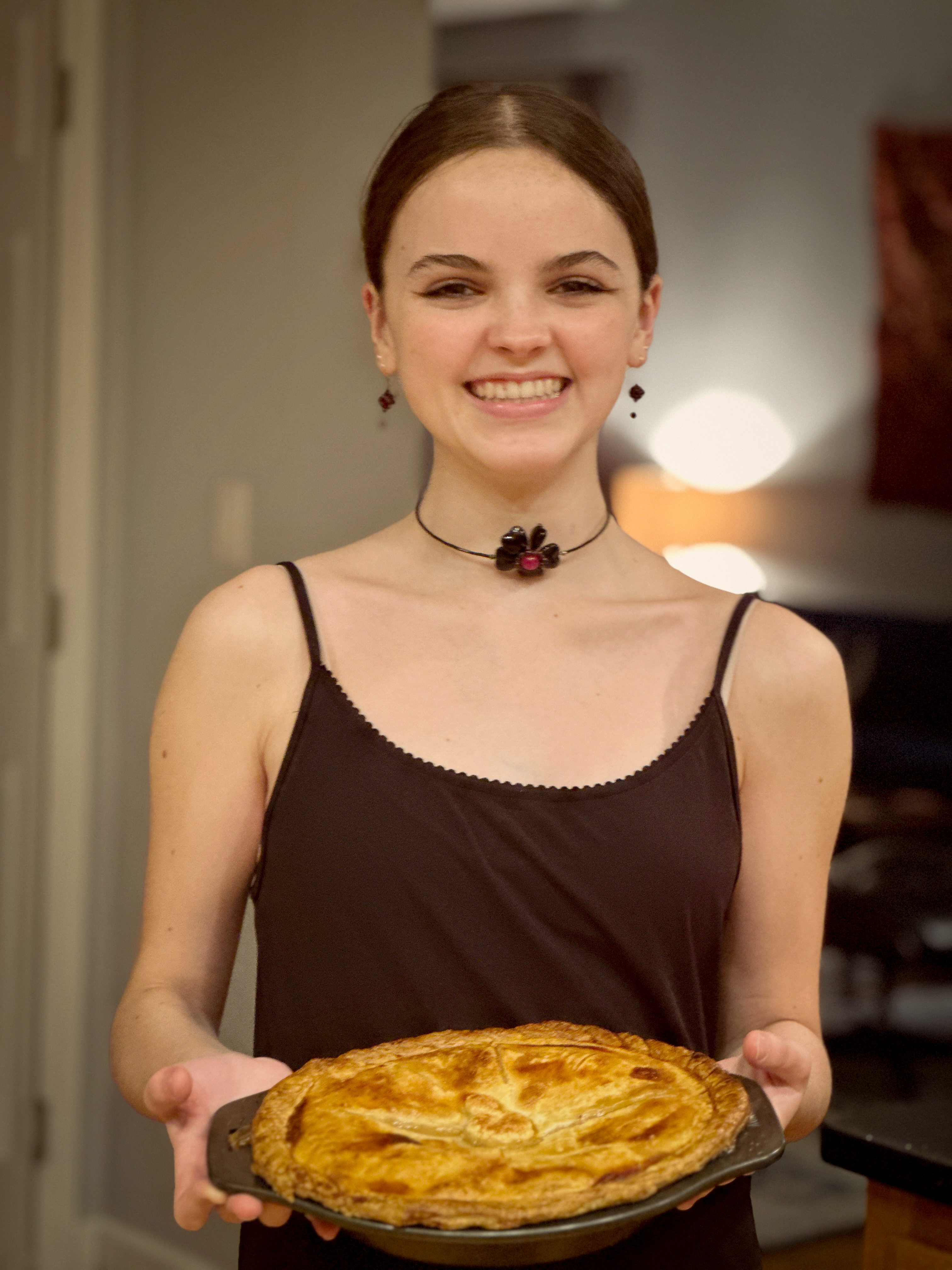
Neko with her Hudson Valley Apple Pie

Nancy,
My knees are weak with admiration and delight. What a journey. Reading this Celebration of Fall is really like a delicious dream walk through your world and experiences, family and friends, almost as good as a hug from you! It is a treasure… like you! ❤️❤️🙏 Charlie
Sent from my iPhone
I loved your recent BLOG !! I was starving when I finished it. So many yummy dishes !!
When I thought your blogs could not get be any better, you absolutely proved me wrong! Fantastic, even if I did assume the beautiful squash soup was cappuccino! Can’t wait to start making so many of these recipes! Thank you for sharing!