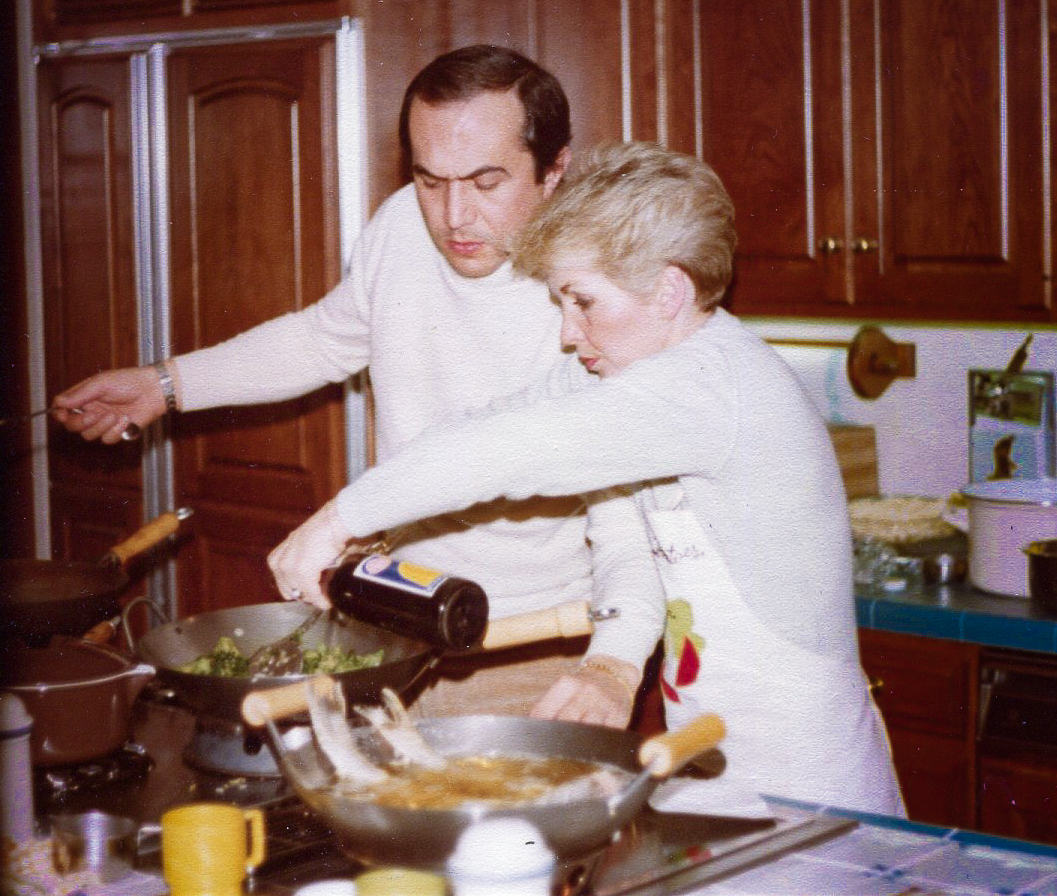
I watched Paolo peering into my open refrigerator, arm draped over the door, scanning its brightly lit contents determined to select ingredients for the “delicious sauce” he had promised to make for dinner that night. He had just arrived from Milan to help me get things organized for the opening of my new Italian market and wine shop that we had partnered to create. After a long day at Convito stacking, sorting, cleaning and making sure the shelves and deli cases were full and neatly arranged for our opening the next day, we decided it was time to go back to my home in Glencoe for a well-deserved recharge. I was clearly exhausted, so Paolo volunteered to make the family dinner that night and allow me to just relax. “All you need to do is watch and enjoy a glass of wine while I do the cooking”, he said.
When he first offered to make dinner, I warned him that I had no idea what ingredients I had at my house and suggested we stop at a grocery store on our way home. He declined and insisted that he would come up with something interesting to toss with the fresh pasta we had just made at Convito in our brand-new pasta extrusion machine.
After several minutes of pondering, Paolo chose a jar of green olives, a container of heavy cream, a package of chicken breasts, a slab of butter and a hunk of fontina cheese placing each item on the counter next to the can of tomatoes he had earlier pulled from my canned goods cupboard. I was happy to relax and enjoy someone else’s cooking for a change. I was also anxious to taste the fettuccine. For over a week I had been unsuccessfully experimenting with several different recipes for the “pasta fresca” we would be selling in our market. The one recommended by the company that sold us the extrusion machine was too dry. Our next test turned out to be too moist, producing green mold in the center of our carefully crafted little fettuccine nests. The recipe we were making the day Paolo arrived from Milan was from his mother Wanda, my other Convito partner. After learning of our problems finding the right recipe, Wanda had walked into a store in Milan that used the exact same pasta machine and in her usual bold manner, asked the owner if she could study and learn from them. Probably shocked that someone had the audacity to be so intrepid, the store owners allowed her to stay and observe their methods and even had her taste the pasta they made at the end of the day. Wanda was amazing!
***************************************************************
After months of planning and organizing, opening day was upon us and the question of whether our pasta would have the right texture and taste was overwhelmed by a bigger one – could this new venture be successful? That answer would come soon enough.
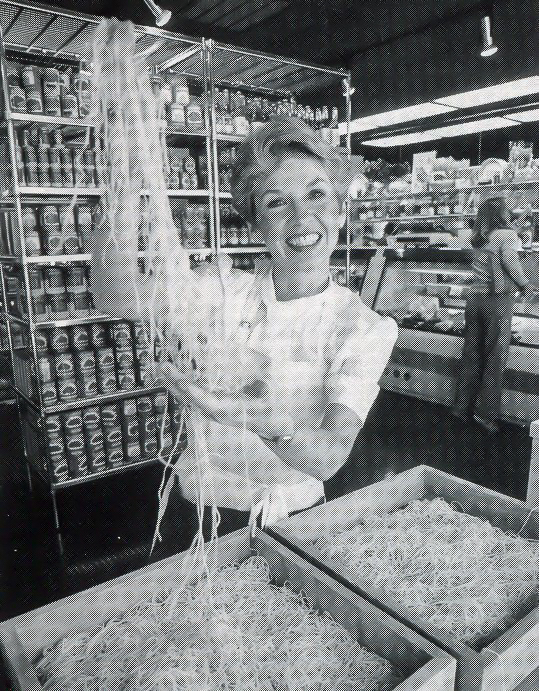
Nancy with fresh spaghetti
The sauce Paolo “threw together” that evening turned out to be absolutely delicious. Sometimes cleaning out the refrigerator can produce wonders. Home cooks have been doing just that for years, putting together unexpected ingredients for many a delicious meal. Paolo’s sauce was not only delicious, but unique and loved by my family so much that the next morning I insisted that we write down some sort of recipe. But recipe writing was not Paolo’s forte. He was a “spur-of-the-moment” kind of cook. Fortunately, I had watched him make the sauce the night before, and eventually came up with something that was very close to what we had eaten that night.
Up to this point, most of Convito’s sauces were versions of classics like Bolognese, Tomato Basil and White Clam; recipes I had developed and tested in Milan with Paolo’s mother, Wanda. But as time went on, we needed more variety and began inventing new sauces like Paolo’s to create more diversity in our offerings. Paolo’s concoction was eventually named Salsa la Paesana and to this day it is still available in our sauce freezer.
***************************************************************
The story behind how Pollo Paesana came to be is one I have always referred to as an accidental recipe, but I no longer think that description is quite accurate. Paolo didn’t accidentally make it – though it was certainly improvisational which might be why he has absolutely no memory of it – but he used his years of eating fine food and being in the presence of great cooks (his mother Wanda being the primary one) to influence his choice of ingredients and how he combined them. Recently, when I informed him via email (he lives in Turkey) about the popularity of his sauce and reminded him of the night he created it, he told me “I do not remember that episode at all and I have never tried a pollo of that kind in the last 20 years.” He all but denied responsibility for it, reminding me that his mother Wanda was a strong opponent of cream in any sauce because she believed a chef only adds cream to cover her mistakes.
Although Paolo doesn’t remember his creation at all (and I suspect thinks that maybe I made up the whole story), I know better because I was there! And Convito and its customers are thankful for the wonderful sauce he made from what happened to be in my cabinet and leftover in my refrigerator that night almost 41 years ago- whether he remembers it or not.
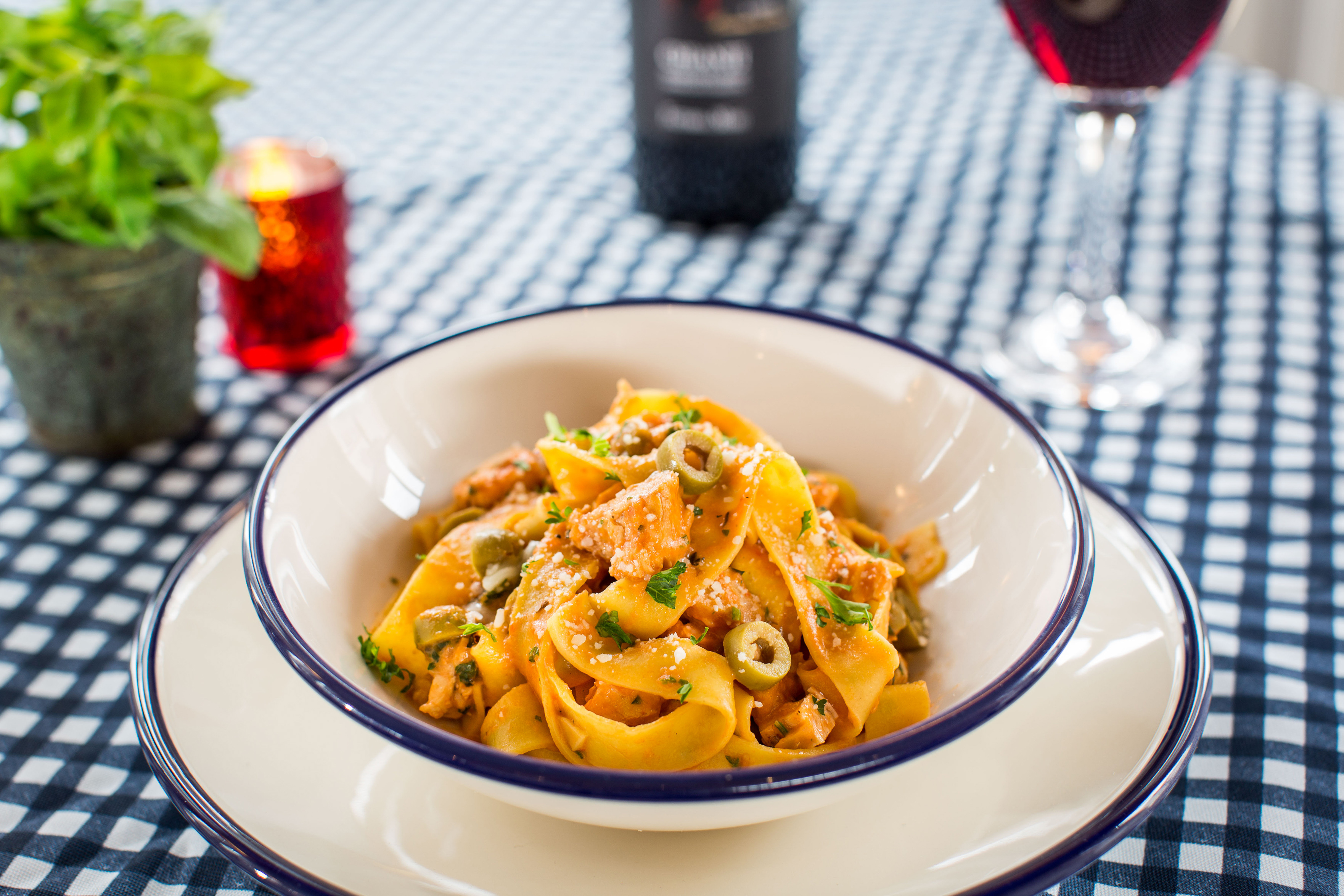
© rob warner photography 2022
Salsa la Paesana
Serves 4
1 pound fettuccine
4 ounces butter
½ cup onions, chopped fine
1 cup diced tomatoes
½ cup tomato puree
½ cup sliced green Manzanilla olives
2 teaspoons dried basil
2 teaspoons salt
½ teaspoon ground black pepper
1 cup heavy cream
½ cup fontina cheese, shredded
2 chicken breasts cooked al dente then diced into ½ inch cubes
Melt the butter in a saucepan over medium heat. Add onions. Sauté until soft.
Add diced tomatoes and tomato puree and sauté for 2 to 3 minutes. Add olives, basil, salt & pepper. Bring to a simmer. Simmer for 5 minutes.
Add cream and simmer for 10 minutes.
Add cheese, melt, stirring constantly.
Add cooked chicken. Stir well.
In the meantime, bring a large pot of salted water to a boil.
Add the pasta and cook until al dente. Drain well and mix with the sauce
***************************************************************
Since opening Convito Italiano in 1980, finding delicious and interesting new recipes for my market and restaurant has been a full-time job. At one time I owned three Convitos (one in Wilmette and two in downtown Chicago) as well as my French bistro Betise, and each restaurant had different menus which changed at least twice a year. The process of finding new recipes that fit certain requirements – salads that stayed fresh for the day for the market cold case, dishes that could be taken home and reheated successfully for the hot food case, dishes for the cafe that matched the focus of the restaurant – was all-consuming for many months of the year. New recipes are the lifeblood of a restaurant, so that task was an important and serious one for me.
My menu strategy when making changes was – and continues to be – that customer favorites and signature dishes should always remain available, but the rest of the menu will change in order to offer something new and exciting and to honor the differences in each restaurant’s location. Our customers know they can always find Rigatoni Noci or Vi’s Tuna in Convito’s salad case, but also be introduced to the latest quinoa or farro salad. Mama Mia Lasagna (with the classic ingredients of meat sauce, mozzarella and ricotta) was a mainstay in the hot food case, while more adventurous customers could select Mediterranean Lasagna with green olives and chicken or Rustic Lasagna with roasted red peppers, sausage and mushrooms.
The latest version of my original store and restaurant – Convito Cafe & Market – was opened in 2007 as a result of having to close our former location due to major structural problems in our rental building. At that time, I was down to two restaurants – Convito Italiano and Betise – and both were located in Wilmette’s Plaza del Lago. After exploring several new locations for Convito Italiano, we made the decision to combine Convito with Betise in an expanded location and rename it Convito Cafe & Market. It is currently an 80-seat restaurant (including an outside cafe with an additional 60 seats during the warmer months) featuring both bistro and Italian fare with a market featuring an array of prepared foods, groceries, cheeses, deli meats, bread and sweets. The market features mostly Italian dishes in the hot food case, while the salad case is more international. Soup recipes vary from American Chicken Noodle to Italian Minestrone alla Genovese. Sauces, however, keep their Italian focus.
The development of the recipes in our market have always been my responsibility and I can name the origins of almost every single one. The restaurant is a little different. When I open a new restaurant, I alone determine the focus and theme – casual Italian, regional, upscale Italian, French bistro – and then I will test dishes with the chef for what we plan to be our opening menu. Daily specials I always leave up to the chef of each restaurant, but continue to stress the importance that those specials fit with the overall theme of each restaurant

eating with Paolo in a Piemontese restaurant
In the beginning, recipes for Convito came mostly as a result of my travels with partner Paolo to Italy’s 20 regions where we sought out restaurants most representative of a particular region’s cuisine. Most of my early recipes were born of inspiration found in the various dishes I consumed in the hundreds of restaurants Paolo and I dined in all over Italy. My favorite ones were usually those in the countryside – out of the way, family run places that focused on the food of the region. Dining in rural Piemonte, in little establishments with limited menus that were tucked away in the shadow of the region’s storied vineyards was where many of my favorite food memories were made. Often, I would try to duplicate the dishes I especially liked with Wanda in her Milanese kitchen or when she came to visit me in Wilmette. And once I better understood regional Italian cuisine, I eventually felt confident testing recipes and creating new dishes all on my own (though it was always more fun with Wanda).

Wanda and I cooking at Convito
One dish I fell in love with was Pasta e Fagioli. I ordered it whenever I saw it on a menu. It seemed to have a million different interpretations in every different Italian region. My favorite versions were built around a rich broth with a few key ingredient(all of them contained pasta and beans – the meaning of pasta e fagioli) and often included pancetta and some ground beef. After days of testing in my own home (Convito’s original kitchen was too small), I came up with a recipe combining my favorites. My version is rich and hearty – similar to one I had in one of those small Piemonte countryside cafes. We now serve this version at Convito. (Lombardia I – Milano “Cooking with Wanda).
***************************************************************
Travel is inspirational, and especially exciting to me is the character revealed about any given country, region or city by the cuisine that represents it. It reveals so much about so many things – the culture, the traditions, and the history of an area. My thirty-seven posts on “My Italian Journeys” are an attempt to illuminate what I found special about all of Italy’s wide-ranging regional cuisine. Most places I visited with my business partner, Paolo Volpara, but many were experienced with other friends and family. My favorite traveling partners were those who had the same love of food that I have – those that understood that food can not only be delicious, but inventive and above all, inspiring.
Italy may have been where I began to understand the relationship between food and regional character, but those lessons served me in many other places as well. Expanding my horizons to France, revisiting England, and assessing what is unique to American cuisine was also inspirational. Learning about the food and culture of different countries has always been my best source for new recipes, whether it be attempting to recreate a dish or just being inspired by a new combination of ingredients or a novel presentation. This process of continual exploration is the way I have kept the creative side of myself engaged and I believe is tantamount to what has kept my business thriving over these forty-plus years
Though this travel-based inspiration has probably resulted in the greatest number of the recipes I created, I have also come up with many by simply paging through cookbooks and food magazines. A new recipe currently featured in our hot case (recipes meant to reheated in one’s own home) came to me from one of the Israeli-born, British chef, the talented Ottolenghi’s many cookbooks. Italian and the southern French cuisine (especially Provence) have much in common with Middle Eastern cooking and though both are distinct from one another, they share many flavors and ingredients that were born in that part of the world. Even though I don’t always use the exact same ingredients as a recipe I found in one of his books, my goal is to somehow catch that Mediterranean spirit he is so famous for and to make it my own.
The recipe below is a prime example. It is not only delicious, but beautiful to look at as are many of his dishes. We sell it in our market and featured it as a special in our cafe as a side dish served with Pesto-encrusted Rack of Lamb. This one I appropriately named Sunshine Potatoes.
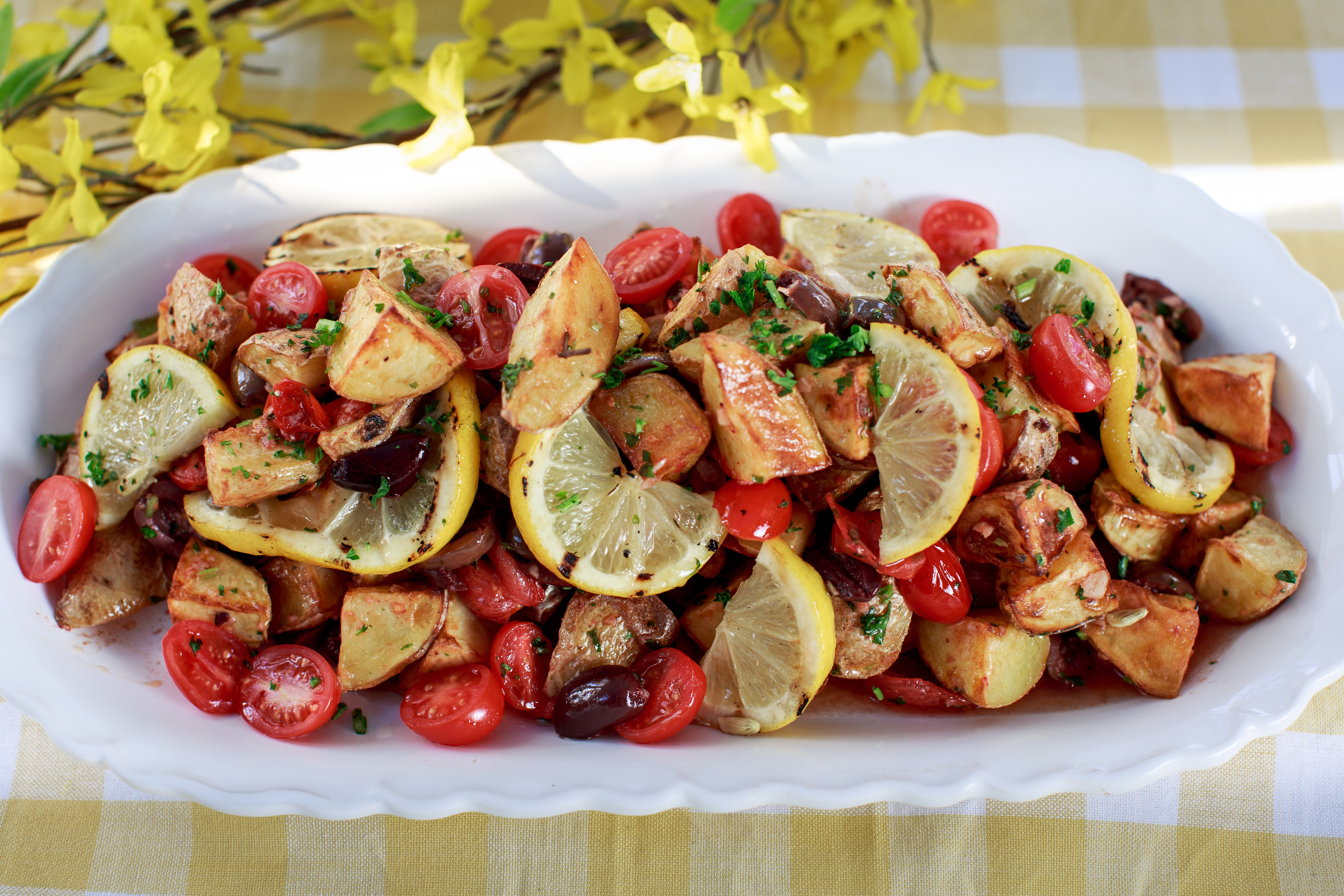
© rob warner photography 2022
Sunshine Potatoes
5# Yukon gold potatoes cooked al dente, put in fridge- sliced into wedges after chilled
2 tablespoons garlic, minced
½ cup olive oil
5 tablespoons chopped fresh sage
2 lemons, thinly sliced with seeds removed
salt & pepper combo
2 cups cherry tomatoes
2 cups kalamata olives
2 tablespoons lemon zestOn a roasting pan spread with the olive oil, place the potatoes, garlic, sage, lemons and salt and pepper. Roast for 10 minutes.
Add the tomatoes & olives and roast for another 10 minutes
Toss with the lemon zest.
Serve immediately or at room temperature. (This can be reheated)
***************************************************************
Another source of inspiration for me has been to roam the great food markets of Europe and Manhattan. The incredible Peck’s food emporium in Milan – a landmark shop featuring fine wines, cheeses, meats & produce – has provided me with countless ideas for displays and to-go recipes. Their layered cheese tortas especially caught my attention and in particular their Basil Torta consisting of thin layers of triple-cream mascarpone and semisoft robiola interspersed with basil and pine nuts. Those particular cheeses have a very short shelf life so they need to be sold within hours of creation. Peck is just steps from Milan’s famous Duomo right in the middle of the city, so the shop is always bustling with not only Milanese citizens, but visitors from all over the world and quick turnover is not a problem for them. Convito attempted to make several different tortas at our Chestnut Chicago store in the mid-eighties, but the cost and shelf-life of the cheeses, plus labor costs forced us to reconsider our efforts. We were not in the middle of the city with thousands of customers streaming through our store every hour, so consequently, we would end up having to discard a good portion of our tortas. Several of our faithful customers were sad to see them discontinued (as was I), but I still make them on occasion for catering orders or for my own personal entertaining. The torta recipe I used more than any was one I named Torta Armani (blog Lombardia II “Milano – Street Smarts”)and it remains my very favorite.
My favorite food shop in America was always Balducci, the iconic Greenwich Village gourmet food store. It provided me with a multitude of ideas especially for our market salad case. I could stand for hours in front of their cases, studying the dishes that most interested me and trying to remember what I thought were all the ingredients in those dishes. Everything looked delicious, but I didn’t dare take out a pencil and notebook. Too obvious! And since smart phones at that time were not around – memorizing was my only method. Many of Convito’s early market salads were inspired by dishes I saw at Balduccis and though it didn’t take me long to want to completely invent my own dishes, I have to admit there might have been a few Convito salads back in the 80s that were all but identical to the wonderful creations I saw in their cases back then.
One salad that has been available at Convito almost since the day I invented it is simply called Antipasto. One chilly fall afternoon in 1981 I remember seeing something very similar in their case and realizing it would be perfect at Convito. I rushed outside and pulled out my notebook to try to record everything I could remember: slices of salami, cheese, tomatoes, artichokes, celery and pasta mixed together in a vinaigrette. When I made my own version back at Convito, I substituted chickpeas for the pasta (we had enough pasta salads) and tossed it with our own vinaigrette, adding dried oregano to make it very Italian. It is different from the Balducci’s version, but most certainly owes a debt to their original one.

© rob warner photography 2022
Antipasto
2 # genoa salami cut into 1x¼ inch pieces
4 cups fontinella cheese cut in same size
4 cups chickpeas, drained well
2 pints grape tomatoes sliced in half
4 cups artichoke quarters in water, drained and sliced in similar pieces to cheese
2 cups celery cut in same size pieces, poachedToss all the above together
Mix with 1½ cups Italian vinaigrette
***************************************************************
Less frequent, but incredibly important, has been the contributions of some of my friends to Convito’s menu. Sometimes someone else’s dish is so perfect that I am compelled to ask for permission to use it in the store or restaurant. Some of my favorites are Nancy Harris’s Ribollita (Tuscany II “An Artist’s Palate”), Dorene Centioli-McTigue’s Pappa al Pomodoro and Linda Calafiore’s, Autumn Orecchiette (My Journey into the Kitchen “Les Dames d’Escoffier – My Culinary Village”). Linda’s orecchiette dish I tasted while visiting her in Carmel, California and Dorene’s Papa al Pomodoro at her Tuscan villa just outside of Cortona. I simply asked them for their recipes and they shared them without hesitation. I have been very lucky to have such creative and generous friends. I have also returned the favor over the years.
Other times, when I am trying to come up with new ideas for a particular category of recipe, I will remember something that I had eaten years earlier – often without knowing exactly when or where. When I was trying to come up with a new butternut squash dish for the market for instance, I recalled an especially delicious dish I had eaten somewhere, many years before. I wasn’t sure where or the exact ingredients, but I remembered it used butternut squash, tomatoes and gruyere in some sort of layered presentation. Several experiments later, I came up with now one of Convito’s favorite fall dishes – Butternut Squash Gratin (My Journey into the Kitchen – “Christmas Changes”).
But my favorite – my very – favorite way to come up with a new recipe is from what I call steeping. Steeping is the process by which I sit and think. It might be in front of a fireplace with a glass of wine in hand or perhaps lounging on a chaise basking in the sun, but it is always a quiet place where I can lose myself in uninterrupted thought and dream. My last “steeping” session was while I was having an MRI and I actually came up with ideas for five new dishes. Although I haven’t had that many MRIs, I do know that the big metal tube you enter for an extended period (that also makes scary thumping noises), can be very claustrophobic, so I always give myself a creative assignment to help me relocate myself to somewhere else. It wasn’t quiet, but it certainly felt secluded!
A recipe that came from my last MRI is a salad I call “Forever French.” After being told that customers were requesting more vegetable salads, I decided I would build something around haricots verts – a slender French variety of green beans, and an ingredient we hadn’t used for a while. My next step was to decide what else to mix with the haricots verts, as well as the kind of dressing that would tie everything together. After more “steeping” (with all the thumping noises going on in my “large tube”) I decided on paper-thin slices of red onion marinated in extra virgin olive oil (to soften both their texture and their “bite”) and diced dried figs, to add just a touch of sweetness. As for the dressing, I decided on a blue cheese vinaigrette. I have used dried figs and blue cheese in a spinach salad we make in the cafe and the sweetness of the figs goes very well with the salty piquant taste of the blue cheese. Voila – a new vegetable salad – invented in a tube!

Forever French
4 pounds haricot verts – cooked al dente, cut in half
2 ½ cups red onions, thinly sliced and marinated in olive oil until soft
2 cups dried figs thinly sliced
1 cup olive oil
¾ cup blue cheese
½ tablespoon salt & pepperWhisk the oil, cheese and salt and pepper together. Mix with the green beans, figs and onions
***************************************************************
Although I prefer my “steeping” process accompanied by a glass or two of wine rather than a medical procedure, the results can be just as successful. Not every dish, however, is a winner. Before the recipes find their way to one of our menus, they all need extensive testing. Sometimes I will just hand them off to the chef to build and refine, but other times I will collaborate with them directly. We start with a basic list of ingredients and as we mix them together and determine proportions of one to another, we might also add other ingredients and eliminate some as we go. Then we taste the final product with the kitchen and market staff and ask for their input. By this point we usually have made something that is met with staff approval to one degree or another, but the ultimate test is how the salad is received by the customers. If it sits in the case without much interest, we will rethink the recipe, change the presentation, or in some cases, move on to other ideas. Another critical metric is how it looks in the case after serval hours. Sad looking salads alas, do not get re-made and go to what I call “recipe heaven”. I have stacks and stacks in my files – some incredibly delicious but that didn’t meet the standards to be sold in a food shop which are very different standards from something to be eaten at home immediately.
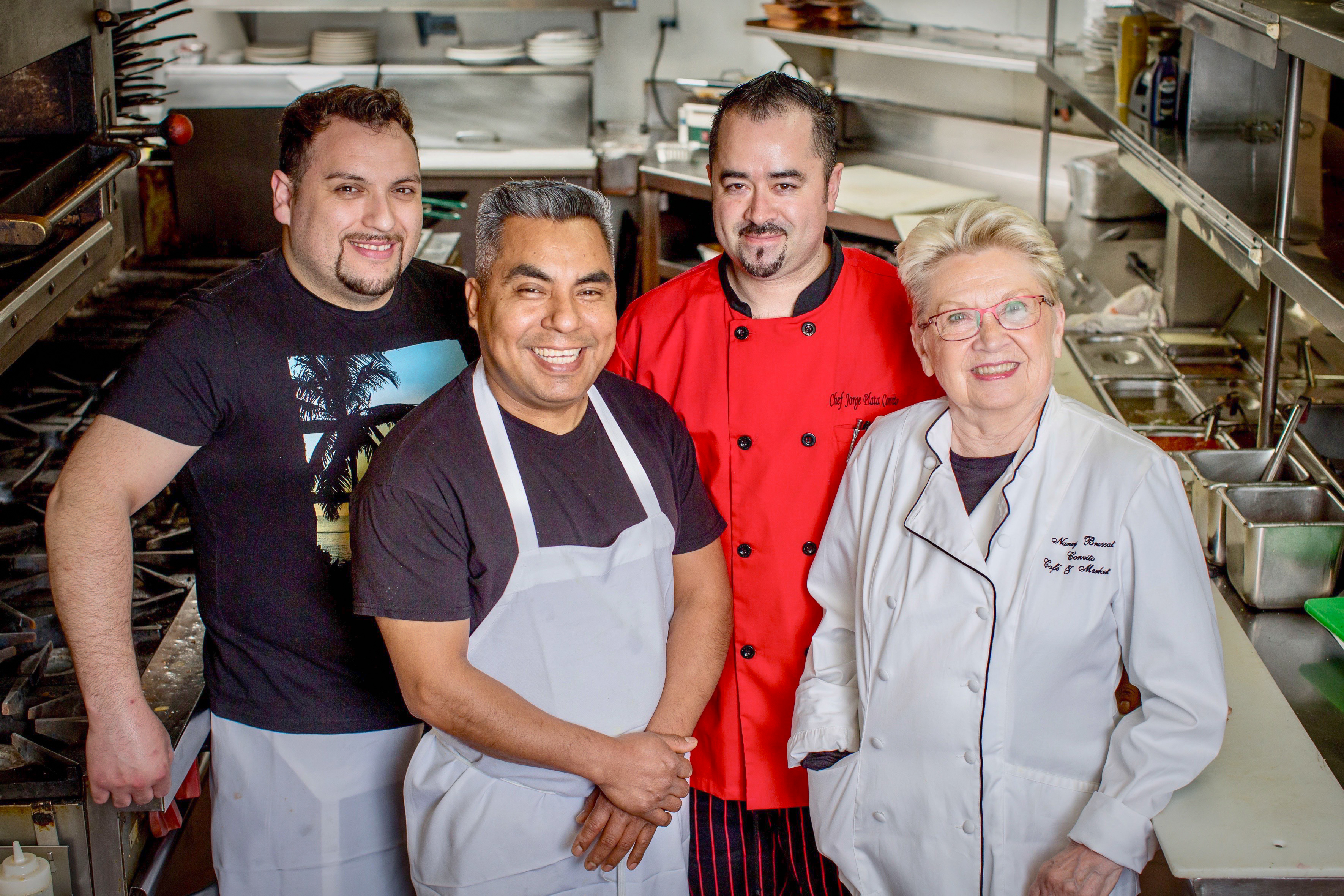
The whole process of invention though testing is without a doubt the most fun and rewarding part of my job. Food simply makes me happy. At its most base form, food provides us all with energy and the ability to maintain life, but to me it is also an adventure. I began my business with this adventurous spirit in mind and I am thankful to have found a way to sustain that energy four decades later. Food will always be something I can rely on to provide challenge and reward in my life, and I have been lucky to be able to share my creations with so many people over the years.
This blog focused on the many ways I search for and find the recipes I use in my restaurant and food market.
My next post will focus more specifically on collaborations with the many chefs I have worked with over the years. Their influence and input on both the menus of all my restaurants as well as my personal relationship with food is immense, and I look forward to sharing that journey.
Until then, Buon Appetito!

Nancy, That was an amazing blog ! I enjoyed everything about it ! I can hardly wait to try the different dishes!
Sending you love and good health!
Jean